Kenya's Wild
Northern Frontier
Cross the equator into Kenya's arid north and the familiar safari cast changes completely, reticulated giraffe, Grevy's zebra, and a permanent river that draws every creature in the region to its banks.
A Different Kenya North of the Equator
North of the equator the familiar southern safari cast disappears, replaced by a suite of species found nowhere else in Kenya, all drawn to one permanent river running through otherwise dry country.
The Samburu Special Five
Reticulated giraffe, Grevy's zebra, Beisa oryx, gerenuk, and Somali ostrich, five arid adapted species unique to Kenya's northern circuit and largely absent from the Mara or Amboseli.
The Ewaso Ngiro River
A permanent watercourse through semi arid country, concentrating elephant, lion, leopard, and crocodile along its banks throughout the year.
Exceptional Leopard Viewing
Several well known individuals rest habitually in the riverside trees, giving Samburu a reputation as one of Kenya's most consistent leopard destinations.
Three Landscapes Along One River
Established in 1985 on the south bank of the Ewaso Ngiro, Samburu forms one ecosystem with the neighbouring Buffalo Springs and Shaba reserves, wildlife moving freely between all three depending on season and water.
Where the Water Concentrates Everything
The doum palm lined banks of the Ewaso Ngiro hold the reserve's highest density of predators and elephant, the natural starting point for most morning drives.
Open Ground for the Northern Specials
Rocky, semi arid terrain away from the river where oryx, gerenuk, and Grevy's zebra range across drier, more open country.
Buffalo Springs and Shaba
Two neighbouring reserves across the river and to the east extend the same wildlife corridor, a change of scenery for guests staying four nights or more.
Moments Unique to the North
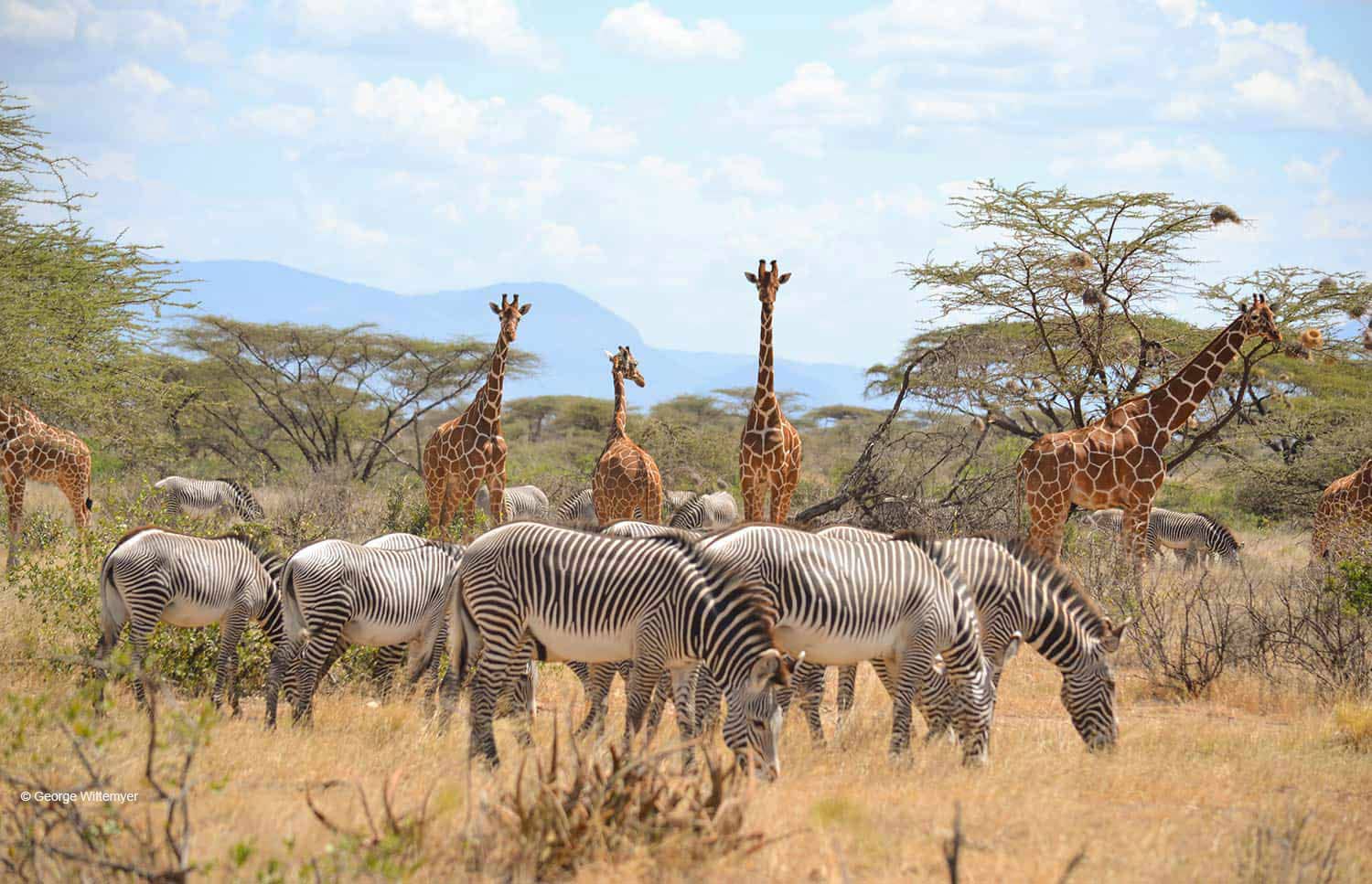 Samburu Special Five
The Samburu Special Five
Reticulated giraffe, Grevy's zebra, Beisa oryx, gerenuk, and Somali ostrich make up a suite of species restricted to Kenya's arid north, giving Samburu a wildlife list with almost no overlap with the southern circuit.

The Gerenuk's Feeding Stance
This long necked antelope rises onto its hind legs to browse from thorn branches other grazers cannot reach, a feeding posture found nowhere else in East Africa and one of the reserve's most photographed sights.

Leopard on the Ewaso Ngiro
Several individually recognised leopard rest with unusual regularity in the riverside trees, giving Samburu a reputation as one of the most reliable leopard destinations in Kenya.
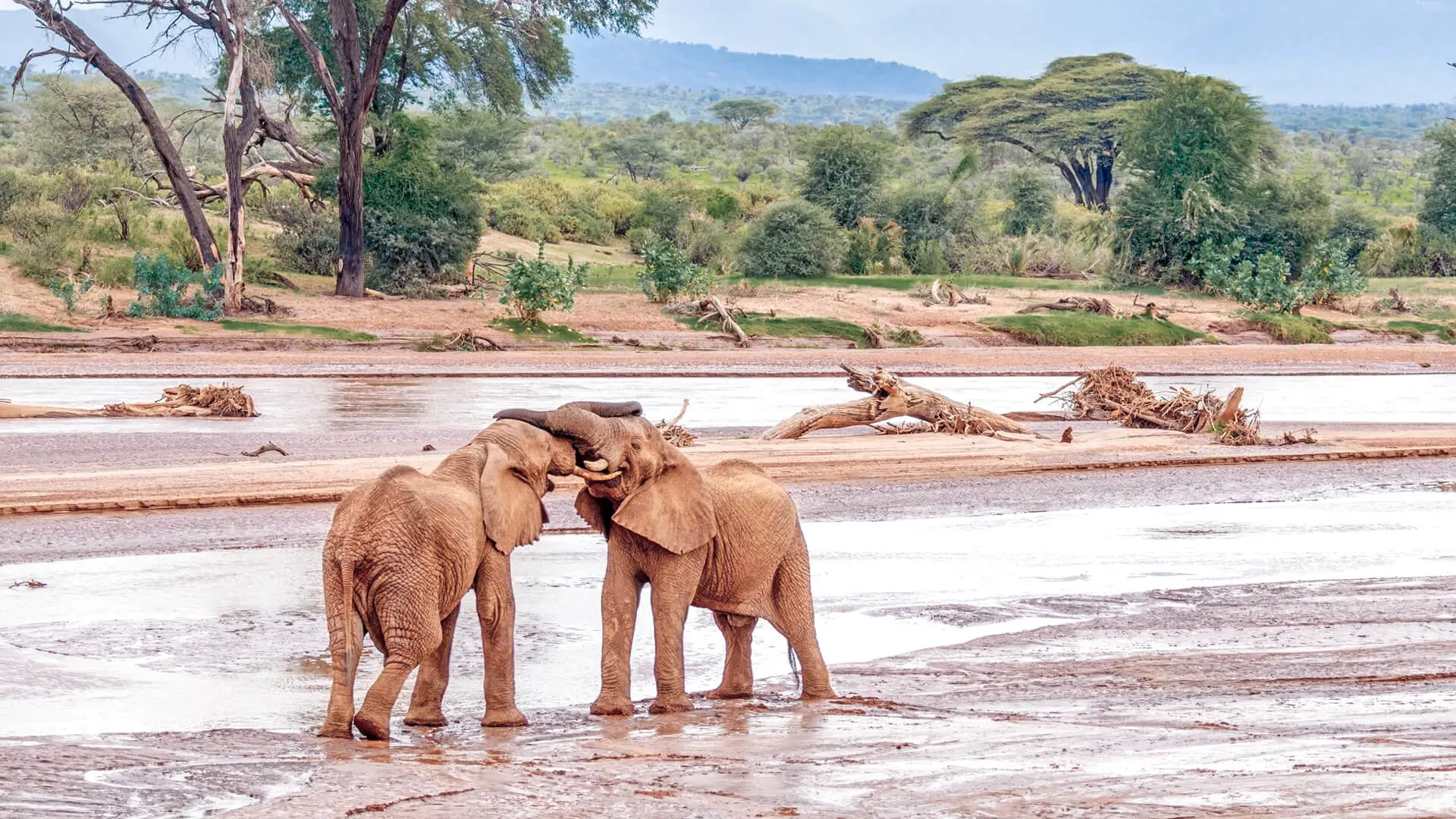 Elephant
 at the River's Edge
Herds cross, drink, and socialise along the Ewaso Ngiro throughout the day, producing close range encounters comparable to those for which Amboseli is famous.

Riverfront Camps
The reserve's finest properties sit directly on the Ewaso Ngiro, turning ordinary meals and quiet afternoons into an extension of the game viewing day.
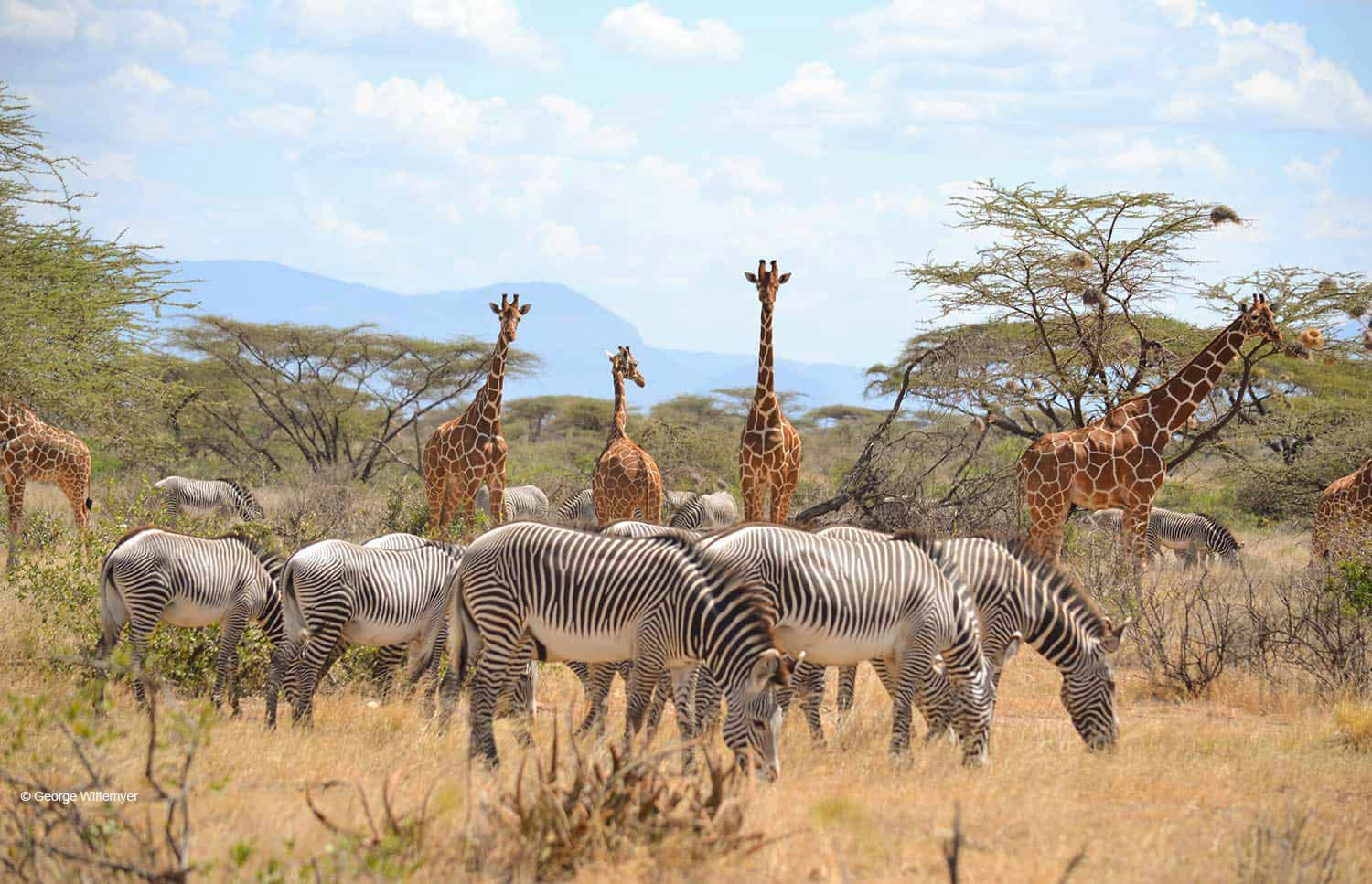 Grevy's Zebra
A Stronghold for the Grevy's Zebra
Kenya holds roughly ninety percent of the world's remaining Grevy's zebra, and Samburu is among the finest places to see this critically endangered, wide eared species up close.
How You'll Spend Your Days
Game Drives
Samburu’s drives divide between the Ewaso Ngiro river corridor, where lion, leopard, and elephant concentrate, and the open interior plains, where oryx, gerenuk, Grevy’s zebra, and Somali ostrich are most commonly found. Morning drives favour the river, where overnight predator activity is freshest and dawn light through the doum palms is exceptional for photography.
Walking Safaris
Guided walks in community areas adjacent to the reserve bring guests to ground level with the dryland ecosystem, tracking wildlife, examining geological features, and engaging with a plant community found nowhere in Kenya’s southern parks.
Samburu Community Visits
The Samburu people, a Maa speaking pastoral community related to the Maasai but adapted to a far harsher climate, welcome guests through community partnered visits arranged near the reserve boundaries, an honest look at traditional livestock keeping and beadwork alongside the ongoing conversation between community and conservation.
Night Drives
Available from camps licensed to operate after dark, night drives reveal Samburu’s nocturnal community, serval, African wildcat, genet, and spring hare, alongside predators whose daytime rest gives way to nighttime hunting.
Bird Watching
More than 450 recorded species make Samburu a strong birding destination, particularly for dry country raptors such as the martial eagle and pale chanting goshawk. The river corridor adds kingfisher, heron, and waterbird species, and a focused morning session can produce a list of eighty or more.
A Rewarding Destination Year Round
Samburu's semi arid climate is more stable than Kenya's southern highland parks, so the main variable across the year is water availability rather than temperature or rainfall.
Peak Season
Dry Season, Jan to Mar & Jul to Sep
Wildlife concentrates most tightly around the Ewaso Ngiro and the reserve’s permanent waterholes, giving predator sightings and northern special encounters their highest reliability. January and February bring clear skies and the quietest visitor numbers of the year.
Green Season
Apr to Jun & Oct to Nov
Rare but significant rainfall disperses wildlife more broadly across the interior plains, making specific sightings less predictable, while bird diversity peaks and the landscape turns from ochre dust to vivid green.
Getting to Samburu
Samburu Airstrip receives scheduled daily flights from Wilson Airport in Nairobi, approximately 45 to 60 minutes with Safarilink and other operators. Charter flights connect directly from the Maasai Mara and Amboseli, making cross reserve circuits straightforward.
- Samburu AirstripPrimary access point
By road from Nairobi, allow four to five hours via the A2 north through Nanyuki, turning east toward Archer’s Post. The route is good tarmac as far as Isiolo, with a final graded dirt stretch, practical for guests combining Samburu with a central Kenya circuit via Mount Kenya.
Sasaab Lodge –Kenya
Sasaab: 9 cliff-edge suites with private plunge pools and rooftop star beds above the Ewaso Nyiro River, with camel rides, helicopter safaris, and The Safari Collection’s acclaimed community ethos.
View Property →Saruni Samburu –Kenya
Saruni Samburu: 6 rock-carved villas perched above the Kalama Conservancy with 360-degree Mt Kenya views, 2 infinity pools, Italian cuisine, and ECO Gold certification since 2008.
View Property →Elephant Bedroom Camp – Kenya
Elephant Bedroom Camp: 14 riverside tented suites with private plunge pools in Samburu, where elephants literally pass through camp daily on the Ewaso Nyiro River with personal butler service.
View Property →“Long before any reserve boundary existed, the Samburu's rotational grazing kept this land from ever being fully used up.”On the Samburu People's Relationship With This Land
The Samburu, a semi nomadic Maa speaking people sharing linguistic and cultural roots with the Maasai, have herded livestock across this arid landscape for generations, developing a rotational grazing system that kept any single area from being permanently overgrazed, a form of ecological knowledge built up over a very long time.
Establishing the reserve meant moving Samburu pastoralists off traditional grazing ground, a history that still shapes the community’s relationship with formal conservation today. Community conservancies on Samburu land bordering the reserve, the Naibunga Conservancy among them, now offer a more direct economic partnership, extending wildlife habitat while returning tourism income to the people who have always lived alongside this ecosystem.
Protecting the Northern Specials
Samburu’s northern specials, Grevy’s zebra and gerenuk in particular, face real pressure from habitat loss and competition with livestock across Kenya’s semi arid north. The Grevy’s Zebra Trust runs the world’s most comprehensive monitoring program for the species from its base near the reserve, the primary line of defence for an animal found almost nowhere else on Earth.
RYDER Signature supports the Trust’s work through guest education and through our partnership with the community conservancies surrounding Samburu, which extend habitat for the northern specials well beyond the reserve’s formal boundary.
Duration and Combinations
Three to four nights is our recommended stay, enough time for the northern specials, evening leopard and lion sessions, a community visit, and river based game viewing across several drives.
Samburu + Maasai Mara
Kenya's defining north to south pairing, combining the arid north's specialist species with the Mara's predator and migration experience. Eight to ten nights.
Samburu + Ol Pejeta + Mount Kenya
A central and northern Kenya circuit combining rhino conservation, mountain scenery, and northern specials, accessible by road via Nanyuki.
Samburu + Amboseli + Maasai Mara
Kenya's fullest circuit, covering the arid north, the southern parks, and the Mara ecosystem in one itinerary. Twelve to fourteen days.
Travellers Samburu Rewards
Species Diversity Seekers
The Samburu Special Five exist nowhere south of the equator, essential for guests who want the widest possible range of East African wildlife.
Experienced Safari Travellers
Guests who have already covered Kenya's southern parks consistently describe Samburu as something genuinely new.
Photographers
Doum palm river light at dawn, the reticulated giraffe against a rocky escarpment, and the gerenuk's extraordinary feeding posture offer subjects found nowhere else.
Wildlife Enthusiasts
The reserve's role as a primary study site for the northern specials gives visiting biologists and serious wildlife enthusiasts real scientific depth.
Samburu Safari FAQ
The reticulated giraffe, Grevy’s zebra, Beisa oryx, gerenuk, and Somali ostrich, five species found in Kenya’s semi arid north and absent from the southern parks.
Samburu and the Mara share very little in common wildlife. Samburu’s arid northern landscape supports the Special Five and its own distinct predator community, while the Mara’s grassland supports the wildebeest migration and one of Africa’s densest lion populations. The two make natural complements rather than substitutes for each other.
Reticulated giraffe, Grevy’s zebra, Beisa oryx, gerenuk, Somali ostrich, lion, leopard, cheetah, elephant, buffalo, Nile crocodile, hippo, and more than 450 recorded bird species, many of them arid zone specialists.
Yes, Samburu is one of Kenya’s finest leopard destinations. Several well habituated individuals rest regularly in the reserve’s riverside trees and are reliably located by our guides.
By scheduled or charter flight from Wilson Airport in Nairobi, roughly 45 to 60 minutes, or by road, about four to five hours via Nanyuki and Isiolo.
Begin Planning Your Samburu Safari
Every Samburu itinerary we design puts you on the Ewaso Ngiro at the right hours, among species you won't find anywhere else in Kenya.