The safari packing list is one of the most asked-about topics in pre-departure planning and one of the most variably answered. Generic lists “bring comfortable clothes, sunscreen and binoculars” are unhelpful for the specific conditions of a week in East Africa’s bush. Overly detailed lists that include every possible item produce anxiety and overpacking. This guide takes the middle course: specific about the items that genuinely matter, honest about what can be left behind, and honest about what most people forget and shouldn’t.
The Fundamental Constraint: Luggage Limits
Safari charter flights in East Africa allow between fifteen and twenty five kilograms per person, split between checked and hand luggage, depending on the specific aircraft and route you fly. All of it must travel in a soft sided duffel or holdall of appropriate size, forty to sixty litres is the practical range. Hard shell suitcases are not accepted on any of these routes, since they cannot go into the hold of a Cessna Caravan or a Pilatus Porter; they must be left at the base hotel or stored in the operator’s office. Within this constraint, every item must justify its weight and volume.
Pack toward fifteen kilograms and you will be within the limit on every carrier we use, whichever aircraft your itinerary ends up on. The camps provide laundry service (typically a twenty four hour turnaround), so multiple days’ worth of every clothing item is unnecessary. Your safari consultant will confirm the exact allowance for your booked flights once your itinerary is set, so you can pack toward the higher end of the range where your route allows it. The constraint is liberating once accepted: it produces a packing clarity that removes the agonising over marginal items and forces the selection of what genuinely matters.

Clothing: What to Bring and Why
Colours: Neutral tones khaki, olive, grey, tan are the functional requirement. Bright colours, including white and red, attract insects and disturb wildlife. Dark blue and black attract tsetse flies specifically. The neutral colour rule is not a fashion suggestion; it is functional guidance grounded in genuine field experience.
Layers: East Africa’s safari destinations are temperate at altitude — the Mara sits at 1,500 metres, the Serengeti’s highlands at 1,500-2,000 metres, Ngorongoro at 2,200 metres. Pre-dawn departures in the cold season (June-August) require a fleece mid-layer and a windproof outer. Midday temperatures in the same season can reach twenty-five degrees. Packing for both ends of this range is the specific challenge. The solution: a base layer, a 200-weight fleece, a light windproof jacket, and lightweight hiking trousers that can be layered over thermals in the morning.
Specific quantities: Two long-sleeved shirts, two short-sleeved shirts, one fleece, one windproof jacket, two pairs hiking trousers, one pair lightweight camp trousers or leggings, three pairs merino wool hiking socks, four changes of base layer underwear. This covers a seven-night stay with laundry.
What to leave behind: Shorts are not recommended in bush environments — thorn protection and tick avoidance are the relevant concerns on any walk. Jeans are too heavy and too slow to dry. Smart casual clothing beyond one presentable dinner outfit is unnecessary; safari camps are reliably informal

Footwear: Match It to Your Safari
Footwear needs depend heavily on the kind of safari you are taking, and treating one type of boot as universal is where most packing lists go wrong.
For a standard vehicle based safari: most time on the ground happens at picnic spots, lodge grounds, and short, flat viewpoints beside the jeep. A comfortable, closed toe pair of trainers or a lightweight walking shoe with good grip is all that is needed. There is no requirement for ankle support or a lengthy break in period.
For a walking safari, fly camping, or a Kilimanjaro or Mount Kenya trek: here, good quality, ankle supporting, waterproof hiking boots that have been worn for at least fifty hours before the trip become genuinely essential. Blisters from unbroken boots, discovered on day three of a seven day trek, are one of the most common and most preventable problems in safari travel. Buy the boots four months before departure, wear them on long walks, and test them with the same socks you will use in the field.
Camp footwear: lightweight sandals or slip on shoes for evenings at camp, for either style of trip. Safari lodges are casual environments, and the transition from daytime footwear at the vehicle to sandals at dinner is both comfortable and appropriate.
Medical and Health Essentials
Malaria prophylaxis as prescribed by a travel medicine specialist — this is a non-optional item for any East Africa safari destination. The specific medication depends on the destination, the traveller’s health profile and the duration of travel; discuss with a specialist at least six weeks before departure. Common prescriptions are Malarone (atovaquone/proguanil), doxycycline or Lariam (mefloquine), each with specific timing requirements and specific contraindications.
A personal first aid kit: standard analgesics (paracetamol and ibuprofen), blister management supplies (moleskin, zinc oxide tape), oral rehydration sachets (essential for managing heat and physical exertion), antihistamine for insect reactions, antiseptic cream, a small supply of any prescription medications with a copy of the prescription.
DEET-based insect repellent of at least fifty per cent concentration for evenings. Spray-on formula is more practical in the field than roll-on for covering arms and neck quickly before the evening activity. Sun protection of SPF 50 or above for daytime use; the equatorial African sun at altitude is more intense than most temperate-climate travellers have experienced.
Safari Essentials: The Items That Change the Experience
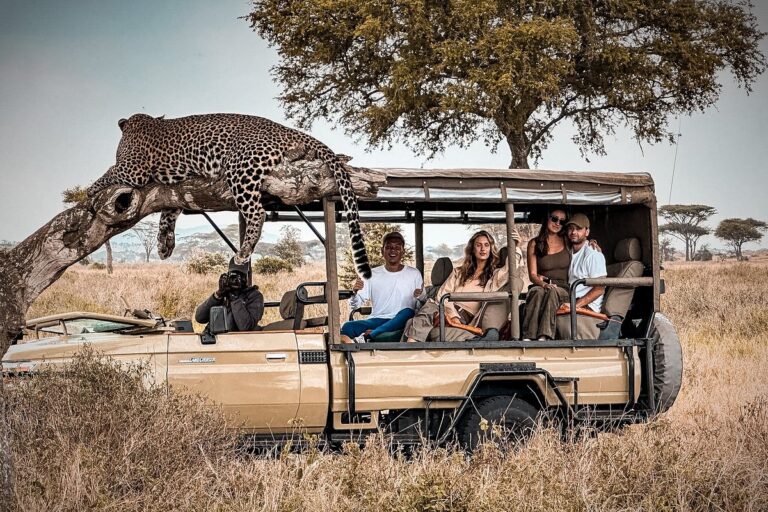
Quality binoculars are the most impactful non-clothing item a safari traveller can bring. The difference between watching a distant pride through adequate binoculars and through a quality eight-by-forty-two pair is the difference between seeing lions and understanding what they are doing. Roof-prism binoculars from Nikon, Vortex or Celestron’s upper range provide appropriate optical quality at sensible prices. Test and wear-in the binoculars before the trip — adjusting the interpupillary distance and dioptre in the field, for the first time, while a leopard is in a tree thirty seconds away, is not the ideal learning moment.
A headtorch with good beam quality and fresh batteries. Essential for pre-dawn departures, for navigating the camp after dark, and for night drives where personal torch use is required. A red-light mode that preserves night vision is a useful feature if available.
A camera and appropriate lens — discussed in Topic 80 for those with photographic ambitions. For travellers without specific photography objectives, a current smartphone on a beanbag (provided at most camps or improvised from a camp-kitchen-filled bag) produces thoroughly adequate safari imagery.
Documents and Finance
Yellow fever vaccination certificate — required for entry to Kenya and Tanzania from some countries; confirm requirements for your specific nationality and routing at least three months before travel, as the certificate must be issued at an approved vaccination centre. Passport with at least six months validity beyond the return date. Visa documentation — both Kenya and Tanzania offer e-visas online before travel; the East Africa Tourist Visa covers all three EAC countries (Kenya, Uganda, Rwanda) and is worth considering for multi-country itineraries.
Cash in small denominations — US dollars are widely accepted at safari camps and airports, and tips for guides and camp staff (which are both expected and important; see tipping guidance in the guide’s relevant section) are typically paid in cash. Most camps have basic card facilities for extras, but cash remains the most reliable currency for the specific cash transactions that arise on any safari.
What to Leave Behind
The items that first-time safari travellers consistently bring and never use: hair straighteners or elaborate beauty equipment (the camp has a mirror; the bush does not require a grooming standard beyond clean and functional); multiple pairs of shoes beyond the footwear covered above; books beyond what can be read in transit (the camp’s library or a single downloaded e-reader library is more practical); and “just in case” clothing beyond one complete spare set of the basics. The luggage limit enforces this discipline helpfully; packing to it rather than to abundance produces better outcomes.
Should I bring my own sleeping bag?
For a standard lodge or tented camp safari, no — camps provide bedding. For a walking safari or fly-camping expedition, confirm with your operator whether sleeping bags are provided or required. For a Kilimanjaro climb or Mount Kenya trek, a sleeping bag of appropriate temperature rating is either required (if not provided by the operator) or strongly recommended even when provided (personal bags are more reliably comfortable than shared operator kit).
Is laundry available at all safari camps?
Quality safari camps universally offer laundry service — typically hand-washed by the camp team with a twenty-four to forty-eight-hour turnaround, sometimes less. On a seven-night safari with laundry available from day two, three changes of most items is adequate. Budget for laundry in your camp cost expectations — it is usually included in the camp rate at quality properties and charged separately at some mid-range ones.
Can I charge electronic devices at camp?
Yes, at virtually all quality safari camps. Solar panels power most camps in remote areas; generator charging is available at others. USB charging ports are standard in tent/room spaces. Confirm battery pack capacity with your camera system before the trip — a full-day game drive requires multiple battery charges for active photographers, and camp charging times may not align with game drive schedules. A quality portable battery pack (10,000mAh minimum) provides charging independence from the camp’s electrical schedule.
Zanzibar Beach Packing
A Zanzibar beach extension adds different requirements to the safari kit: lightweight swimwear, beach cover-ups, quality reef-safe sunscreen (biodegradable products are appropriate in a marine conservation area), a lightweight dry bag for beach excursions, and sandals for the beach and Stone Town walking. The overlap between safari and beach kit is partial: the neutral-coloured outdoor clothing works on both; the specialised bush footwear does not substitute for beach sandals. A second small bag — a fifteen-litre daypack for the beach — stored at the Kilimanjaro or Arusha hotel during the safari and collected for the Zanzibar connection, allows separate optimisation of each kit without exceeding the total luggage limit.

The most experienced East Africa travellers carry a capsule wardrobe that works across all three environments of the full journey — safari bush, mountain approach, beach — rather than three separate wardrobes. The merino wool base layer works in the cold of the Kilimanjaro crater and the coolness of a Zanzibar evening. The lightweight windproof jacket serves on the mountain, on the cold early-morning game drive and on a dhow sunset cruise. The merino t-shirt works in all three environments. Packing with this multi-environment functionality reduces total kit weight without sacrificing coverage.
Technology and Power Management
The East Africa safari environment is hard on electronics in ways that most urban travellers do not anticipate. Dust infiltrates camera bodies and tablets through gaps that home use never stresses. Temperature swings between cold dawn and hot midday create condensation on cold optics. Vibration from driving on corrugated roads damages internal components over repeated exposure. The practical responses: sealed dry bags for electronics in vehicles, lens cloths for managing dust and condensation, and a camera battery management strategy that accounts for cold-weather performance reduction (lithium batteries lose twenty to thirty per cent of their rated capacity at the temperatures encountered on a seven-day Kilimanjaro climb).
Power banks of 10,000 mAh or more provide two to three full smartphone charges and supplement the camp’s solar charging availability for photographers who need consistent access between camp electrical sessions. International travel adapters for the specific plug types of Kenya and Tanzania (UK three-pin is standard, though some camps have USB charging only). A waterproof phone case for the boat excursions and any water-adjacent activities that the beach or river-based game viewing involves.
What First-Timers Always Forget
The items that experienced East Africa travellers consistently cite as the most common packing omissions: a small personal first aid kit with blister management supplies for hiking boots that prove less broken-in than expected; a packable down jacket for the cold that is underestimated until the first pre-dawn game drive; quality sunglasses with UV400 protection for the intense equatorial light that is harder on eyes than any temperate climate sun; a lightweight camp towel that dries quickly for the bush shower sessions that many camps provide rather than full bathrooms; and a personal water bottle of at least one litre, since the camp’s water provision may not be immediately available on early morning departures.