A Maasai village visit near Ngorongoro is one of the few cultural additions to a Tanzania safari that genuinely earns its place on an itinerary, provided it is arranged with the right expectations. Most visits are organised through a lodge or guide rather than approached independently, last between one and two hours, and take place at a boma, a homestead enclosure of low mud and dung huts arranged around a central livestock pen, rather than at a purpose built tourist site. Understanding what actually happens during that hour, what it costs, and what the visit does and does not represent, matters more than the visit itself for anyone deciding whether to include it.
Where these visits happen around Ngorongoro
The Ngorongoro Conservation Area differs from a standard national park in that it permits human settlement alongside wildlife, and Maasai communities have grazed cattle across these highlands for generations. Villages commonly visited sit along the road corridors between Karatu, the crater rim, and Nainokanoka, meaning a visit typically fits either on the drive up to the crater rim before an early game drive, or on the way back down towards Karatu at the end of a day. Camps and lodges on the crater rim, including those clustered around Lemala, Sopa and the Serena and Sopa access roads, tend to have working relationships with one or two specific villages nearby, and a guide arranging the visit through an established relationship generally produces a steadier, less transactional experience than one booked ad hoc through a roadside tout.
What actually happens during the visit
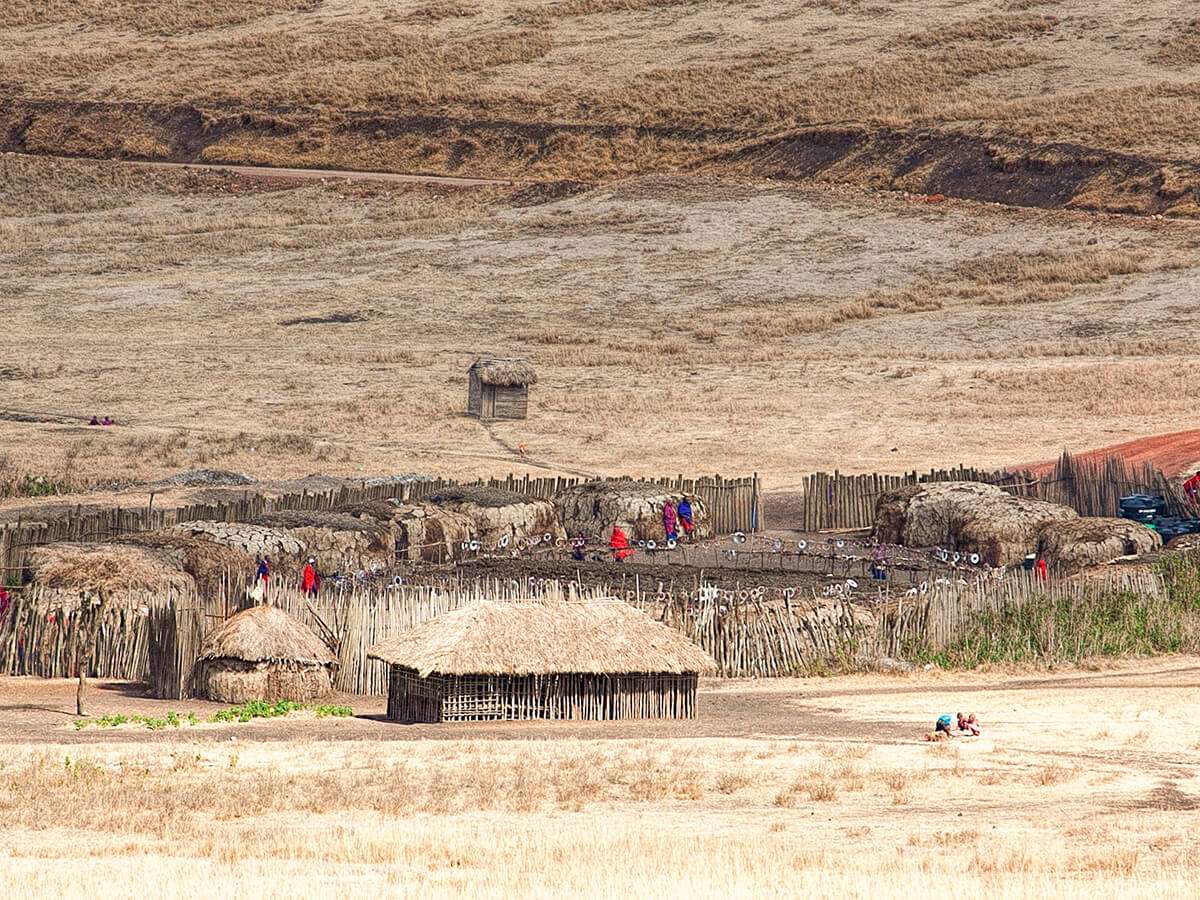
A typical visit begins with a welcome from the village elder or a senior warrior, followed by a demonstration of the adumu, the vertical jumping dance most associated with Maasai warriors, performed in a semicircle with rhythmic chanting rather than instruments. Visitors are usually invited to enter one of the huts, low, dark, and built from a timber frame packed with a mixture of mud, grass, and cattle dung, to see how a family actually lives day to day, including the small fire pit used for cooking and the raised sleeping platforms. Guides often explain the layout of the boma itself, with the thorn bush perimeter (the enkang) built specifically to keep predators away from livestock overnight, and the central cattle enclosure reflecting how central cattle wealth remains to Maasai identity and status. Many visits end with an opportunity to view or buy beaded jewellery, carved items, or fabric made by women in the village, laid out on cloths or small tables at the end of the walk.
What it costs
Entry fees for a standard village visit near Ngorongoro typically run from 20 to 50 US dollars per person, sometimes rising towards 75 dollars depending on the specific village and whether the visit is arranged through the camp or negotiated independently at the gate. This fee is separate from, and in addition to, the Ngorongoro Conservation Area’s own entry and transit fees, and is paid directly to the village rather than to the conservation authority. Some lodges fold the cost into a package rate; most do not, so it is worth asking in advance rather than being surprised by a request for cash, since village visits are typically cash only and rarely accept card payment. Beyond the entry fee, there is usually a soft expectation of purchasing at least a small item of beadwork on the way out, and a reasonable budget for this is a further 20 to 50 dollars, though nothing is compulsory and no legitimate village will refuse entry to someone who declines to buy.
Why prices can feel inconsistent
Visitors sometimes report being quoted a fixed fee in advance and then facing additional requests once inside the village, whether for photographs, for entering a particular hut, or for a longer dance performance. This is a real and fairly common friction point, and the practical way to reduce it is to agree the full scope of the visit, including what is and is not covered by the entry fee, with the guide before arriving rather than negotiating once inside. A guide who has visited the same village repeatedly, and who has a working relationship with its leadership, is generally in a better position to hold a fee to what was agreed than one arranging a visit at a village they do not know well.
What the visit represents, and what it does not
It is worth being honest about what a one hour scheduled visit can and cannot show. This is a curated, paid encounter built around a specific set of activities that repeat for each group that comes through, not an unfiltered window into daily Maasai life, and treating it as full ethnographic insight rather than a structured introduction sets up an unrealistic expectation. At the same time, dismissing these visits entirely as staged and therefore worthless overstates the case in the other direction. The people performing the dance and living in the boma are genuinely Maasai, the homes are real homes rather than film sets built for tourism, and the income from these visits is a meaningful and, for many households in the conservation area, an increasingly important supplement to a pastoralist livelihood that has come under real pressure in recent years.
The wider context around Ngorongoro’s Maasai communities
Visitors researching this topic will likely encounter reporting on the Tanzanian government’s ongoing relocation programme, under which Maasai families have been moved out of parts of the Ngorongoro Conservation Area on conservation grounds since 2022, a process that has drawn criticism from human rights organisations over reduced access to schools and health services within the conservation area, and led to large scale protests along the Ngorongoro to Serengeti road in 2024. As of early 2026, government commissions have recommended that the relocation process continue, despite an earlier pause ordered in December 2024. This is a live and contested policy question rather than a settled one, and it forms an unavoidable backdrop to any cultural visit in the area. A guide with a genuine, longstanding relationship with a specific village is generally better placed to speak to how a particular community has been affected than a generic overview can be, and visitors with a serious interest in the subject are better served asking their guide directly than assuming any single narrative applies uniformly across the whole conservation area.

A note on language and spelling
The correct spelling is Maasai, reflecting the pronunciation of the word in the Maa language, rather than the older colonial era spelling “Masai” that still appears on some maps, lodge names, and older guidebooks. Using the correct spelling is a small but genuine sign of respect, and most modern operators and conservation authorities in the region have shifted to it accordingly.
Practical tips for visitors
A few points make the experience smoother for both sides. Asking before taking photographs of individuals, rather than assuming permission, is both respectful and generally well received when done directly, and a simple gesture towards a camera with a questioning look communicates the request even without a shared language. Bringing small denominations of Tanzanian shillings or US dollars avoids awkward change situations, since villages are not set up to break large notes. Clothing that covers the shoulders and knees is appropriate, and visitors who ask their guide in advance whether a particular village welcomes children joining games or greetings with local children, something many villages enjoy, tend to get a warmer reception than those who arrive and simply observe from a distance. Finally, choosing a visit through an operator with an established, ongoing relationship with a specific village, rather than the first opportunistic stop offered along the roadside, tends to produce a more genuine and less transactional hour for everyone involved.


