Empakaai Crater is the collapsed volcanic caldera that most visitors to Ngorongoro never see, sitting around forty kilometres north east of the main crater and reached only on foot, accompanied by an armed ranger, along a steep forested trail down to a soda lake that is frequently tinged pink with flamingos. Where the main Ngorongoro Crater draws a large volume of vehicle traffic every day of the year, Empakaai receives a small fraction of that number, and a visit here typically means having a genuinely wild, largely untouched landscape almost entirely to oneself.

Where Empakaai sits and how to reach it
Empakaai lies within the Ngorongoro Conservation Area, in the same volcanic highland chain as the main crater, Olmoti, and the still active Ol Doinyo Lengai further north. Most visitors reach the trailhead by vehicle from the crater rim lodges or from Karatu, a drive of roughly one and a half to two hours depending on the starting point, passing through or near Nainokanoka village along the way. The final approach follows the Henry Fosbrooke Road through dense highland forest, and the drive itself, passing traditional Maasai bomas and grazing cattle, is often as memorable as the hike that follows.
What the crater actually looks like
Empakaai is roughly six and a half kilometres across and around three hundred metres deep, considerably smaller than the main Ngorongoro Crater but with steeper, more heavily forested walls. Unlike Ngorongoro, whose floor supports open grassland grazed by thousands of animals, Empakaai’s floor is dominated by a soda lake that occupies close to half of the crater basin, ringed by dense montane forest on the slopes above it. From the rim, on a clear day, the view extends beyond the crater itself to Ol Doinyo Lengai, the Maasai’s Mountain of God and one of the few genuinely active volcanoes in East Africa, and occasionally as far as the snow capped peak of Kilimanjaro in the distance.
The descent to the lake
The hike down from the rim to the lakeshore takes between thirty and forty five minutes, covering a relatively short distance of around two and a half kilometres but dropping nearly three hundred metres through thick forest, with strangler figs and dense undergrowth lining a path that is well maintained but genuinely steep in places. Every visitor is accompanied by both an experienced local guide and an armed ranger from the Ngorongoro Conservation Area Authority, a requirement rather than an optional extra, reflecting the presence of buffalo, elephant, and other large wildlife along the route. Reaching the lakeshore itself is usually described by visitors as one of the more striking moments on any northern Tanzania itinerary, arriving from dense forest into open ground beside a still, alkaline lake with steep green walls rising on every side.
Wildlife and birdlife around the crater
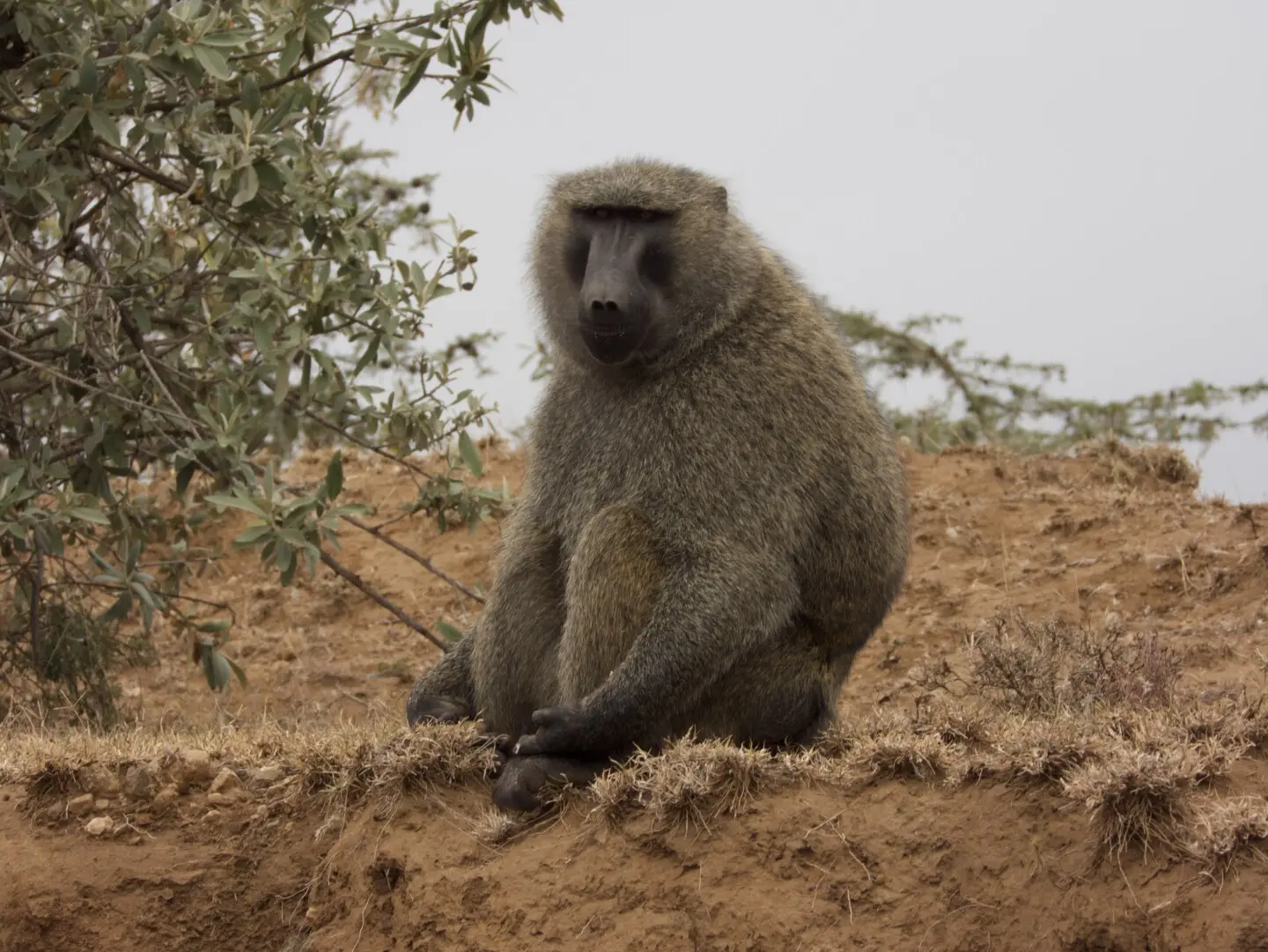
The lake and its shoreline attract flamingos in variable numbers depending on the season and water conditions elsewhere in the region, alongside a wider range of water birds and waders drawn to the lake’s alkaline shallows. On the forested slopes above, buffalo, hyena, bushbuck, and troops of baboon and blue monkey are commonly encountered, and elephant sign, and occasionally elephant themselves, appear on the crater floor. Because the crater is walked rather than driven, sightings here tend to be closer and quieter than the equivalent encounter from a vehicle on the main crater floor, though visitors should not expect the density of predator and plains game sightings that make the main Ngorongoro Crater famous; Empakaai’s appeal is landscape and solitude rather than a checklist of big cats.
Return climb and fitness required
The climb back out of the crater is the more demanding half of the walk, covering the same nearly three hundred metres of elevation gain over just over a kilometre of trail, and is noticeably harder given the altitude, with the crater rim itself sitting above 2,900 metres. Most visitors in reasonable general fitness complete the round trip comfortably within two to three hours including time at the lakeshore, though a slower, more deliberate pace is advisable given the altitude and loose forest floor underfoot. Sturdy footwear is genuinely necessary here rather than a nominal recommendation, and visitors prone to breathlessness at altitude should factor in extra time for rest stops on the ascent.
Combining Empakaai with Olmoti
Empakaai is very commonly paired with a shorter visit to Olmoti Crater on the same day, since both trailheads are reached from the same general area near Nainokanoka village and both require the same armed ranger arrangement through the Ngorongoro Conservation Area Authority. A typical combined day starts with the shorter, gentler walk into Olmoti in the morning, before continuing on to Empakaai for the more substantial hike in the early afternoon, with the full day, including driving between trailheads and back to a crater rim lodge or Karatu, usually running six to eight hours door to door. Visitors with less time sometimes choose Empakaai alone and skip Olmoti, given that Empakaai’s lake and views are generally considered the more dramatic of the two.
Best time to visit
Empakaai can be visited throughout the year, though the drier months from roughly June to October and again in the shorter dry spell around January and February tend to offer firmer trail conditions and clearer long distance views towards Ol Doinyo Lengai. Flamingo numbers on the lake fluctuate with water levels and food availability elsewhere in the region’s soda lakes, including Lake Natron further north, so sightings cannot be guaranteed on any given visit regardless of season. Early morning starts are generally recommended, both to avoid the cloud that can build over the highlands by midday and obscure the long distance views, and to make the most of cooler temperatures for the climb back out.
Costs and permits
A visit to Empakaai requires the standard Ngorongoro Conservation Area entry and transit fees in addition to a separate walking permit and the mandatory ranger fee, arranged through a licensed operator rather than independently at the trailhead. These costs are usually built into a broader Ngorongoro itinerary by tour operators rather than quoted as a standalone line item, and visitors planning to add Empakaai to an existing crater safari should raise it with their operator in advance, since the ranger booking and vehicle logistics generally need to be confirmed before arrival in the conservation area rather than improvised on the day.
Why it is worth the detour
For visitors who have already spent a day driving the crowded floor of the main Ngorongoro Crater, Empakaai offers something genuinely different within the same conservation area: solitude, physical effort, forest rather than open grassland, and a view of an active volcano that the crater floor itself cannot offer. It rewards a reasonable level of fitness and a willingness to walk rather than simply observe from a vehicle, and for that reason it remains one of the more overlooked additions to a northern Tanzania itinerary, known well to specialist operators but still absent from many standard crater only itineraries.