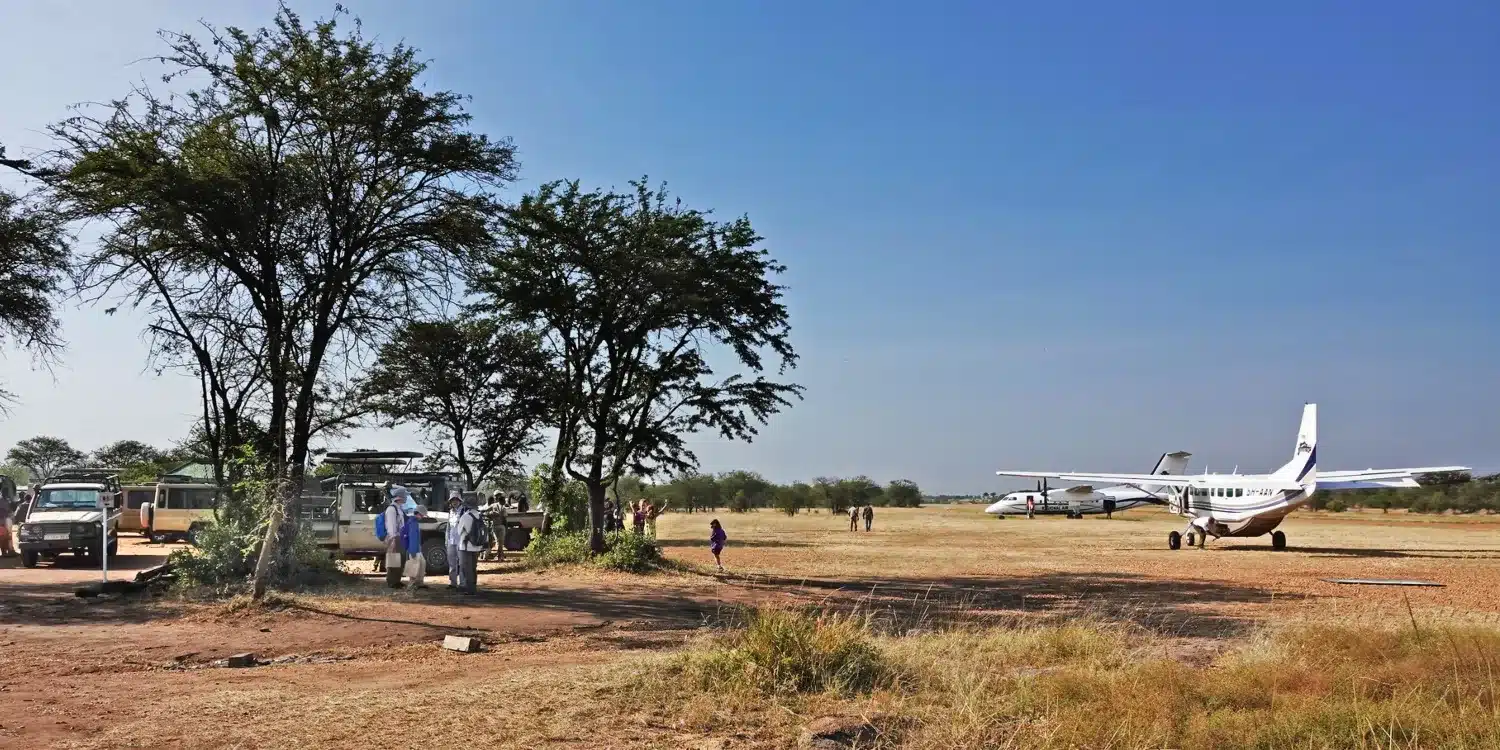
Serengeti airstrips are scattered across the park’s four main sectors rather than concentrated at a single hub, so the airstrip that matters for any given traveller is the one nearest the camp they have booked, not the one with the most flights or the biggest reputation. Landing at the wrong airstrip for your camp can add anywhere from thirty minutes to well over two hours of extra road transfer, on tracks that are not built for speed, so matching airstrip to camp before booking a flight is one of the more consequential small decisions in planning a Serengeti trip.
Why airstrip choice matters more than it first appears
Most safari flights between Arusha and the Serengeti are scheduled as multi-stop “milk runs,” with a single aircraft touching down at two or three airstrips in sequence to drop and collect passengers before returning to Arusha. Which airstrips a particular flight calls at, and in what order, depends on that day’s bookings, so the same route can take forty-five minutes on one day and closer to ninety on another simply because of an extra stop. Once on the ground, the further mismatch between airstrip and camp compounds this unpredictability with a fixed road transfer that cannot be shortened, since Serengeti’s internal roads are unpaved, rutted by rain, and shared with wildlife that has right of way. A camp in the Western Corridor booked against a flight into Seronera, rather than Sasakwa or Kirawira, can mean an additional two hours of driving on either end of the day, eating directly into game viewing time.
Seronera Airstrip: the central hub
Seronera is the busiest and most heavily used airstrip in the park, sitting around one kilometre south of the Seronera visitor information centre in Central Serengeti. It has a proper terminal building, functioning as both a lobby and an administrative office, which sets it apart from the more basic bush strips elsewhere in the park. Seronera is served by the widest range of scheduled flights, connecting to Arusha, Kilimanjaro International Airport, Dar es Salaam and Zanzibar, which makes it the default choice for the majority of first-time visitors staying in the Central Serengeti area. Camps and lodges within a short transfer of Seronera include Four Seasons Safari Lodge Serengeti, Kubu Kubu Tented Lodge, One Nature Nyaruswiga, Lemala Ewanjan Camp, Siringit Camp, Lemala Nanyukie, Ehlane Plains and Namiri Plains, with most transfers running well under an hour. Because Seronera sits at the heart of the year-round wildlife hub described elsewhere on this site, this airstrip is also a sensible choice for travellers whose booked camp lies within Central Serengeti generally, even if the specific property is not listed above.

Kogatende Airstrip: gateway to the northern Mara sector
Kogatende serves the northern Serengeti, close to the Mara River, and is the airstrip most closely associated with the peak river crossing season between roughly July and October. Landing here places a traveller within a short drive of the crossing points themselves, which matters enormously for anyone whose entire trip is built around witnessing a crossing, since even a ninety minute transfer from a more distant airstrip can mean missing a crossing that unfolds in a matter of minutes. Camps and lodges served by Kogatende include Singita Mara River Tented Camp, Lemala Kuria Hills, Serengeti Bushtops, Nomad Lamai and Kimondo Migration Camp. Flight schedules to Kogatende are noticeably denser during peak migration months than at other times of year, when demand for northern sector access falls and some operators reduce frequency.

Lobo Airstrip: the north-eastern approach
Lobo sits in the north-eastern Serengeti, roughly thirty minutes to an hour by road from the park’s main entrance in that sector, and around six kilometres from Klein’s Gate. It is a useful airstrip for camps positioned in the Lobo area itself, a part of the park known for open granite kopjes and resident wildlife that does not depend on the migration passing through, which makes it a reasonable choice even outside peak crossing season. Camps such as Klein’s Camp and other properties in the wider Lobo Hills area are typically reached from this airstrip rather than from Kogatende or Seronera, even though the driving distance between all three is not enormous by Serengeti standards.
Sasakwa and the Grumeti Reserves airstrip
The Sasakwa airstrip sits within the privately managed Singita Grumeti Reserves, bordering the western side of the park along the Northern Western Corridor. This airstrip exists specifically to serve the small number of very high-end lodges and camps operating within the Grumeti concession, and is not generally used by travellers staying inside the national park boundary itself. Anyone booked into a Singita property in this area should expect their flight itinerary to route through Sasakwa rather than through Seronera or Kirawira, since transfers from those airstrips into the Grumeti concession would add substantial and unnecessary driving time.

Kirawira B Airstrip: access to the Western Corridor
Kirawira B is a smaller airstrip in the western Serengeti, a short distance north of the Grumeti River, roughly three hours from Mwanza by road and about an hour from Ndabaka Gate. It sits close to the first of the Grumeti’s migration crossing points, and within a few kilometres of the Grumeti Game Reserve and Handajega Gate, which makes it the logical choice for camps positioned along the Western Corridor during the period when the migration passes through this sector, typically between May and July. Because it is a comparatively minor airstrip, flight frequency into Kirawira B tends to track the migration’s presence in the corridor rather than remaining constant year round.

Serengeti Kusini and Ndutu: the southern plains
Serengeti Kusini airstrip sits close to the Kusini Kopjes in the southern part of the park, roughly nine kilometres from the Maswa Game Reserve boundary, and about an hour’s drive from the airstrip into the park itself since the strip lies just outside the boundary. This makes it a natural choice for anyone travelling specifically for the calving season between January and March, since the airstrip sits close to Lake Ndutu, Lake Masek and the seasonal short grass plains where the bulk of calving takes place. The separate Ndutu airstrip serves camps including Sanctuary Kusini Camp, Kimondo Migration Camp, Serengeti Under Canvas and Nomad Serengeti Camp, most of which include the airstrip transfer as part of the accommodation package rather than charging it separately, though this should always be confirmed at the time of booking rather than assumed.
Fort Ikoma Airstrip: the overflow option
Fort Ikoma sits in the north-western part of the park, close enough to Seronera that it is rarely used as a primary destination and functions instead as an overflow airstrip when Seronera is experiencing unusually heavy traffic on a given day. It is a matter of a few kilometres from Retima Hippo Pool, Nyabogati Hippo Pool and the Fort Ikoma gate itself, so travellers occasionally rerouted here from Seronera should not expect a materially different transfer experience.
Matching flight time to transfer time, not just to distance
A one-way flight from Arusha to almost any Serengeti airstrip takes roughly forty-five minutes to an hour and a half in still air, with the variation coming almost entirely from how many intermediate stops that day’s flight makes rather than from genuine distance. What varies far more, and matters more for planning a first day or last day of safari, is the road transfer from the airstrip to the actual camp. A traveller landing at Seronera for a Central Serengeti camp might face a transfer of twenty minutes, while a traveller landing at the same airstrip but booked into a Western Corridor property could face two hours or more of additional driving on rough tracks. For this reason, the single most useful question to put to an operator or camp before finalising a flight booking is not “which airstrip serves this part of the Serengeti” but “which airstrip serves this specific camp with the shortest possible road transfer,” since the two questions do not always produce the same answer.
Weather delays and how airstrips handle them
None of the Serengeti’s airstrips have paved runways or instrument landing systems, which means visibility and surface conditions genuinely affect whether a flight can land as scheduled. Heavy rain during the long rains of April and May, or the shorter rains of November, can leave a grass or gravel strip too soft or waterlogged for a safe landing, and in these cases pilots either divert to the nearest usable alternative airstrip or delay departure until conditions improve. Kogatende and Kirawira B, both smaller and less developed than Seronera, are somewhat more prone to this kind of delay during the wetter months, simply because their surfaces drain less predictably. Camps positioned near these airstrips are generally well practised at accommodating a late or rerouted arrival, but travellers with a tight onward connection, such as an international flight the same evening, should treat any itinerary built around a single afternoon flight during the rainy season with a degree of caution and build in a buffer where possible.
Confirming the right airstrip before you fly
Because camp names and airstrip names do not always correspond in an obvious way, and because a small number of camps have moved which airstrip they use as new strips have opened or older ones have closed, the most reliable way to confirm the correct airstrip is to ask the camp directly, in writing, rather than to rely on a generic list. This is particularly worth doing for any camp near a sector boundary, such as properties on the edge of the Western Corridor or the boundary between Central and Northern Serengeti, where more than one airstrip might be geographically plausible but only one is actually used for guest transfers. Confirming this detail before booking a flight avoids the situation, more common than it should be, of a traveller arriving at an airstrip to find that the transfer vehicle sent to collect them was actually waiting at a different one.
Luggage and timing considerations specific to bush flights
Bush flights into any of these airstrips are operated on small aircraft, typically Cessna Caravans seating around thirteen passengers, with a combined carry-on and checked luggage limit generally set at fifteen kilograms per person and a requirement for soft-sided bags rather than rigid suitcases, since hard luggage does not pack efficiently into the aircraft’s limited hold space. Most airlines request passengers arrive at the departure airstrip at least an hour before scheduled take-off, and because the same aircraft often continues on to further stops after a given passenger disembarks, delays at an earlier airstrip on the milk run can shift arrival times at a later one by a meaningful margin, which is worth building into the first day’s itinerary rather than assuming precise arrival times will hold. Building at least an hour of slack into any same-day connection to a camp activity or to an onward flight is a habit worth forming for anyone flying into the Serengeti’s network of bush airstrips, regardless of which one their particular camp uses.


