Serengeti elephants are among the most consistently visible large mammals in the park, a striking recovery from a population that was reduced to a few thousand individuals through the ivory poaching crisis of the 1970s and 1980s. Aerial surveys conducted jointly by Tanzanian and international conservation bodies over the following decades recorded a roughly threefold increase in elephant numbers across the wider ecosystem, and today herds are a near guaranteed sighting on most Serengeti game drives, particularly around permanent water sources and riverine woodland. Understanding elephant social structure and the areas they favour turns a passing sighting of grey shapes in the distance into a genuinely rewarding period of observation.
How Serengeti Elephant Herds Are Structured
Elephant society in the Serengeti follows the same matriarchal pattern found across the species’ range. Family units are led by the oldest and typically largest female, the matriarch, who carries decades of accumulated knowledge about water sources, safe routes and seasonal feeding grounds, and who makes the decisions that guide the group’s daily movement. A core family unit usually numbers around ten individuals, made up of the matriarch, her adult daughters, and their calves of varying ages, though several related family units will sometimes merge temporarily into a larger clan of up to seventy animals, particularly around abundant water or food sources during the dry season. Adult males leave their natal family group at around twelve years of age and from that point live largely solitary lives or move in loose, shifting bachelor groups with other males, rejoining female herds only briefly when a female is in oestrus.
Communication within and between family groups happens partly through calls at frequencies below the range of human hearing, known as infrasound, which can carry across several kilometres and allow separated family members or unrelated herds to remain aware of each other’s location and movement across a surprisingly large area of the ecosystem.

Seronera Valley: Reliable Year Round Viewing
Central Serengeti’s Seronera Valley, already known for its exceptional predator density, holds elephants throughout the year thanks to the permanent water provided by the Seronera River and its tributaries. Family groups here are accustomed to a high volume of vehicle traffic and tend to be relatively relaxed around game drive vehicles compared with herds in more remote parts of the park, which allows for extended, close range observation of behaviour that would otherwise be difficult to witness, including mud bathing, dust throwing to protect skin from sun and insects, and the tactile greeting rituals between family members reuniting after time apart.
The Grumeti River and Western Corridor
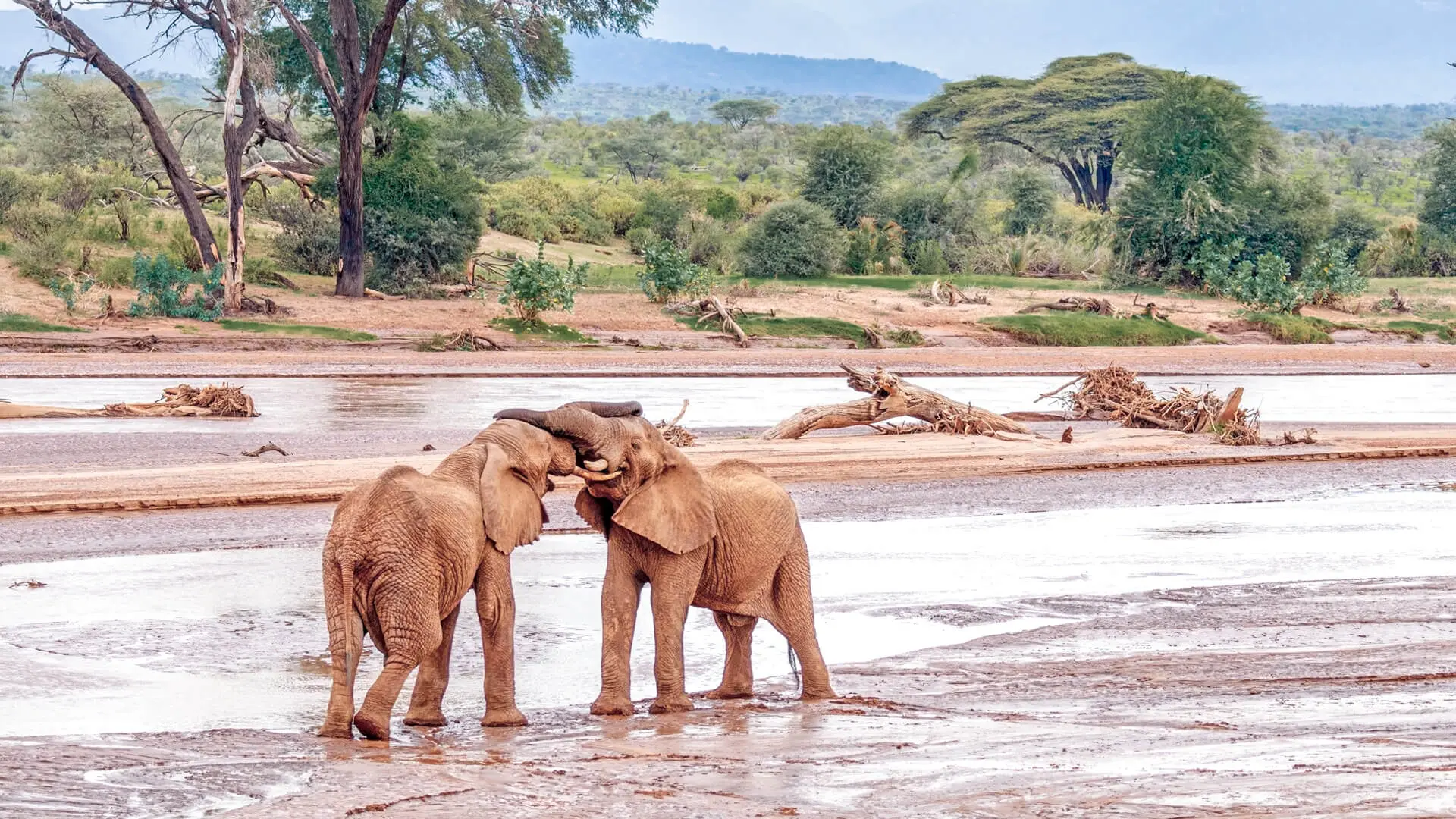
During the dry season, roughly June through October, elephants concentrate heavily along the Grumeti River in the Western Corridor, gathering at the river’s pools to drink, bathe and cool themselves through the hottest part of the day. This concentration around a shrinking, reliable water source makes the Grumeti one of the most productive areas in the park for extended elephant viewing during the dry months, with family groups sometimes visible for an hour or more as they move through the full sequence of drinking, bathing and socialising at the water’s edge. The same stretch of river also holds the Serengeti’s Nile crocodile population, and it is not unusual to watch elephants wading within metres of large crocodiles basking on the riverbank, generally with no conflict between the two, since adult elephants have little to fear from crocodiles under normal circumstances.
Northern Serengeti and the Mara River Woodlands
The wooded landscape near the Mara River in the far north supports some of the largest and least disturbed elephant herds in the ecosystem, a reflection of the area’s lower visitor numbers for most of the year outside the peak crossing season. Large family groups here move through mixed acacia woodland and open grassland, and the lower density of vehicles compared with Central Serengeti means encounters often feel less rushed, with herds continuing normal feeding and social behaviour rather than reacting to a queue of vehicles.
Feeding Behaviour and Ecological Role
An adult elephant can spend up to sixteen hours a day feeding, consuming a highly varied diet of grasses, leaves, bark and fruit that shifts with the season and with local availability, and a single adult can eat well over one hundred kilograms of vegetation daily. This scale of consumption gives elephants an outsized influence on the wider Serengeti landscape. By pushing over trees to reach upper branches, stripping bark, and trampling paths through dense vegetation, elephants open up woodland into more mixed habitat that benefits a wide range of other species, from browsing antelope that can now reach previously inaccessible foliage to grazers that benefit from the more open ground created where elephants have cleared thicket. Their daily movement between feeding and water also disperses seeds across considerable distances in their dung, which supports the regeneration of the very woodland they feed on.
Elephant Behaviour Worth Watching For
Beyond simple feeding and movement, several elephant behaviours reward patient observation. Ear flapping, in which an elephant repeatedly fans its large, blood vessel rich ears, is a genuine cooling mechanism rather than a display, since flapping rapidly lowers blood temperature as air passes over the ear’s surface. Mud and dust bathing, usually following a session of drinking, coats the skin in a protective layer that guards against both sunburn and biting insects, and calves in particular can be seen enthusiastically rolling and splashing in the process. Distress or excitement is often signalled through trumpeting, a loud, high pitched call quite different from the low rumbles used for everyday communication between family members, and is worth noting as a cue that something, whether an approaching predator, a separated calf, or simply high spirits during a reunion, has shifted the mood of the group.
Bulls and Musth
Solitary bull elephants encountered away from family groups are frequently older males in search of receptive females or simply moving independently between feeding areas, and they are generally the largest individuals visible on a Serengeti game drive, sometimes reaching six tonnes and over three metres at the shoulder. Periodically, mature bulls enter a hormonal state known as musth, marked by a noticeably swollen temporal gland behind the eye, a dark secretion running down the side of the face, and heightened aggression and unpredictability. Guides are trained to recognise a bull in musth from a safe distance and will typically keep vehicles well back from any animal displaying these signs, since musth bulls are considerably more likely to behave erratically toward both other elephants and vehicles than elephants outside this hormonal state.

Conservation Recovery and Ongoing Monitoring
The scale of the Serengeti elephant population’s recovery since the poaching crisis of the late twentieth century is one of the more genuine conservation successes in the wider ecosystem, achieved through a combination of the international ivory trade ban, sustained anti poaching patrols, and long term research programmes tracking individual family groups. Conservation organisations working alongside Tanzania National Parks have fitted a number of elephants with tracking collars in recent years, allowing researchers to monitor movement patterns across the park and into the surrounding buffer zones, and to respond quickly where elephant movement brings herds into contact with community land bordering the park, reducing the potential for conflict between elephants and neighbouring farmers.
Calf Rearing and Family Bonds
Elephant calves are born after a gestation period of close to twenty two months, among the longest of any land mammal, and remain closely dependent on their mothers for several years, nursing regularly while also gradually learning to feed independently under the guidance of older female relatives. The entire family unit shares responsibility for a calf’s safety, a behaviour known as allomothering, in which aunts and older siblings help watch over and even physically shield young calves from perceived threats, walking closely alongside them and positioning their own bodies between the calf and any approaching vehicle or predator. This collective protectiveness is most visible when a family group is disturbed or startled, since the entire herd will often close ranks around the youngest members rather than simply fleeing as individuals. Calves that lose a mother are sometimes informally adopted by another lactating female within the same family group, a further reflection of how tightly bonded these units remain across a female elephant’s naturally long lifespan, which can extend past sixty years in the wild.

Elephants Compared With Other Tanzania Parks
Travellers who have visited Tarangire National Park, renowned for what are often the largest elephant herds in northern Tanzania during the dry season, sometimes wonder how the Serengeti compares. Tarangire’s elephant concentrations along the Tarangire River during the driest months can exceed anything typically seen in the Serengeti, since the Serengeti’s much larger overall area allows elephants to disperse more widely rather than concentrating around a single dominant river system. What the Serengeti offers instead is greater consistency across a longer itinerary, since elephants are woven throughout Central Serengeti, the Western Corridor and the north rather than concentrated in one specific zone, meaning a visitor moving through several parts of the park over several days is likely to encounter elephants repeatedly rather than only during a single dedicated stretch of the itinerary, and this spread across zones tends to suit travellers who want elephants as one strong element within a broader wildlife itinerary rather than the single focus of the trip.
Photographing Elephants in the Serengeti
Elephants are among the most forgiving subjects for safari photography, given their size, relatively slow and predictable movement, and tolerance of vehicles in well visited areas such as Seronera. The most rewarding images typically come from water’s edge encounters along the Grumeti River or Seronera’s tributaries, where bathing and drinking behaviour offers genuine action and interaction between family members, rather than a static line of animals walking across open grassland. Backlit dust thrown up during a dry season crossing, or the fine spray from a trunk during a bathing session, can add real atmosphere to an otherwise straightforward sighting, and guides who position a vehicle with the light behind the photographer rather than behind the elephants generally produce noticeably stronger results.

Best Time of Day and Season for Elephant Viewing
Elephants can be encountered at almost any hour, but the cooler periods of early morning and late afternoon tend to produce the most active behaviour, including feeding, bathing and social interaction, while the middle of the day often sees herds resting in whatever shade is available. Seasonally, the dry months from June through October concentrate elephants most reliably around the Grumeti River and other permanent water sources, offering the most predictable viewing, while the wetter months see herds disperse more widely across the park in search of fresh growth, which can make sightings less concentrated but no less frequent given the population’s overall recovery and current size across the ecosystem.


