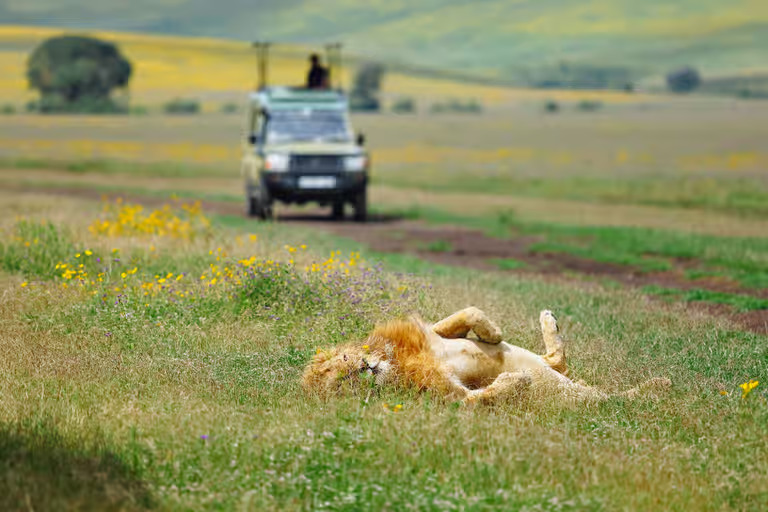
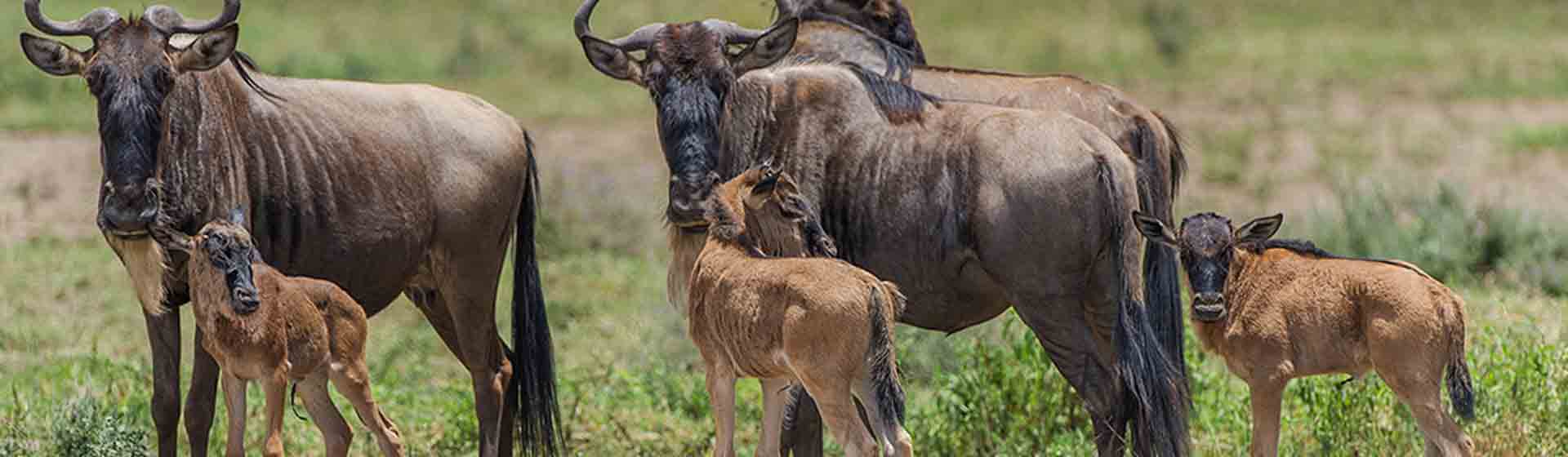
The Serengeti calving season runs from January through March, with the sharpest concentration of births falling in a three week window in February, when as many as 8,000 wildebeest calves are born in a single day on the short grass plains around Ndutu. Nearly half a million calves arrive in this period, almost all of them within sight of the same lion prides, cheetah coalitions and hyena clans that have followed the herds south to be there when it happens.
Why January to March, and Why Ndutu
The timing is set by rainfall, not by the calendar. The short rains arrive across the southern Serengeti and the Ngorongoro Conservation Area border between November and December, and within weeks the volcanic soils around Ndutu produce a flush of short grass with a mineral and protein content that suits late pregnancy better than almost anywhere else in the ecosystem. Wildebeest carry their calves for roughly eight and a half months, and the females that mated in the Serengeti’s rutting season the previous May and June come into the final stage of gestation just as this grass becomes available. The herds that spent the dry months spread across the northern Serengeti and the Mara begin moving south from November, and by December most of the pregnant females have settled into the Ndutu plains, Lake Masek shoreline and the grasslands stretching toward the Gol Mountains and Naabi Hill Gate.
The Biology Behind a Synchronised Birth
What makes the Serengeti calving season different from ordinary seasonal breeding elsewhere in Africa is how tightly compressed it is. Rather than spreading births across several months, the majority of the ecosystem’s roughly 1.3 to 1.5 million wildebeest give birth within a window of two to three weeks, most of it landing in early to mid February. Researchers studying the phenomenon have found that the degree of synchrony goes well beyond what rainfall and grass quality alone would predict, and recent field experiments using playback of male rutting calls suggest that vocal cues from bulls during the mating season may help set the timing collectively across the herd, not just for individual females responding to their own hormonal cycles.

The result is a strategy ecologists call predator swamping. A lion can eat perhaps seven to nine kilograms in a single sitting, and even the combined hunting pressure of every resident predator in the Ndutu area cannot come close to consuming the volume of calves born in a single week, let alone a single day. By flooding the plains with far more vulnerable young than any predator population can process, the herd ensures that the overwhelming majority of individual calves survive, even though the raw number lost to lions, cheetahs, hyenas and jackals in this period is higher in absolute terms than at any other point in the migration’s year. A newborn wildebeest calf can stand within about ten minutes of birth and is capable of running with the herd inside an hour, which is the second half of the same survival strategy: speed compensates for what synchrony alone cannot cover.
How the Season Unfolds, Month by Month
Early January is transitional. The bulk of the migration has arrived on the southern plains but births are still scattered, a few hundred calves a day rather than thousands, and the herds are still spread loosely between Ndutu, the Ngorongoro Conservation Area’s western boundary and the plains east toward the Gol Kopjes, depending on where the most recent rain has fallen. Guides in the area describe this period as building tension: enormous herds, visibly heavily pregnant, moving slowly across open ground with predators already gathering at the margins.

February is the peak. The bulk of the year’s calves, close to half a million of them, arrive within roughly three weeks centred on the first half of the month, though the exact peak shifts by a week or two from year to year depending on when the short rains actually broke. This is also the period of the most concentrated predator activity anywhere in the Serengeti-Mara ecosystem. Cheetah hunts happen in full daylight and at high frequency, because a calf only days old cannot outrun even a mediocre cheetah, and the open, short grass terrain around Ndutu gives cheetahs the sightlines they need. Lion prides move through the herds with a confidence rarely seen elsewhere, and hyena clans, sometimes thirty or more animals working together, specialise in separating a calf from its mother in the chaos of a herd on the move.
By March the pace slows. Most calves are four to eight weeks old, strong enough to keep pace with the adults, and the intensity of predation drops accordingly, though it never stops entirely. Rain tends to fall more heavily in March than in January or February, turning the black cotton soil around Ndutu into a genuine driving hazard after a downpour, and some of the mobile camps in the area begin planning their move north toward the Serengeti’s central and western sections as the plains here start to dry and the herds thin out ahead of the long rains proper.
Where Exactly to Be
Ndutu is not a single fixed point but a region straddling the boundary between Serengeti National Park and the Ngorongoro Conservation Area, centred on Lake Ndutu and Lake Masek. That administrative boundary matters practically: within the Ngorongoro Conservation Area side, guides are permitted to drive off established tracks and run night drives, both prohibited inside the national park proper, which is why so many of the calving season’s most detailed predator sightings, kills included, happen on the NCA side rather than the Serengeti side of the same open plain. The short grass plains stretching from Ndutu east toward the Gol Kopjes and Naabi Hill Gate hold the highest concentration of calving activity, while the Matiti Plains and the edge of the Maswa Game Reserve to the west see smaller but still significant numbers, with considerably less vehicle traffic.
Predator Activity in Detail
The character of predation shifts through the season in ways worth knowing before booking game drives. Cheetahs dominate the daylight hours precisely because their hunting style depends on sight and speed rather than ambush, and the open plains around Ndutu, combined with the sheer density of vulnerable calves, make this one of the most reliable cheetah hunting grounds anywhere on the continent during February. Lions hunt calves opportunistically rather than through the coordinated stalks typical of adult wildebeest hunts elsewhere in the year, often taking advantage of the general confusion when a large herd is moving. Spotted hyena clans are, by most guides’ accounts, the most consistently active predator during peak calving, working in numbers to isolate individual calves from the herd, a strategy that succeeds more often here than anywhere else these animals hunt in East Africa.
Camps Built Specifically Around This Window
Several operators run camps that exist only, or primarily, for the calving season, relocating or closing entirely once the herds move on. Olakira Camp, positioned in the Ndutu region itself, is a mobile tented camp that repositions later in the year to follow the migration north. Ubuntu Camp sits close to the Ngorongoro Conservation Area boundary and follows the same seasonal pattern. Kimondo Camp is set deeper into the southern plains with views over a permanent waterhole that draws wildlife independently of the wider migration. Kirimu Camp and Malaika Ndutu Luxury Camp both operate specifically within the December to March window, the latter positioned at the lake’s edge with interconnected family suites, a detail worth knowing for anyone travelling with children during calving season. Lemala Ndutu Tented Camp sits on the Ngorongoro Conservation Area side of the boundary, which puts its game drives among those benefiting from off-road and night driving privileges. For travellers who prefer a permanent structure to a mobile tented camp, Mwiba Lodge and Lake Masek Luxury Tented Lodge are the established options in the wider area, both operating year-round rather than closing between seasons.
Photography and Viewing Considerations
The daylight hunting pattern that defines calving season is a genuine advantage for photographers, since cheetah action in particular unfolds in workable light through the middle of the day rather than being confined to the low light of dawn and dusk that governs most predator photography elsewhere in the Serengeti. The trade off is crowding at the best known sightings. Ndutu during peak February weeks draws a significant number of vehicles, and a well known cheetah family or an active lion pride can attract more traffic than a first time visitor might expect from an area often marketed around its sense of open wilderness. Guides based in the Ngorongoro Conservation Area side of Ndutu tend to have more room to manoeuvre, both because off-road driving is permitted there and because the boundary itself thins out the crowd relative to sightings squarely inside the national park.
Combining Calving Season With the Rest of the Park
Ndutu itself has no hot air balloon operation, so travellers wanting a balloon flight over the migration during this period typically arrange a transfer of around ninety minutes each way to the central Serengeti, usually built around an overnight stay near Seronera rather than a same day round trip. Several itineraries pair three or four nights at Ndutu for the calving action with a further two or three nights in central Serengeti, partly for the balloon option and partly because Seronera’s resident lion and leopard population offers reliable sightings that do not depend on the unpredictable timing of a specific birth or hunt. A short extension to Ngorongoro Crater rim, roughly two to three hours’ drive from Ndutu, is another common addition, since the crater’s dense, contained wildlife population makes for a very different but complementary experience to the open plains further south.
Rain is worth planning around on a practical level rather than avoiding altogether. The black cotton soil that makes the Ndutu plains so fertile becomes genuinely difficult to drive on after a heavy downpour, and camps in the area route game drives around known problem sections rather than through them when conditions are wet. This is more a feature of March, when rainfall is heavier, than of January or the first half of February. Layered clothing that copes with warm, dry mornings turning into a sudden afternoon storm serves better here than the drier packing lists built around the northern Serengeti’s July to October dry season crossings.
Booking Timing
Demand for the Ndutu area during February is high enough that the smaller mobile camps, most of which run eight to ten tents, are frequently booked out nine to twelve months ahead for specific dates. Travellers with flexibility on exact dates, rather than a fixed week, generally still find availability at six to eight months out, though the very best positioned camps sell through even that window during a strong season. Given how heavily the experience depends on being in the right specific spot on any given day rather than simply being in the Ndutu region generally, the choice of camp and its exact positioning relative to Lake Ndutu, Lake Masek and the Gol Kopjes plains matters more here than it does during most other phases of the migration.