A Serengeti balloon safari begins in the dark, hours before the flight itself lifts off. Guests are collected from their lodge or camp between 4:00am and 5:30am, driven to one of the park’s launch sites while the bush is still black, and greeted with a hot drink as ground crews unroll and inflate the envelope by torchlight. What follows is a roughly hour long, near silent flight over the Serengeti at first light, ending in a landing, a champagne toast, and a full bush breakfast served on linen tablecloths in the middle of the plains. It is one of the most requested add on experiences in the Serengeti, and one of the few ways to see the park’s scale rather than its detail.
How the Morning Actually Unfolds
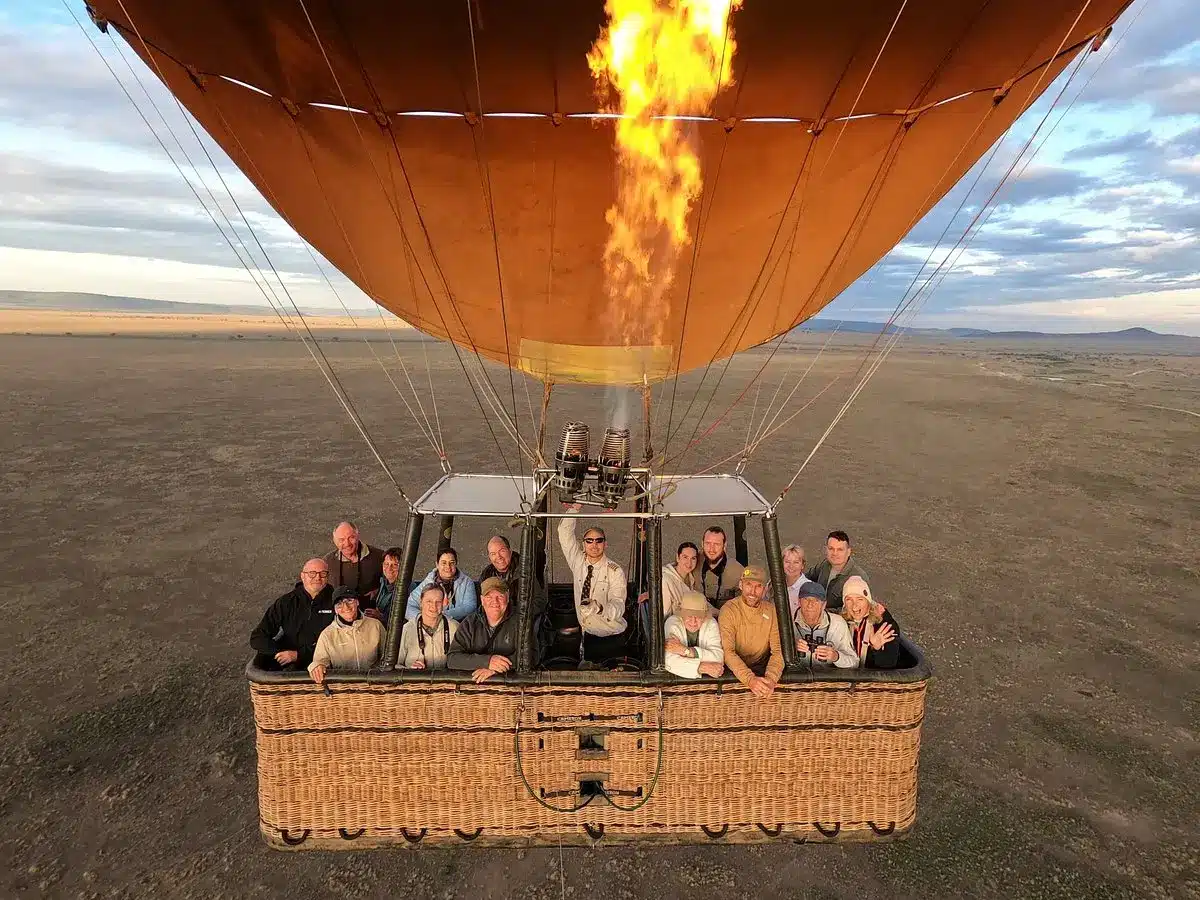
The exact pickup time depends on how far a camp sits from its assigned launch site, since guests need to arrive roughly twenty minutes before sunrise. At the launch site, a safety briefing covers boarding technique, the crouching landing position, and what to hold onto during ascent and descent. The pilot and two or three ground crew inflate the balloon using a large fan followed by controlled bursts from the propane burners, a process that takes fifteen to twenty minutes and is worth watching rather than photographing from inside the vehicle. Boarding involves climbing into a segmented wicker basket, usually divided into individual standing compartments for passengers with the pilot positioned centrally.
Liftoff is immediate and startlingly quiet. Once the burners cut out between bursts, the only sound is wind and, occasionally, animals below reacting to the shadow passing overhead. Flights alternate between higher altitude passes, useful for taking in the sweep of the plains, river lines and distant kopjes, and low level drifts of ten to thirty metres above the ground, close enough to look directly down on grazing herds, a pride resting in shade, or a river full of hippos. The pilot has some control over altitude but very little over direction, since the balloon travels wherever the prevailing wind takes it, which is part of what makes each flight genuinely unique rather than a fixed route flown daily.
Where the Flight Launches From
Flights launch from up to four sites depending on the season and where migration activity is concentrated. The central Seronera site operates year round and sits close to the Seronera River, an area with resident wildlife regardless of the time of year, including the highest concentration of large predators in the park. The Western Corridor site, near the Grumeti River and the shores of Lake Victoria, typically operates from June through September or October, coinciding with the migration’s westward push. Northern Serengeti flights from the Kogatende area run roughly July through October, over the same landscape of rolling hills and the Mara River where the crossings take place. A fourth site near Ndutu in the southern Serengeti operates from late December through mid March, timed to the calving season on the short grass plains.

Which site a guest flies from is not usually a choice made independently of accommodation, since balloon operators fly from the site nearest to where guests are staying and transfer times factor directly into the very early wake up call. A camp booked specifically to combine game drives with a balloon flight should be chosen with the relevant launch site’s operating season in mind, since a camp in the Western Corridor in February will not have balloon access at that time of year even though the camp itself remains open.
What the View Actually Shows
The value of a balloon flight over a game drive is perspective rather than proximity. From a vehicle, an observer sees individual animals and behaviour up close. From a balloon at a few hundred feet, the same landscape reveals patterns invisible from the ground: how a wildebeest herd’s line across open grassland actually connects to the treeline they are heading toward, how a river’s course shapes where wildlife concentrates along its banks, or how a kopje sits within the wider plain rather than as an isolated rock formation seen from one angle at eye level. Photographers describe it as the only opportunity on a Serengeti trip to capture the ecosystem’s scale in a single frame rather than piecing it together from a sequence of ground level images.

During migration season, from a northern or western launch site, this scale becomes dramatic rather than simply informative. Wildebeest columns that from a vehicle appear as a few hundred animals in view at once reveal themselves from altitude as continuous lines stretching for kilometres, curving around obstacles and converging toward river crossing points. Predators are harder to spot from the air than from the ground, since a balloon’s altitude and distance from the herd work against close observation, but the overall dynamic between predator, prey and terrain is easier to understand from above than from any single vantage point on the ground.
The Landing and Bush Breakfast
Landings vary in character. Some are a smooth, controlled descent straight onto open ground. Others involve the basket tipping onto its side as it touches down and drags briefly across the grass, which is a normal outcome of ballooning rather than a sign anything has gone wrong, and is exactly why the safety briefing’s crouching position instruction matters. Once passengers disembark, a ground vehicle usually arrives within minutes to transport guests to a breakfast site set up specifically for the morning’s flight, sometimes combined with a short game drive en route if sightings present themselves.
The breakfast itself follows a long standing tradition in ballooning worldwide: a champagne or sparkling wine toast on landing, followed by a full cooked breakfast served at a table with proper linen, in the middle of the bush, with the balloon’s ground crew and pilot often joining guests to answer questions about the flight. Most operators also issue a commemorative flight certificate. The entire experience, from pickup to return to camp or the resumption of the day’s game drive, typically runs four to five hours.

Who a Balloon Safari Suits
The experience suits travellers who value perspective and atmosphere over close wildlife encounters, and who are comfortable with a very early start in exchange for something a standard game drive cannot replicate. It particularly rewards photographers working on landscape or aerial compositions, and travellers visiting during migration season who want to understand the scale of the herds beyond what is visible from a vehicle windscreen. Most operators set a minimum age around six or seven and do not permit pregnant women to fly, restrictions that apply consistently across commercial operators in the Serengeti rather than varying camp by camp.
It suits an itinerary of at least four or five days better than a very short stay, since a balloon flight is weather dependent and occasionally cancelled or rescheduled at short notice, and building the flight into an early day of a longer trip leaves room to rebook rather than losing the opportunity entirely. For a first time visitor to the Serengeti with only two or three days available, a balloon flight is worth weighing against the time it removes from game drives, since the early wake up and subsequent late morning return typically displaces what would otherwise be the day’s best game viewing window.

Weather, Cancellations and Rebooking
Ballooning is entirely weather dependent, and pilots make the final call on whether a flight goes ahead based on wind conditions at the launch site in the hour before dawn. Strong or gusty wind is the most common reason a flight is postponed, since safe inflation and a controlled landing both require calm conditions. Rain is a less frequent factor given that flights happen at first light before the day heats up, but during the November and April rain windows, cancellations become somewhat more likely. Reputable operators reschedule automatically to the following morning where possible and refund guests in full if no available date remains within their stay, so the financial risk of booking a flight is limited even when the specific morning does not go ahead as planned.
This is the practical reason most camps and travel designers recommend scheduling the flight for the second morning of a stay rather than the first or last. A first morning booking leaves no buffer if wind cancels the flight, and a last morning booking risks the flight being cancelled with no rebooking day left before departure. A guest arriving into camp in the afternoon, flying the following dawn, and having at least one additional morning in reserve before departure has the best chance of the flight actually happening as booked.
What to Wear and What Not to Bring
Because the pre-dawn transfer and the ascent both happen in cold air, layering matters more than it does for a standard mid morning game drive. A fleece or light down layer over a base layer works well, since the temperature at altitude and in the pre-dawn hours is noticeably colder than the Serengeti’s daytime warmth, and layers can be removed once the sun clears the horizon and the flight and subsequent breakfast warm up. Closed shoes or ankle boots are preferable to sandals given the uneven ground at launch and landing sites, and a hat with a chin strap is worth having for after landing rather than during the flight itself, when loose items are best kept secured.
Operators generally ask guests to avoid large bags, loose scarves, and bright white clothing in the basket, partly for practical space reasons inside a segmented wicker compartment and partly because loose fabric can catch on the basket’s rigging during boarding or landing. A small camera with a wide angle or standard zoom lens is more practical during the flight itself than a large telephoto setup, since the balloon’s altitude and constant gentle movement make precise long lens framing difficult, and the more valuable images from a balloon flight tend to be landscape compositions rather than close wildlife portraits in any case.
Combining a Flight with the Rest of a Serengeti Trip
Because balloon flights conclude by mid morning, most guests are back at camp or continuing directly into a game drive by 10:00am or 11:00am, meaning the day is not lost to the activity even after the early start. Many camps schedule the balloon flight for the second or third morning of a stay rather than the first, both to allow for a weather related reschedule and to let guests settle into camp before committing to a 4:00am wake up call. For travellers planning a Serengeti trip around December 2026 or through the 2027 calving and migration seasons, checking which launch site corresponds to the camp’s location and travel dates in advance avoids discovering only on arrival that the nearest site is out of season for that specific week.


