Serengeti crocodiles reach their greatest concentration along the northern stretch of the Mara River, where Nile crocodiles that have occupied the same bends and sandbanks for decades wait for the wildebeest migration to arrive each year. These are not opportunistic scavengers passing through. They are territorial residents, some of them among the oldest and largest individuals of their species anywhere in Africa, and understanding how they live, hunt and endure gives a visitor a far richer view of the river than simply watching for the crossing itself.
Where the Mara River’s crocodiles are found
The Mara River enters the Serengeti ecosystem from the Kenyan side of the border, flowing south through the Mara Triangle before crossing into Tanzania near Kogatende and continuing down through the northern Serengeti to eventually feed Lake Victoria. Crocodile density is highest at the established crossing points, places such as the pools near Kogatende, the bend at Lookout Hill and the stretch of river close to Purungat Bridge just across the Kenyan border. These locations are not random. Each is a natural funnel where the riverbank narrows or the water slows, forcing wildebeest into a tight, predictable line as they enter the water, and crocodiles have learned over generations exactly where that funnel forms.

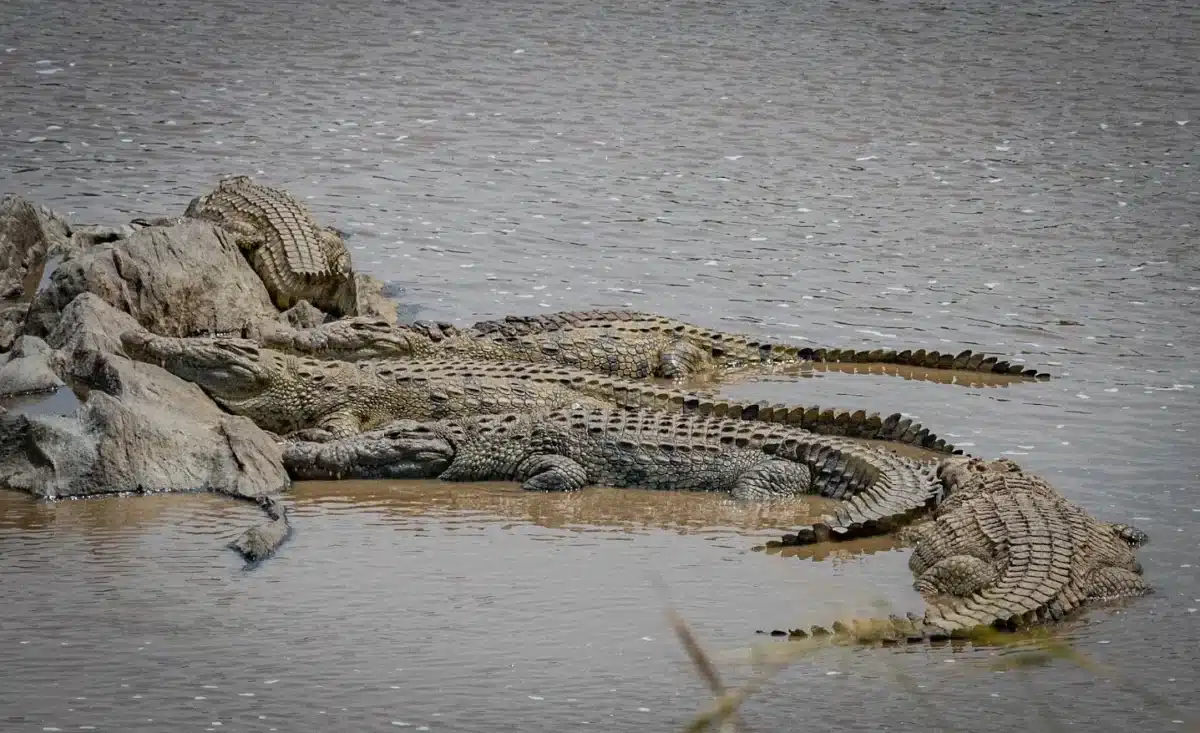
Away from the migration season, crocodiles do not disappear. They remain in residence year round, sheltering in deeper pools and undercut banks during the drier months when the river’s flow drops and prey becomes scarcer. Guides who work the northern sector through the quieter months of the year, from December through May, still find crocodiles baking on sandbanks or submerged with only eyes and nostrils above the surface, patient in a way that few other Serengeti predators are.
How large do Mara River crocodiles grow?
Adult male Nile crocodiles in the Mara River system commonly reach four and a half to six metres in length and can weigh between five hundred and eight hundred kilograms, figures that place them among the largest individuals of the species recorded anywhere on the continent. Females are considerably smaller, typically between two and a half and three and a half metres, and it is the females rather than the males who carry out the nesting work each year. The largest documented individuals in the river are believed to be seventy to one hundred years old, having grown continuously since arriving as small juveniles decades ago and having claimed the most productive stretches of bank as their own territory, sometimes returning to the same waiting spot across many consecutive migration seasons.
Estimating the total crocodile population of the Mara River is genuinely difficult, since the animals spend long stretches submerged or hidden among reeds and undercut banks, and different surveys covering different sections of river produce different numbers. Working estimates from researchers and guides who track individual crocodiles across seasons generally place the population at several hundred large adults along the river’s combined Kenyan and Tanzanian stretches, with the heaviest concentrations around the Mara Triangle and the crossing points nearest Kogatende. The population is considered stable and is not currently a conservation concern, supported by the reliable annual food source the migration provides and by the protection both the Serengeti and the Maasai Mara Reserve extend to the river corridor.
How Mara River crocodiles hunt during a crossing
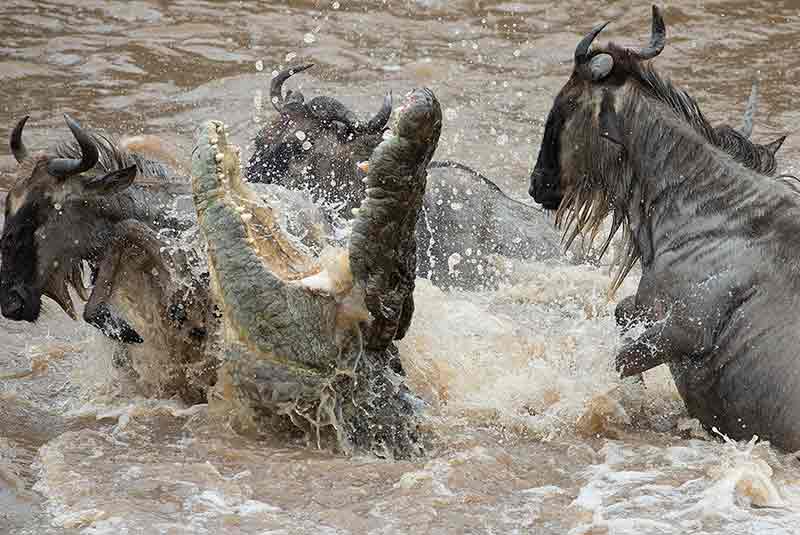
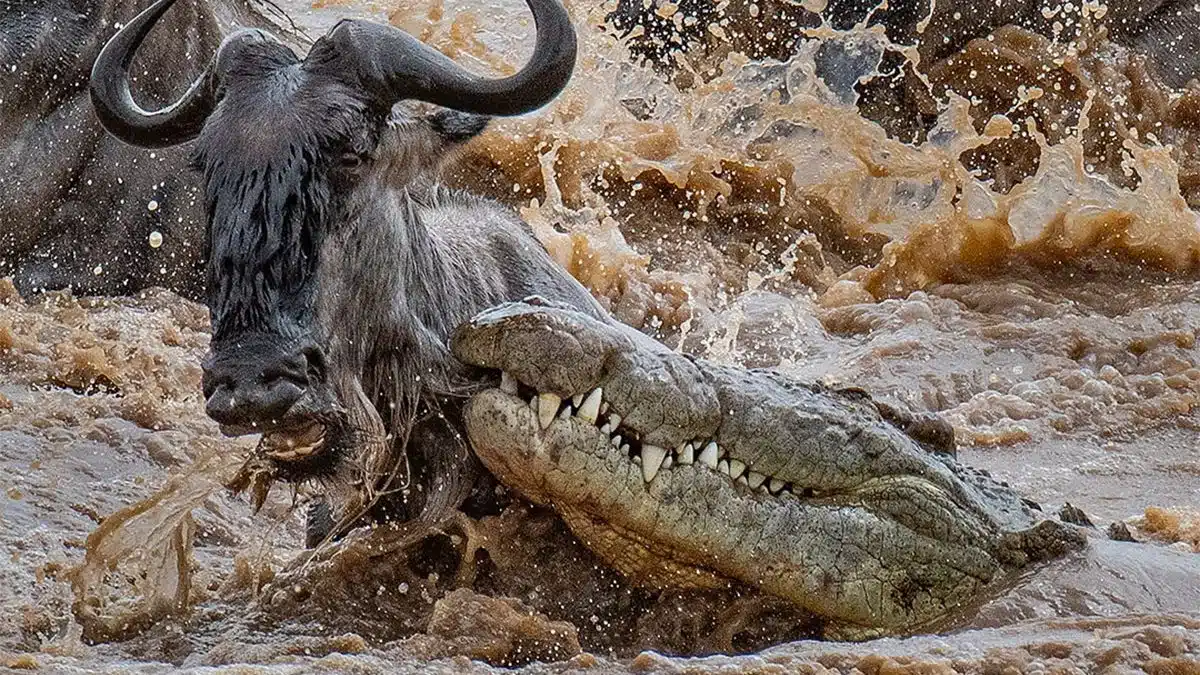
A wildebeest crossing is chaotic by nature, with hundreds or sometimes thousands of animals entering the water within a short span of time, and Mara River crocodiles have adapted their hunting strategy specifically to exploit that chaos. Rather than chasing an individual animal, a crocodile positioned at a crossing point waits submerged near the point where the current concentrates swimming wildebeest into a narrow channel. The noise and disturbance created by hundreds of animals entering the water simultaneously masks the crocodile’s approach, and an ambush strike typically targets a leg or the flank of an animal that has slowed, stumbled on the riverbed, or become separated from the main group.
Once a crocodile has secured a hold, it relies on its body weight and the classic death roll, spinning its entire body to disorient the prey and tear away flesh, rather than attempting to drag a fully grown wildebeest bodily out of the water. Larger, older crocodiles at the most productive crossing points frequently make the majority of kills during a single crossing event, since they occupy the best ambush positions and have the size and experience to subdue an adult wildebeest quickly. Younger or smaller crocodiles are often left scavenging on carcasses rather than making the initial kill.
Nesting and the crocodile life cycle on the Mara
Female Nile crocodiles on the Mara nest during June, July and August, digging nests into the sandy banks and vegetated margins set back from the main current, which places the nesting period directly alongside the peak crossing season. This creates a genuine trade off for nesting females, who must balance guarding a clutch of twenty five to eighty eggs against the feeding opportunity the migration represents at exactly the same time of year. Guides who follow known individual females across seasons describe this tension in detail, since a female that spends too much time at a crossing point risks nest predation, while one that stays close to her nest forfeits a share of the richest feeding period of the year.
Eggs incubate for roughly ninety days and hatch in late September or October, with hatchlings emerging at around twenty eight centimetres long and immediately vulnerable to monitor lizards, herons, large fish and other predators in the shallower margins of the river. As with many crocodilian species, the temperature inside the nest during incubation determines the sex of the hatchlings, with warmer nests generally producing more males. Very few hatchlings survive to adulthood, and the crocodiles that do reach the sizes visible at the main crossing points represent decades of survival against long odds.
Best places to watch crocodiles at the Mara River
The most productive viewing generally comes not from watching the water itself but from watching the riverbank vegetation and sandbanks close to known crossing points, where crocodiles bask for long stretches of the day to regulate their body temperature. Kogatende and the pools immediately south of it are consistently among the most reliable spots, along with the area around Lamai Wedge on the Tanzanian side and the pools near Purungat on the Kenyan side of the border. Camps positioned in the northern Serengeti or the Mara Triangle put guests within a short drive of these points, which matters considerably during crossing season when timing a sighting depends on being close enough to react quickly once herds begin to gather on the riverbank.
Outside the July to October crossing window, crocodile viewing shifts toward patient observation rather than dramatic action. Early morning and late afternoon, when crocodiles emerge to bask after the coolest part of the night, tend to produce the clearest sightings, with animals visible on open sandbanks rather than submerged in the current.
Crocodiles within the wider Mara River ecosystem
Crocodiles are not the only predators working the river corridor. Lions, leopards and spotted hyenas patrol the banks for wildebeest that make it across exhausted, injured or disoriented, while African fish eagles, marabou storks and vultures clear away what the larger predators leave behind. Hippos share the same pools and stretches of river as the crocodiles and are, in practice, considerably more dangerous to humans on land, though the two species generally coexist in the water without direct conflict, since their feeding strategies and prey do not overlap.
The crocodile population’s health is tied directly to the health of the wider river system, since the animals depend on the Mara maintaining sufficient water flow and fish stocks outside migration season to sustain a population of this size. Conservation pressure on the river, driven by upstream water extraction and deforestation in the Mau Escarpment where the Mara originates in Kenya, is increasingly recognised as a long term threat to the crocodile population, even though the animals themselves are listed as a species of least concern and currently face no immediate risk of decline.
Are Mara River crocodiles dangerous to visitors?
Crocodiles pose no meaningful risk to visitors who remain inside vehicles or stay back from the water’s edge at designated viewing points, which is standard practice at every riverside crossing site in the northern Serengeti. The danger crocodiles present is specific to the water itself and to animals or people entering it, which is precisely why guides insist on strict distance from the bank at any crossing point and why walking safaris in the northern sector avoid the immediate riverbank. Local fishing communities living along the Mara’s course outside the protected area do face genuine risk from crocodile encounters, and this is one of the reasons the river corridor within the park boundary is managed as closely as it is, both for wildlife protection and for visitor safety.
Camps built along the river, including several in the Kogatende and Lamai areas, take crocodile proximity seriously in their own layout, with raised walkways, escorted movement after dark and clear guidance to guests about staying well back from unfenced riverbanks at night, when crocodiles are more likely to leave the water to bask or move short distances over land.
Viewing crocodiles outside the July to October crossing season
Visitors planning a Serengeti trip for December 2026 or through 2027 who are specifically drawn to crocodile viewing should understand that the dramatic hunting behaviour associated with the migration is a crossing season phenomenon, concentrated between roughly July and October when the herds are moving through the northern sector. A December visit falls instead within the period when the migration has moved south toward the Ndutu plains for calving season, and the Mara River’s crocodiles at that time of year are resident rather than actively hunting migrating herds. They remain visible baking on sandbanks and in the deeper pools near Kogatende, but sightings will not include the ambush behaviour that defines a crossing. Visitors whose primary interest is crocodile hunting behaviour rather than crocodile presence generally do better scheduling a northern sector visit for the dry season crossing window later in the year.
What makes the Mara River crocodiles distinctive
What sets the Mara’s crocodile population apart from Nile crocodile populations elsewhere in Africa is less their number and more their age, size and the degree to which their annual behaviour is now genuinely understood through decades of observation. Guides who have worked the northern sector for many years can often identify specific individuals by scarring, colouration or a preferred waiting position, and can describe a given crocodile’s hunting history across several migration seasons. That level of familiarity, built up over the same decades the largest crocodiles have spent growing in the same stretches of river, is part of what makes watching them at a crossing point a genuinely different experience from an ordinary wildlife sighting elsewhere in the park.


