Five days in the Serengeti is widely considered by guides who work the park regularly to be the ideal length for a first safari, long enough to combine two zones without the itinerary feeling rushed, but short enough to fit comfortably within a two week overall trip alongside Zanzibar, Kilimanjaro or a wider Tanzania circuit. Unlike a three day trip, which more or less has to stay within a single zone, five days gives real scope to pair central Serengeti’s year round wildlife with whichever seasonal zone is active at the time of travel, whether that is the calving grounds in the south, the Grumeti crossings in the west, or the Mara River crossings in the north.
Why Five Days Changes the Itinerary Logic
The core constraint on a three day trip is that there is no time to relocate within the park without losing an entire day to travel. Five days removes that constraint. A typical structure splits the trip into two segments, commonly two nights in central Serengeti around Seronera followed by three nights in whichever zone matches the season, or the reverse order depending on flight schedules and which camps have availability. This two zone structure is the single biggest advantage five days holds over three, and it is the main reason operators consistently recommend five days as the minimum length for anyone whose safari priority includes a specific migration event rather than general wildlife viewing.
Sample Itinerary: Central Serengeti Plus the Active Migration Zone
A representative five day itinerary begins with a flight from Arusha or Kilimanjaro International Airport to Seronera airstrip, arriving in time for an afternoon game drive on day one. Day two is spent entirely in central Serengeti, split into an early morning and a late afternoon drive with rest at camp during the heat of the day, covering the Seronera Valley, the kopjes to the south, and the riverine woodland where leopard sightings are most consistent. On the morning of day three, guests transfer, either by a short scheduled flight or a longer road transfer depending on which zone is next, to the second base camp. Days three through five are then spent in that second zone, whether Ndutu in the south for calving season, the Western Corridor near the Grumeti River, or the north around Kogatende and the Mara River, before a final flight back to Arusha on the afternoon of day five.
December Through March: Pairing Central Serengeti with Ndutu
For travellers planning a trip in December 2026 or across the first months of 2027, the natural five day pairing combines central Serengeti with Ndutu in the far south. The short rains typically arrive in November, prompting the migratory herds to move south out of the north and back toward the plains around Ndutu, with the first calves usually appearing before Christmas and the main calving push building through January and February. A December departure lands at the start of this window, offering early arrivals and building predator activity around Ndutu, along with lower crowds and more forgiving rates than the frantic booking pressure that builds around the February peak. Central Serengeti in this period is at its greenest, with excellent resident lion and leopard sightings around Seronera to open the trip before the transfer south.

May Through July: Pairing Central Serengeti with the Western Corridor
From roughly May into July, the herds move northwest through central Serengeti toward the Western Corridor and the Grumeti River, where large Nile crocodiles make crossing attempts genuinely dramatic, if less heavily visited than the northern crossings later in the season. A five day trip built around this window typically opens with two nights in Seronera, then transfers to a camp in or near the Grumeti Reserve for the remainder of the stay, timed to catch the herds as they build toward the river. This period also covers the wildebeest rut, adding a behavioural dimension, males contesting territory and mating rights, that is largely absent from the calmer months either side of it.
July Through October: Pairing Central Serengeti with the North
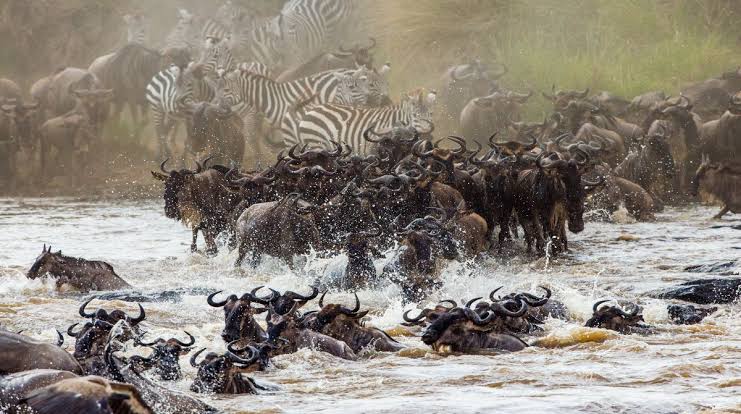
The northern Serengeti around Kogatende and the Lamai Wedge sees the most sought after event in the Serengeti calendar, the Mara River crossings, at their most reliable from August through September, with July and October offering a reasonable chance at slightly lower cost and lower crowds. A five day trip in this window commonly spends two nights in central Serengeti before flying north to a camp positioned with river frontage or good access to known crossing points. Camps this far north for this specific window are the single most competitive booking category anywhere in the Serengeti calendar and routinely need booking twelve to eighteen months ahead for peak weeks.
Alternative Structure: Serengeti Plus Ngorongoro
Not every five day trip needs to stay entirely within the Serengeti. A common and highly regarded alternative pairs three nights in central Serengeti with two nights at the Ngorongoro Crater, taking advantage of the crater’s exceptional wildlife density and its far more reliable black rhino sightings than anywhere within the Serengeti itself. Since the crater sits directly on the road route between Arusha and the Serengeti, this version of the itinerary can be built entirely around road transfers rather than internal flights, which lowers the overall cost of the trip while still delivering two genuinely distinct landscapes and wildlife experiences.
What Five Days Realistically Delivers
A well planned five day trip covering two zones gives strong odds at four of the Big Five, lion, leopard, elephant and buffalo, and, depending on which second zone is chosen, a real chance at witnessing a specific migration event rather than simply passing through resident wildlife. Black rhino remains the exception; sightings within the Serengeti are concentrated almost entirely around the Moru Kopjes in the south central park, and neither the Ndutu, Western Corridor nor northern zones described above offer meaningful rhino odds. Travellers determined to complete the Big Five within five days should consider the Serengeti plus Ngorongoro structure instead, since the crater delivers rhino far more reliably than any Serengeti zone.
Booking Lead Times for a Five Day Trip
How far ahead a five day itinerary needs to be booked depends heavily on which second zone is chosen. Camps positioned for the August and September Mara River crossings routinely sell out twelve to eighteen months in advance, particularly smaller camps with limited tent counts and strong river frontage. Ndutu camps for the January and February calving peak need somewhat less lead time, generally six to nine months, though the best positioned properties still fill early. Western Corridor camps for the May to July window are comparatively easier to book at shorter notice, typically requiring only three to six months, which makes this pairing a reasonable option for travellers planning later than they would like for the more competitive windows.
Cost of a Five Day Serengeti Safari
A five day, four night trip covering two zones typically runs from around 2,800 US dollars per person for a mid range fly in itinerary, up to 6,000 US dollars or more per person for a premium camp pairing during peak crossing season, before international flights. The two internal flights required to move between zones, generally 150 to 300 US dollars per person each way, add a meaningful cost on top of the ground package compared with a single zone trip, and should be priced explicitly rather than assumed as included in every quoted rate. Park entry fees, typically 70 to 83 US dollars per adult per day, plus separate Ngorongoro Conservation Area fees if that variant of the itinerary is chosen, are additional costs worth confirming line by line before booking.
Common Mistakes When Planning a Five Day Trip
The most frequent error is splitting the five days too evenly, giving each zone two and a half days in effect, which in practice means a rushed transfer day cuts meaningfully into game viewing time in both locations. A cleaner structure gives the primary zone, whichever holds the specific event a traveller most wants to see, the larger share of the trip, commonly three nights against two, rather than dividing the stay in half. A second common mistake is choosing the second zone based on a generic “best time to visit the Serengeti” recommendation without checking that the specific dates of travel actually align with that zone’s peak activity, since the migration’s exact position shifts by two to four weeks from year to year depending on how early or late the rains arrive. A third mistake, particularly among travellers newer to fly in safaris, is underestimating how much a mid trip transfer can eat into a day; a flight described as forty minutes in a brochure can involve two hours or more of total transfer time once airstrip transfers, check in procedures and connection buffers on either end are included.
Packing for a Two Zone Trip
Because a five day itinerary of this kind almost always involves at least one internal flight, the fifteen kilogram soft sided baggage limit common to Tanzania’s light aircraft operators remains the binding constraint on what to bring, exactly as it does on a shorter three day trip. The main additional consideration for five days over three is temperature range if the second zone sits at a different altitude or is more exposed than central Serengeti; Ndutu and the southern plains, in particular, can run notably cooler at night than the more sheltered woodland around Seronera, and a warm layer for early morning game drives is worth prioritising over items that only suit one specific zone.
Camera equipment deserves a second thought on a five day, two zone trip, since each zone tends to reward a different focal length. Central Serengeti’s kopjes and riverine woodland often allow closer approaches to resting predators, where a mid range zoom is sufficient, while the open plains around Ndutu or the wide river frontage at a crossing point generally call for greater reach to capture distant action without disturbing the animals. Travellers carrying a single lens for the whole trip are better served by a versatile mid to long zoom than by a wide angle, since wildlife rather than landscape is the primary subject in both zones on this length of itinerary.
Is Five Days the Right Length?
Five days suits travellers who want more than a single zone snapshot but do not have the time or budget for a longer, multi park circuit, and it is the shortest itinerary length that reliably allows a specific migration event to be built in alongside general Serengeti wildlife. It is a poor fit for anyone determined to complete the Big Five including rhino purely within the Serengeti, and it remains a compressed trip for anyone hoping to combine the Serengeti with more than one additional major destination, such as Zanzibar and Kilimanjaro together, within the same five days rather than as a separate extension either side of the safari itself.


