Zebra Migration in the Serengeti
The Serengeti zebra migration moves alongside the far more famous wildebeest herds across the same 800 kilometre circuit each year, yet it rarely receives its own attention in safari planning despite involving somewhere in the region of 200,000 to 300,000 animals and playing a genuinely distinct ecological role in how the Serengeti Mara ecosystem functions. Zebra are not simply travelling companions of the wildebeest. They are, in a real sense, the migration’s advance party, and the order in which the different species move across the plains each year is not accidental.
Why zebra travel with the wildebeest
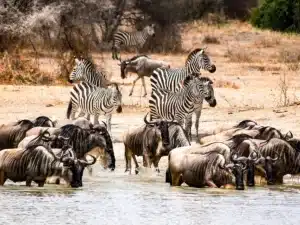
Zebra and wildebeest share the same broad migratory circuit, moving from the southern short grass plains near Ndutu during the wet season, north through the Serengeti’s central and western sectors as the dry season builds, and into the Mara River region of the northern Serengeti and the Maasai Mara Reserve by the middle of the year, before returning south again as the rains resume. The relationship between the two species has traditionally been described as a grazing succession, a term coined by researcher Richard Bell in a 1971 paper that first laid out how different grazing species use the same landscape in sequence rather than in direct competition. In Bell’s original account, zebra move through an area first, followed roughly eight weeks later by wildebeest, with Thomson’s gazelles arriving round eight weeks after the wildebeest.
The traditional explanation for this order rests on the physical differences between the grazers. Zebra have a simple, less efficient digestive system that allows them to process large volumes of tough, low quality forage, which means they can profitably graze down the tall, coarse grass stems that other species cannot digest efficiently. Once zebra have cropped an area down, the shorter, more nutrient dense grass shoots that regrow behind them become accessible to wildebeest, whose more efficient ruminant digestion allows them to extract more nutrition from smaller quantities of higher quality grass. Gazelles then follow behind the wildebeest, taking advantage of the low growing forbs and flowering plants that the two larger grazers leave behind untouched.
A 2024 study that challenged the traditional picture
Research published in the journal Science in 2024 by a team led by Wake Forest University biologist T. Michael Anderson added a genuine complication to this long accepted picture. Rather than finding pure facilitation, in which zebra simply clear the way for wildebeest without any competitive tension between the species, the study found evidence of what the researchers termed a push pull dynamic. Zebra, as bulk feeders needing large volumes of vegetation to meet their energy demands, are effectively pushed along ahead of the much larger wildebeest population, since remaining in an area the wildebeest have begun to graze would leave zebra unable to find enough food to sustain themselves. It is competition rather than pure cooperation that drives the front end of the sequence, even as the back end, where wildebeest grazing does make food more accessible to gazelles, still functions largely as facilitation.
The same research found that fire and rainfall significantly affect how closely the species follow one another. After a fire has burned through an area of savannah, the resulting new growth is unusually nutrient rich, and gazelles in these burned areas do not need to wait as long behind the wildebeest before the vegetation becomes suitable for them. Heavy early season rain has the opposite effect, encouraging excess growth of tall grass that leaves gazelles more dependent on zebra and wildebeest clearing the way first. The overall migration timing that visitors experience in any given year is therefore shaped as much by that year’s specific fire and rainfall pattern as by any fixed seasonal calendar.
Zebra memory and its role in guiding the migration
One of the more consistently observed traits among Serengeti zebra is a strong spatial memory for safe migration routes and reliable water sources, built up over an individual zebra’s own repeated experience of the annual circuit rather than being purely instinctive. Guides and researchers have long noted that mixed herds travelling together often appear to benefit from this memory, with zebra effectively able to lead less experienced or more disoriented wildebeest toward known safe river crossing points and grazing areas. Wildebeest, in turn, are credited with an unusually acute sense of smell that can detect distant rainfall and fresh grass growth from tens of kilometres away, a sensory advantage zebra do not share to the same degree. The pairing of the wildebeest’s long range detection of rain with the zebra’s precise memory of safe routes is one of the more practical explanations for why the two species travel together so consistently, beyond the shared benefit of safety in larger mixed herd numbers.
How many zebra actually take part
Population figures for the Serengeti’s migratory zebra population are less contested than the wildebeest figures currently under scientific review, with most researchers and the Tanzania Wildlife Research Institute’s periodic aerial surveys converging on an estimate of roughly 200,000 to 300,000 zebra taking part in the annual migratory circuit. This makes zebra the second largest population within the Great Migration by number, well behind the wildebeest regardless of which of the recent competing wildebeest estimates proves more accurate, but well ahead of the roughly 300,000 to 400,000 Thomson’s and Grant’s gazelles and the much smaller eland population of around 12,000 animals that complete the migratory herd. Unlike wildebeest, zebra numbers have not been the subject of a comparable satellite recount, largely because their population is smaller and their distinctive black and white striping makes them somewhat easier to distinguish reliably in aerial photography than wildebeest are from similarly sized species.

Predation pressure on migrating zebra
Zebra face substantially different predation pressure from wildebeest during the migration, in part because of their size and in part because of how they respond to threats. An adult zebra is larger and more powerfully built than an adult wildebeest, capable of a defensive kick strong enough to break a lion’s jaw, and zebra tend to fight cooperatively as a family group when threatened rather than scattering individually. This makes a healthy adult zebra a genuinely risky target for a single predator, and lion prides working zebra herds typically rely on coordinated group hunting tactics rather than the more opportunistic ambush approach that can succeed against an isolated wildebeest. At river crossings, however, zebra face the same crocodile ambush risk as wildebeest, and the chaos of a mixed species crossing event does not distinguish between the two when a crocodile strikes at whichever animal has stumbled or fallen behind.
Family groups, known as harems, typically consist of one stallion, several mares and their foals, and this social structure persists even during the migration itself, with harems generally staying together as a cohesive unit within the much larger moving herd rather than dissolving into the mass the way wildebeest, which have a much looser social structure, often appear to. This tighter family cohesion is part of why zebra herds crossing a river often show more visible hesitation and group decision making at the water’s edge than wildebeest do, with a harem sometimes turning back from a crossing point collectively if the lead animals sense danger, only to attempt the crossing again at a different point or time.
Where to see the zebra migration in the Serengeti
Because zebra travel on broadly the same circuit as the wildebeest, the best locations for viewing shift through the year in step with the wider migration. During the wet season from roughly December through March, zebra concentrate on the southern short grass plains around Ndutu and the Ngorongoro Conservation Area’s northern edge, grazing alongside the wildebeest ahead of the calving season. As the dry season builds from April, the herds move north through the central Serengeti around Seronera and into the western corridor along the Grumeti River, before concentrating in the northern sector near the Mara River from around July through October, when the crossing season draws the most visitor attention. Zebra generally begin moving through a given area slightly ahead of the main wildebeest concentration, so a guide tracking the zebra herds can sometimes offer an early indication of where the larger wildebeest movement is likely to follow in the coming weeks.

Zebra are also somewhat more evenly distributed across the ecosystem outside the peak migration months than wildebeest, since a resident, non migratory population of plains zebra lives within the Serengeti year round in addition to the migratory herds, meaning visitors can expect reasonable zebra sightings across the park regardless of season, even if the dramatic scale of the mixed migratory herd is a feature of specific months. A visitor travelling in December 2026 or through the early months of 2027, when the migratory herds are settling on the southern plains around Ndutu ahead of calving season, should expect zebra sightings concentrated in that same southern zone, moving and grazing alongside the wildebeest rather than separately, since this is one of the periods in the annual cycle when the two species’ ranges overlap most completely.
Zebra species and subspecies in the Serengeti
The zebra involved in the Serengeti migration are plains zebra, Equus quagga, specifically the subspecies found across East Africa, distinguished from the plains zebra of southern Africa by narrower, more closely spaced stripes that extend fully down the legs to the hooves, with no pale shadow striping between the main black bands of the kind seen in some southern populations. This is distinct from Grevy’s zebra, a separate and considerably rarer species found in northern Kenya with narrower, more numerous stripes and larger, more rounded ears, which does not occur in the Serengeti ecosystem at all and is not part of the migratory herd under discussion here. Confusing the two species is a common error in casual wildlife writing, but the distinction matters conservation wise, since Grevy’s zebra is classified as endangered while the plains zebra populations of the Serengeti Mara ecosystem remain healthy and are not considered at risk.

Why the zebra migration deserves attention in its own right
The zebra migration is frequently treated as background scenery to the wildebeest spectacle, yet the underlying biology, from the digestive specialisation that lets zebra process grass no other grazer can use efficiently, to the spatial memory that appears to genuinely shape the group’s navigation, is a distinct and well documented story rather than a footnote to the wildebeest’s. Understanding the grazing succession, and the more recent research complicating the simple picture of pure cooperation between the species, gives a visitor a considerably more accurate sense of what is actually happening on the plains during a multi species herd sighting, rather than seeing the mixed herds as an undifferentiated mass moving for the same reasons at the same pace.
This distinction is worth knowing before booking a trip specifically built around a hoped for Grevy’s zebra sighting, since visitors occasionally arrive in the Serengeti expecting the species and are disappointed to learn that a trip to northern Kenya, rather than northern Tanzania, is required to see it. The plains zebra found throughout the Serengeti migration remains, in any case, the more numerous and more consistently visible of the two species across the region as a whole.