Luxury Serengeti lodges are often marketed on the same handful of features: infinity pools, private plunge pools, gourmet dining and butler service. Those amenities are real, but they are not what actually separates a genuinely exceptional property from an expensive but ordinary one. The properties that consistently earn repeat guests and the strongest reputations among experienced safari travellers are set apart by four things that rarely appear in a brochure: the quality and land access of the guiding, the exclusivity of the land itself, the staff-to-guest ratio, and how honestly the camp handles the trade-offs inherent in its own location. This guide looks at what actually distinguishes the best from the merely expensive, using named properties as illustrations rather than a simple ranked list.
Land Access Matters More Than Thread Count
The single biggest differentiator among luxury Serengeti properties is not the interior design but where the camp is allowed to drive. Inside Serengeti National Park proper, all camps, regardless of nightly rate, are bound by the same TANAPA rules: game drives are restricted to daylight hours, vehicles must stay on designated tracks, and off-road driving is not permitted. A camp on a private concession, most notably the Singita-held Grumeti Reserves in the western corridor or the Nomad-operated Lamai Wedge in the north, operates under entirely different rules. Night drives, off-road positioning for a sighting, and walking safaris with an armed guide are all permitted on these concessions in ways they simply are not inside the national park. A guest paying a comparable nightly rate at a beautifully appointed but park-based lodge is, in practical terms, buying a more limited set of activities than a guest at a concession camp, regardless of how the two properties compare on furnishings.

The Guiding Is the Product
Ask any experienced safari professional what actually makes a luxury camp worth its price, and guiding comes up before architecture nearly every time. The best properties, including Singita’s Sabora Tented Camp and Faru Faru Lodge in the Grumeti Reserves, and Sayari and Lamai Serengeti in the north, are known within the industry specifically for the calibre and continuity of their guiding teams, many of whom have spent a decade or more reading the same stretch of land. A guide who genuinely understands where a particular pride is likely to be on a given morning, rather than following radio reports of where other vehicles have already gathered, delivers a materially different experience from one working a generic rotation. This is difficult to assess from a brochure, but a reasonable proxy is guide tenure: camps that retain senior guides for many years, rather than rotating staff seasonally, tend to deliver more consistent sightings.
Exclusivity Is a Real, Measurable Thing
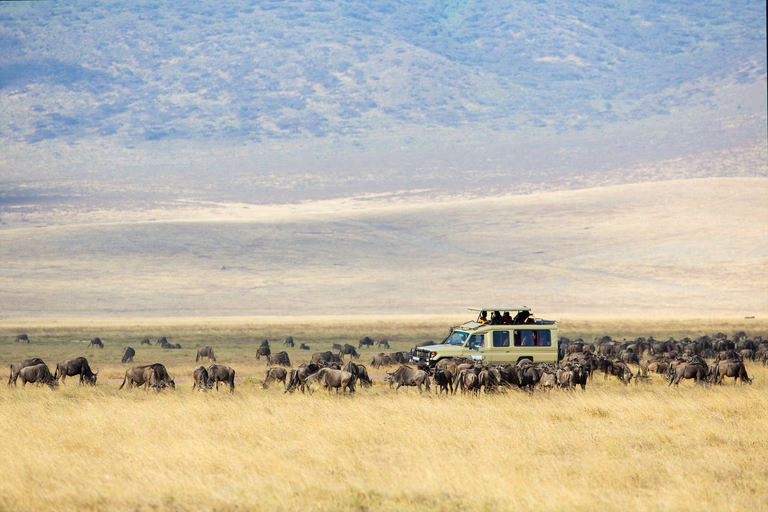
Exclusivity in this context is not a marketing word; it has a concrete measure, which is vehicle density at a sighting. A Mara River crossing viewed from a vantage point accessible to the general national park public during peak season in August or September can involve fifty or more vehicles converging on a single crossing point. The same event, viewed from a camp with private concession frontage on the river, such as Nomad’s Lamai camp in the Lamai Wedge, can mean a handful of vehicles at most, sometimes only the guest’s own. Ultra-luxury pricing at properties like Singita Sasakwa Lodge, which commands rates above 2,000 US dollars per person per night, is substantially a function of buying this scarcity, not the fittings inside the tent. Understanding this distinction helps explain why two camps that look similar in photographs can differ by a factor of three or more in price.
Four Seasons Safari Lodge Serengeti and the Central Zone Case
Not every luxury property depends on a private concession, and Four Seasons Safari Lodge Serengeti, positioned in the central zone overlooking a natural watering hole, makes a strong case for a different model. Its central location gives year-round access to resident wildlife rather than a single seasonal event, its infinity pool sits directly above game viewing, and it delivers a genuinely five-star infrastructure, generators, reliable Wi-Fi, air conditioning, in a park where many camps still run on solar power alone. For travellers who want luxury infrastructure without the seasonal narrowness of a concession camp built around one migration event, this represents a legitimately different, rather than lesser, version of luxury.

Staff Ratios and What They Actually Change
Luxury properties in the Serengeti typically run staff-to-guest ratios far higher than a conventional hotel, often approaching one staff member for every one or two guests once guiding, housekeeping, kitchen and management are counted. This is not simply a comfort statistic. It is what allows a camp to offer genuinely flexible timing, a private bush breakfast arranged on short notice, a game drive extended past the usual return time because a sighting is unfolding, rather than a fixed schedule applied uniformly to every guest. Smaller camps, generally under twelve tents, tend to sustain these ratios more easily than larger lodges, which is one reason the most exclusive properties in the Serengeti tend also to be among the smallest.
Honesty About Trade-Offs Is a Genuine Marker of Quality
One underappreciated marker of a genuinely excellent luxury camp is how directly its team communicates the limitations of its own location, rather than presenting every property as suitable for every traveller regardless of month. A well-run camp in the western corridor will say plainly that the migration passes through for a matter of weeks in May and June and that the rest of the year offers strong resident game but not the crossing spectacle. A camp overselling its own location, claiming migration proximity for months when the herds are demonstrably elsewhere, is a warning sign regardless of how polished its brochure looks. The best operators treat this honesty as part of the service, since a guest who arrives with accurate expectations has a materially better experience than one who was oversold.
Sustainability Claims Deserve the Same Scrutiny
Many luxury camps now market sustainability credentials, solar power, borehole water systems, community employment programmes, alongside their exclusivity claims, and these deserve the same direct questioning rather than automatic trust. Genuine community partnership, of the kind Singita’s Grumeti operations have built over two decades with surrounding villages, funding schools, anti-poaching employment and healthcare, tends to be specific, long-running and verifiable through independent reporting rather than a single paragraph on a website. A camp that can name its community partners, describe a specific programme in detail and point to how long it has run is generally telling the truth; one that offers only general language about being eco-friendly is worth a more sceptical eye.
Design and Architecture, in Proportion
Design still matters, and the best Serengeti properties do it well: Singita’s Sabora recreates a 1920s expedition-era aesthetic with genuine craftsmanship, while Sayari’s more contemporary design uses glass and canvas to frame views across the Mara River valley. But design should be understood as the final differentiator among camps that have already cleared the higher bars of land access, guiding quality and honest positioning, not as a substitute for them. A beautifully designed tent in the wrong location for a guest’s travel month, or staffed by a rotating cast of seasonal guides, is a lesser experience than a more modestly furnished camp that gets those fundamentals right.

What Luxury Actually Costs, Zone by Zone
Pricing at the luxury tier is not uniform across the Serengeti, and understanding why helps explain apparent inconsistencies between camps. In the central zone, properties such as Four Seasons Safari Lodge Serengeti generally price from around 1,200 to 2,000 US dollars per person per night, reflecting infrastructure and year-round demand rather than seasonal scarcity. In the Grumeti Reserves, Singita’s properties command 2,000 US dollars per person per night and above, a figure driven overwhelmingly by exclusive land access rather than the buildings themselves. Northern zone concession camps such as Sayari and Lamai Serengeti sit in a similar range during the July to October crossing season, with rates easing somewhat outside that window even though the properties and their access rights remain unchanged. None of these figures typically include Serengeti park fees, currently around 70 to 83 US dollars per adult per day, or the additional concession and special campsite fees that apply on top, so a full comparison between two luxury camps needs to account for these separately quoted costs before drawing conclusions about relative value.
Who Ultra-Luxury Genuinely Suits, and Who It Does Not
Ultra-luxury Serengeti camps are frequently sold as a universal upgrade, but they suit a narrower set of travellers than the marketing suggests. They suit honeymooners and couples prioritising privacy and willing to pay heavily for it, repeat safari travellers who have already experienced the Serengeti’s headline sightings and are now paying for exclusivity rather than novelty, and photographers for whom uncrowded sightings translate directly into better images. They suit these travellers less well: families with young children, since the smallest, most exclusive camps often carry minimum age policies of twelve years or higher; larger groups, since an eight or ten tent camp cannot easily accommodate a party of fifteen without booking out the entire property; and first-time safari travellers on a fixed, tight itinerary, for whom a well-run central Serengeti lodge at a third of the price will deliver excellent, reliable wildlife viewing without the premium attached to exclusivity that a first-timer may not yet have the experience to fully appreciate.
Booking Lead Times at the Top End
The smallest, most sought-after luxury camps sell out furthest in advance, which is itself a signal of quality but also a practical planning constraint. Camps with fewer than ten tents on private concessions, particularly for the July through September crossing weeks or the February calving peak, are routinely fully booked twelve to eighteen months ahead for their most desirable dates. Larger luxury lodges with thirty or more rooms, including several of the central zone’s established properties, generally retain availability closer to travel, sometimes within three to six months, simply because they have more inventory to sell. A traveller set on a specific small camp for a specific narrow season should treat that booking, not the flights or the rest of the itinerary, as the first decision made.
What This Means When Comparing Two Camps
When two luxury Serengeti properties are being compared on price, the more useful questions are not about thread count or the number of plunge pools, but about land access (national park or private concession), guide tenure, staff ratio relative to bed count, and how directly the camp’s own team describes what a guest will and will not see in the specific month of travel. A property that scores well on these measures, even at a lower nightly rate than a competitor, is very often the better choice, because these are the factors that determine the actual quality of the days spent on safari rather than the quality of the evening spent back at camp. A useful final check is to ask a prospective camp directly how long its current head guide has worked there and whether the camp sits on national park land or a private concession; the answers to those two questions alone reveal more about what a stay will actually be like than any photograph in a brochure.