How long should you spend in the Serengeti depends far more on which sector of the park an itinerary actually covers than most planning guides admit, because the honest answer for a traveller staying only at Seronera in the centre is genuinely different from the answer for someone chasing river crossings at Kogatende in the north or calving season at Ndutu in the south. A blanket recommendation of “three days” or “five days” glosses over the fact that the Serengeti ecosystem covers roughly 25,000 to 30,000 square kilometres across two countries, and moving between its sectors takes real time that has to come out of the days available for wildlife viewing.
Two nights is the minimum, not the target
Two nights, giving four game drives across three park days including arrival and departure, is the shortest stay that makes sense in the Serengeti, and it works only for travellers based entirely in central Seronera who are not trying to chase a specific seasonal event. Arriving by road from Arusha already consumes most of one day, since the drive to Naabi Hill Gate takes six to seven hours before the additional hour or more needed to reach Seronera itself. A two night stay under these conditions leaves one full day of unhurried game viewing and two partial days either side of it, which is enough to see resident wildlife but leaves no buffer if weather, a vehicle issue or a slow border crossing eats into the schedule.
Three to four nights covers one sector properly
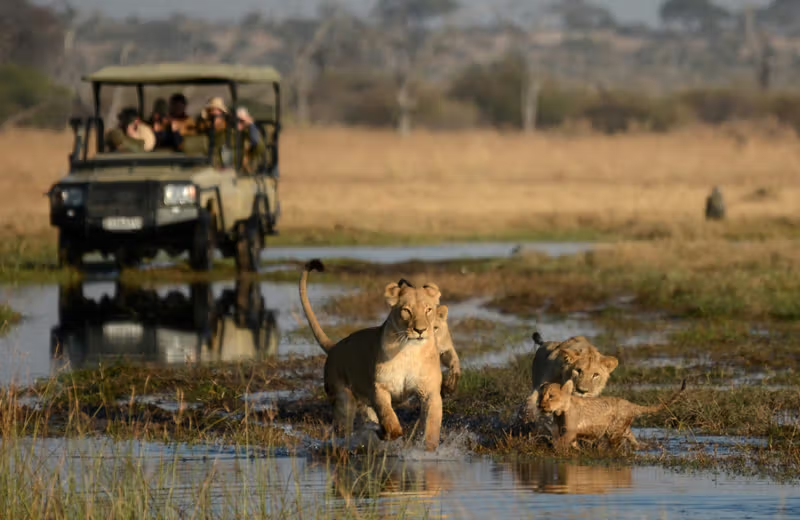
Three to four nights is the point at which a single sector, whether central Seronera, the Western Corridor or the southern plains around Ndutu, can be explored without feeling rushed. This length allows a guide to vary the routes driven each day rather than repeating the same loop, gives genuine flexibility to follow up on a sighting reported by another vehicle, and builds in enough slack that one disappointing drive does not define the whole visit. For a first time visitor flying in rather than driving, and staying at one camp for the entire visit, three to four nights is realistically the sweet spot most experienced guides recommend, balancing cost against the diminishing returns of extra nights spent in exactly the same landscape.

Five to seven nights allows movement between sectors
Once a stay extends past four nights, it becomes worth splitting the time between two sectors rather than staying static in one, and this is where the practical driving distances inside the park start to matter directly. From Seronera to Lobo in the north is roughly eighty kilometres and around two hours without stops; continuing on to Kogatende near the Mara River adds a further stretch that can take most of a day once wildlife stops and track conditions are accounted for. From Seronera south to the Ndutu area is a broadly similar distance and driving time. A five to seven night stay comfortably supports a pattern such as three nights in one sector followed by two to three nights in another, with a half day transfer or a short scheduled flight between them rather than a full day lost purely to driving.
Flying between sectors on light aircraft, landing at one of the park’s bush airstrips, cuts what would be a full day’s drive down to thirty or forty minutes in the air, and for travellers with limited total time this is usually the better trade even though it adds cost. Driving the same route as an extended game drive, stopping for sightings along the way, suits travellers who have the extra day to spare and see the transfer itself as part of the safari rather than dead time to be minimised.

Eight or more nights suits travellers chasing a specific seasonal event across multiple sectors
Eight nights or more becomes worthwhile specifically for travellers who want to follow the wildebeest migration across more than one stage of its annual cycle, or who are combining the remote Western Corridor, the calving grounds near Ndutu and the northern river crossing zone near Kogatende in a single trip. Because the herds move according to rainfall rather than a fixed calendar, an itinerary built around eight or more nights also has enough built in flexibility to adjust the middle days of the trip based on where the migration actually is at the time, something a shorter itinerary simply cannot absorb without cutting a sector entirely.
Matching length to the reason for visiting
A traveller visiting mainly for the Big Five and general plains game, without a specific seasonal target, gets excellent value from three to four nights in central Seronera, since resident lion, leopard, elephant and buffalo populations are present throughout the year regardless of where the migratory herds happen to be. A traveller specifically chasing the February calving season should weight their nights toward Ndutu rather than splitting time evenly across sectors, since the birthing itself is concentrated on the short grass plains there and driving north during that window trades a near certain event for a low probability one. A traveller aiming for a Mara River crossing, typically from July through September, needs enough nights specifically in the Kogatende area, because crossings are unpredictable hour to hour and a single day’s visit can easily miss one entirely while a guide based there for three or four consecutive days has a realistic chance of being in position when it happens.
How a Serengeti stay fits into a wider Tanzania itinerary
Very few travellers visit the Serengeti in isolation from the rest of Tanzania’s northern circuit, and the total nights available for the whole trip usually determines how many can be allocated to the Serengeti specifically rather than Ngorongoro, Tarangire or a Zanzibar extension. A common structure for a first Tanzania safari of seven to eight total nights allocates three to four nights to the Serengeti, one to two nights at the Ngorongoro Crater, and the remainder split between Tarangire and travel days. Extending the total trip to ten or twelve nights allows the Serengeti allocation to grow toward five or six nights without squeezing the other parks, which is the more comfortable structure for travellers who find that three nights anywhere on safari leaves them wanting more rather than feeling satisfied.
Signs that a proposed length is too short for what is being promised
A quoted itinerary that promises a specific river crossing, a specific calving experience and a Western Corridor visit inside a total of three or four Serengeti nights is promising more than the geography realistically allows, since each of those experiences is tied to a different sector and a different few weeks of the year. It is worth asking directly, as covered in more detail in our guide to the questions worth asking a Serengeti operator before booking, exactly which sector the proposed nights will actually be spent in, since a headline itinerary description can sound comprehensive while the practical time allocated to any single sector is too short to deliver what is being marketed.
Planning length around the December to March calving window
Travellers planning a trip for December 2026 through March 2027, when the wildebeest herds are concentrated on the southern plains around Ndutu for calving, face a slightly different calculation than travellers visiting in the dry season. December itself sees the herds beginning to gather on the plains as the short rains green the grass, with the concentrated birthing peak typically falling in a window across January and February. A stay of three to four nights based specifically at Ndutu during this period delivers an extremely high density of predator activity, since the newborn calves draw lion, cheetah and hyena into close range of the herds, but travellers who split the same three or four nights between Ndutu and central Seronera during this specific window often see less concentrated action than if they had committed the full stay to one location. Booking for this season also needs to happen further ahead, since the small camps around Ndutu with the best positioning sell out for the peak calving weeks between six and twelve months in advance.
Common mistakes in planning Serengeti length
The most frequent planning error is booking too many nights in a single camp within one sector purely to save on transfer costs, ending up with repetitive game drives over identical terrain once the initial day or two of novelty has worn off. The second most common mistake runs the opposite direction: spreading a short total stay across three or more camps in different sectors, which sounds thorough on paper but in practice converts too many of the available days into transfer days rather than game drive days. A third mistake is treating the Serengeti as a single homogenous unit when building a multi park Tanzania itinerary, allocating it the same three nights regardless of whether the trip falls during calving season, migration season, or the quieter shoulder months when wildlife is more dispersed and a slightly longer stay compensates for lower sighting density per drive.
Weighing extra Serengeti nights against other parks
Every extra night spent in the Serengeti is usually a night not spent in Ngorongoro, Tarangire or on a Zanzibar beach extension, and the decision genuinely comes down to what a traveller values most. Ngorongoro Crater delivers an extremely high concentration of resident wildlife, including the best black rhino sightings in northern Tanzania, within a single compact day, which some travellers feel makes one night there sufficient rather than the two or three nights that suit a full Serengeti sector. Tarangire offers enormous elephant herds and impressive baobab studded scenery that some families find easier for younger children to enjoy over shorter game drives. None of this argues against the Serengeti receiving the largest single allocation of nights in a first time northern circuit itinerary, since it remains the most complete single wildlife destination in the region, but it is worth deciding deliberately rather than defaulting to an even split across every park on the itinerary.
The honest short answer
Two nights is workable if the goal is simply to experience the Serengeti at all within a tight overall trip. Three to four nights is the realistic minimum for a genuinely satisfying single sector visit. Five to seven nights supports a proper two sector itinerary that follows the seasonal pattern rather than fighting it. Eight nights or more suits travellers building their entire Tanzania trip around the migration’s full annual arc. The right number depends less on a general rule and more on being specific, before booking, about which sector matters most and what time of year the trip actually falls in, and then working backward from that specific goal to a number of nights, rather than picking a round number first and hoping the itinerary can be made to fit it afterward.