A hot air balloon flight over the Serengeti costs between roughly 500 and 650 US dollars per person in 2026, depending on the launch site and operator, with most standard shared flights sitting close to 550 to 600 dollars. That figure covers the transfer from camp, the flight itself, the champagne toast on landing, and a full bush breakfast, but it does not cover the Serengeti’s daily park entry fee, which is charged separately unless a safari package has already bundled it in. Understanding exactly what the price includes, what it does not, and how safe the activity actually is matters more here than for most safari add ons, given how much a single balloon flight adds to a trip’s overall budget.
What the Price Actually Covers
The headline figure includes round trip transfer from the lodge or camp to the launch site, the flight itself, which typically runs fifty to seventy minutes in the air, a champagne or sparkling wine toast immediately after landing, and a full cooked bush breakfast served at a table set up in the field. Most operators also issue a commemorative flight certificate as part of the standard package. Children between roughly seven and twelve years old are usually offered a reduced rate, often 400 to 450 dollars, and most operators do not permit children younger than six or seven to fly at all, a restriction tied to the practical demands of standing for the duration of the flight rather than an arbitrary age cutoff.
What the price does not cover is equally important to understand before booking. The Serengeti’s daily park entry fee, typically in the 80 to 100 dollar range per person, is charged separately unless a safari operator has already built it into a package price. Gratuities for the ground crew and pilot are also not included and are customary at roughly 10 to 20 dollars per person, generally collected in cash at the breakfast table. Northern Serengeti launch sites, tied to peak migration season demand, sometimes carry a modest premium over the Central Seronera flight, so the exact figure a guest pays can vary by a hundred dollars or more depending on where and when the flight is booked.

Why the Cost Is What It Is
The price reflects genuine operating costs rather than simple market positioning. A single hot air balloon envelope requires safety-mandated replacement after a set number of flight hours, a cost comparable to replacing a high-end vehicle, and each flight requires a licensed pilot along with a ground crew of the size needed to inflate, launch, track, recover and transport the balloon, plus staff to prepare and serve the breakfast that follows. National park concession fees are charged per passenger on top of standard park entry, adding a further fixed cost to every seat sold regardless of how full a given flight is. In the Serengeti specifically, one operator holds the concession for most of the park’s launch sites, meaning there is little price competition driving costs down the way there might be for game drives, where dozens of independent operators compete directly.
Assessing whether the cost is justified depends on what a guest is comparing it to. Measured purely as cost per hour of activity, a balloon flight is expensive relative to a full day game drive covering the same rough price across a shared vehicle. Measured as a once in a trip experience delivering a perspective on the Serengeti that no other activity replicates, most guests who have taken the flight describe it as worth the expense specifically because it is not repeatable in the same way a game drive is, and because the landscape scale view from altitude genuinely cannot be obtained any other way.
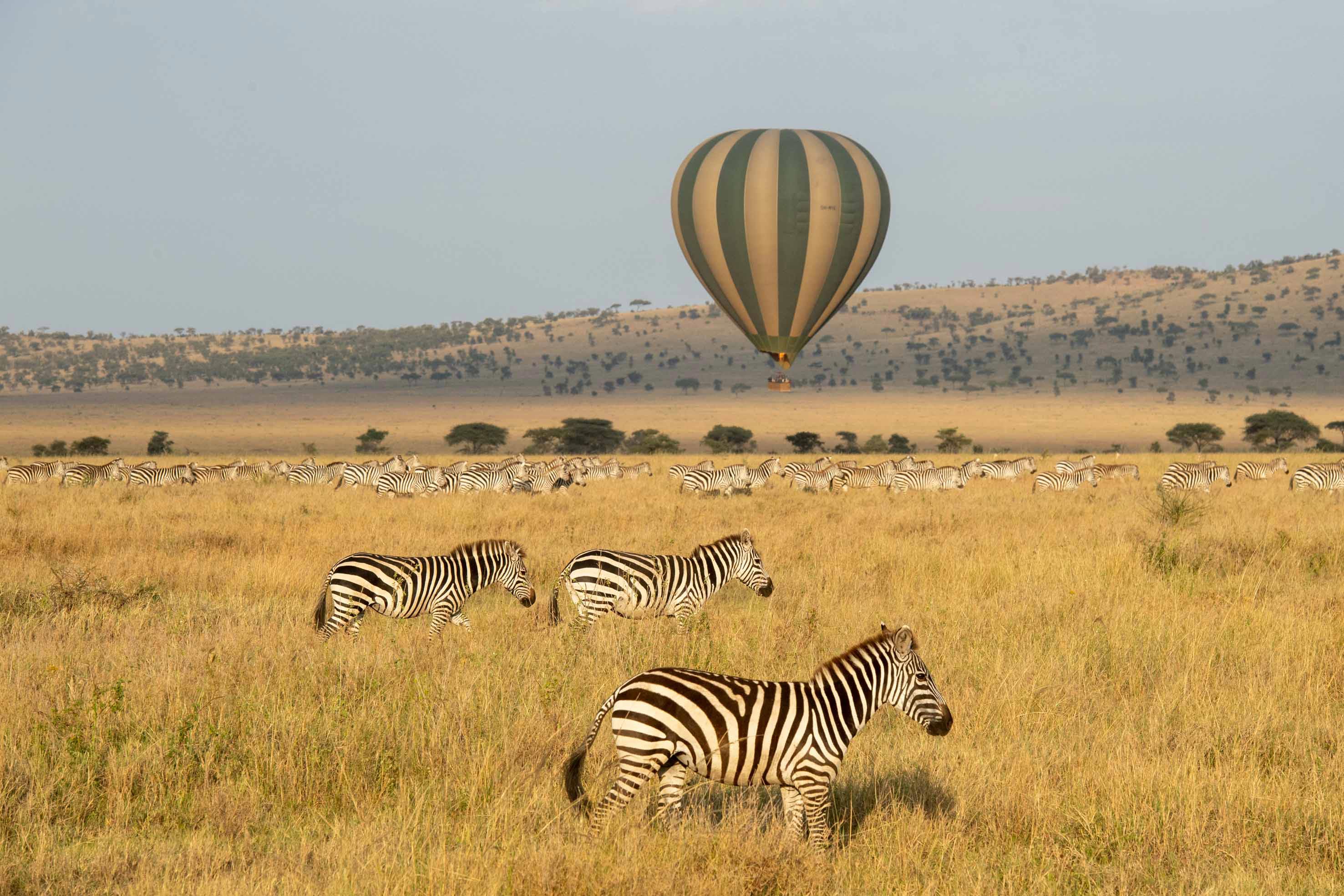
How Safe Is a Serengeti Balloon Flight
Commercial balloon operators in the Serengeti fly under Tanzania Civil Aviation Authority certification, and the standards applied to licensing, maintenance and pilot training broadly match or exceed international commercial aviation norms rather than being a locally relaxed standard. The main established operator has run daily flights since the early 1990s and reports an accident free safety record across three decades of continuous operation. Pilots hold commercial balloon licences requiring regular recertification, and ground crews are trained specifically in inflation, launch, tracking and recovery procedures rather than being general safari staff assigned to balloon duty.
The activity carries a level of risk broadly comparable to any commercial aviation experience rather than to genuinely high-risk adventure activities. Landings are the point in the flight where minor bumps are most likely, and the safety briefing’s instruction to adopt a crouching position on landing exists specifically to manage that moment safely, since a balloon basket sometimes tips onto its side and drags briefly across the ground as part of a completely normal landing rather than a sign anything has gone wrong. Pregnant women are not permitted to fly on any commercial Serengeti operator’s balloons regardless of trimester, a standard restriction applied consistently across the industry rather than varying by company policy.

Weather as the Main Practical Risk
The most common disruption to a booked balloon flight is not a safety concern but a scheduling one: wind conditions at the launch site in the pre-dawn hour determine whether a pilot proceeds with inflation and launch, and flights are postponed rather than flown in conditions judged unsafe for controlled ascent or landing. Reputable operators reschedule automatically to the next available morning within a guest’s stay and refund in full if no rebooking date remains, so the financial exposure from a weather cancellation is limited, but the experience itself can be lost entirely on a very short stay with no buffer day built in.
Booking the flight for a morning early enough in a multi night stay to leave at least one additional morning in reserve is the most reliable way to protect against losing the experience to a single bad-weather morning. This matters most during the shoulder season rain windows around November and April, when postponements become somewhat more frequent than during the drier June to October and December to March periods.
Shared Balloon Versus Private Charter
The standard 500 to 650 dollar per person price applies to a shared balloon, typically carrying up to twelve or sixteen passengers depending on the launch site and balloon size. A private charter, booking an entire balloon exclusively for one party, costs substantially more overall but removes the variability of flying alongside strangers and allows more flexibility in scheduling around a group’s specific plans rather than a fixed daily departure time. Honeymooners and small private groups are the most common bookings for a private charter, and the premium over a shared flight is worth weighing against how much a fully private morning genuinely matters compared with sharing a basket with a handful of other guests, most of whom are equally focused on the view rather than on each other.
Group size also affects logistics in a smaller way even on a shared flight. Because baskets are divided into individual standing compartments, a couple or family will usually be positioned together within one compartment rather than split across the basket, so the shared nature of the flight has limited practical effect on the experience itself beyond the total number of people on board.

Comparing the Cost to Other Serengeti Activities
A single balloon flight at roughly 550 to 650 dollars per person is close to, and sometimes higher than, the daily rate for an entire private vehicle and guide on a standard game drive, which puts the decision into sharper focus when a trip is on a defined budget. A private walking safari with an armed ranger typically runs somewhat less per person for a half day, and a standard shared game drive vehicle, split across a group, costs meaningfully less per person than one balloon seat. None of these activities replace what a balloon flight offers, since the perspective from altitude is genuinely unique, but the comparison is worth having explicitly when deciding how to allocate a limited safari budget across several optional add ons rather than assuming the balloon flight is simply another line item of similar size.
Where a balloon flight tends to represent better relative value is on a longer stay of five nights or more, where the cost is a smaller proportion of the total trip budget and where a guest has already had several game drives covering close wildlife viewing before adding the balloon as a genuinely different kind of morning rather than a substitute for time spent tracking animals from a vehicle.
Practical Budgeting Tips
Booking a balloon flight through the camp or lodge directly, rather than through a separate third party activity provider, often simplifies both the payment process and the transfer logistics, since the property already coordinates pickup times with the operator on a regular basis. Asking specifically whether park entry fees are included in the quoted balloon price, rather than assuming they are, avoids an unexpected addition to the bill on the morning of the flight. Carrying cash in small denominations for crew gratuities is worth doing in advance, since breakfast sites in the bush obviously have no card payment facility and the customary 10 to 20 dollars per person is generally expected to be settled on the spot rather than added to a camp bill later.
For a family travelling with children under the minimum flying age, checking a specific operator’s age policy before booking the rest of the itinerary avoids building a morning around an activity that turns out to exclude part of the group, since minimum ages vary slightly between operators even though six or seven years old is the most common threshold across the Serengeti’s main balloon companies.
Booking Timelines and What to Expect at Payment
Because capacity per flight is limited to roughly twelve to sixteen passengers per balloon and demand during peak migration months is high, booking six to nine months ahead of a planned trip is the safer approach for anyone travelling during July through October or the December through March calving season. Most operators and safari agents require full or partial payment at the time of booking rather than on the day, with weather related cancellations refunded rather than the deposit being forfeited. Anyone planning a Serengeti trip for December 2026 through the 2027 calving season should treat the balloon flight as one of the earliest bookings to confirm, well ahead of finalising the rest of the itinerary, given how tightly the small daily passenger capacity constrains availability during that specific window. Confirming the flight early also gives an itinerary time to be built around it properly, with a buffer morning in reserve and the correct launch site matched to wherever the rest of the trip ends up placing a guest for that stage of the safari.


