Kilimanjaro summit success rates are one of the most quoted and least honestly presented statistics in the adventure travel industry. Operators advertise rates of ninety, ninety-five, even ninety-eight per cent on routes where the independent evidence suggests the true figure is considerably lower. The discrepancy is not always deliberate fraud it can reflect different definitions of “summit,” different calculation methods, and selective sample periods. But it matters enormously to a climber trying to make an informed booking decision, and understanding why it matters requires understanding what actually determines summit probability on this mountain.
RYDER Signature is transparent about success rates with every client, provides the methodology behind the numbers, and designs itineraries specifically to maximise the factors that drive genuine summit outcomes.
What the Overall Statistics Actually Show
TANAPA does not publish route-specific summit success rate data in a form that allows independent verification. Independent estimates, based on researcher surveys, operator reporting and guide community knowledge, suggest overall Kilimanjaro success rates across all routes, all operators, all itinerary lengths of between sixty and seventy per cent. This means that roughly one in three attempts does not reach Uhuru Peak.
This figure should not be alarming in isolation. It reflects a wide range of preparation levels, route choices, operator quality levels and itinerary lengths, many of which are at the less favourable end of the spectrum. The same figure applied to a well-prepared climber on a seven-day Lemosho with a qualified operator would be substantially more optimistic. The question is not what the average rate is, but what the rate is for someone who has made the decisions that most reliably predict success.
What Operators Actually Mean When They Quote High Rates
The most common source of inflated success rate claims is the definition of “summit.” Some operators count Stella Point at 5,756 metres, approximately 140 metres below Uhuru Peak as a summit. Stella Point is the first fixed point reached on the crater rim after the summit approach and is recognised by TANAPA with a certificate. But Uhuru Peak, at 5,895 metres, is the true summit of Kilimanjaro and the point that every serious climber is aiming for. A ninety per cent success rate to Stella Point on a six-day Machame is a very different achievement from a ninety per cent rate to Uhuru Peak on the same itinerary.
Other inflation mechanisms: excluding from the denominator climbers who turned back before the summit attempt day, calculating rates over a period when conditions were unusually favourable, or counting only climbs in the dry season peak when success rates are highest. None of these practices is necessarily dishonest in isolation; collectively, they produce figures that have little practical meaning for a climber planning a climb.
The Five Factors That Most Reliably Predict Summit Success
Decades of Kilimanjaro data both formal research and the accumulated experience of long-tenured operators and guides converge on five factors that most reliably distinguish successful summits from failed ones. These are, in rough order of impact:
Itinerary length. The single most reliable predictor of summit success is the number of days on the mountain. The relationship is not linear a six-day itinerary does not produce eighty per cent of the success of a seven-day one but the acclimatisation hours available on a longer itinerary provide a real and measurable physiological benefit. Every credible study of Kilimanjaro success rates shows a positive relationship between days and summit probability. The mountain does not become easier; the body has more time to adapt to its demands.
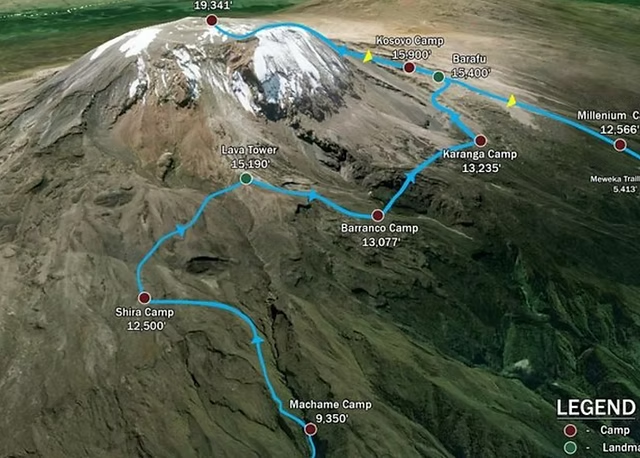
Route selection. Routes that include a genuine “climb high, sleep low” acclimatisation day specifically the Lava Tower day on Machame and Lemosho produce better outcomes than those that ascend more directly. The Northern Circuit’s comprehensive altitude profile at nine to ten days produces the best rates of all. Marangu on a five-day schedule produces the lowest rates of any commonly used route and itinerary combination.
Operator quality. The guide’s experience, training and pacing discipline have a direct relationship with summit outcomes. An experienced guide who sets and maintains an appropriate pace slower than most fit climbers would set themselves preserves energy and reduces the oxygen debt that triggers altitude sickness in the critical days before the summit. An inexperienced guide who allows clients to set their own pace, or who rushes stages to stay on schedule, spends down the acclimatisation bank that the itinerary has built.
Individual physiology. Altitude response is individually variable in ways that are not predictable from fitness, age or experience. Some climbers acclimatise efficiently and perform well above 4,500 metres; others have an inherent physiological response that makes extreme altitude difficult regardless of preparation. This factor cannot be controlled but can be managed the medical monitoring, Diamox option and flexible descent protocol that responsible operators maintain provide the safety net for climbers whose physiology creates difficulty.
Preparation and fitness. Physical preparation does not prevent altitude sickness but it affects the energy budget available to manage it. A fit climber facing moderate AMS at 4,600 metres has more physical reserve available for the summit push than an unfit one facing the same symptoms. Training also builds the psychological resilience the familiarity with sustained discomfort that helps on summit night when the rational brain is generating a compelling case for turning back.
How to Evaluate an Operator’s Claimed Rate
Ask five specific questions of any operator who quotes a success rate. First: to which point does the rate apply Stella Point or Uhuru Peak? Second: over what time period was the rate calculated and does it exclude the wet season? Third: what is the total number of attempts the rate is based on is it statistically meaningful? Fourth: is the rate calculated including all clients who began the attempt, including those who turned back before summit day? Fifth: can they provide the rate broken down by route and by itinerary length separately?
An operator who welcomes these questions and provides specific answers is one who tracks their performance with genuine attention. An operator who becomes defensive, provides vague answers or quotes a competitor’s rate is exhibiting a different relationship with performance data. The quality of the answers is more informative than the number itself.
Why Operators Underinvest in Success Rate Accuracy
The commercial incentive structure of the Kilimanjaro market does not reward accuracy in success rate reporting. An operator who reports a genuine seventy-eight per cent Uhuru Peak success rate on seven-day Lemosho climbs appears less impressive in a search result than one who claims ninety-five per cent without methodology. The climber who does not ask methodological questions takes the ninety-five per cent at face value and books accordingly.
The result is a market where the incentive for honest reporting is low and where genuinely high-performing operators those whose actual rates are in the eighty to eighty-five per cent range for properly designed itineraries are outcompeted in marketing by operators who are willing to be creative with the definition of “summit” or the selection of the comparison window. Informed clients who ask the right questions correct this market failure in a small but meaningful way.
Success Rates and the Turn-Around Decision
Understanding success rates also means understanding what a responsible turn-around decision looks like. The thirty to forty per cent of Kilimanjaro attempts that do not reach the summit are not all failures of preparation or operator management. A significant proportion are appropriate safety decisions made by guides who observed deteriorating symptoms and prioritised the climber’s health over the summit. A turn-around made at 5,000 metres because a climber was developing moderate to severe AMS is not a failed summit; it is the guide-client system working correctly.
Climbers who understand this, and who extend the same respect to a recommended turn-around that they would extend to a recommendation to continue, have made the conceptual shift that distinguishes a responsible mountaineer from someone treating Kilimanjaro as an endurance test to be completed at any cost. The summit is the goal; it is not the measure of whether the climb was worthwhile.
RYDER Signature’s Approach to Success Rates
We track summit success rates by route and itinerary duration for every climb our operators complete and review this data annually. Our rates for seven-day Lemosho and seven-day Machame itineraries are in the range that credible altitude medicine research suggests for well-managed climbs: consistently above seventy-five per cent, with our best guide teams producing rates above eighty per cent. We do not count Stella Point as a summit in our reporting and we do not exclude climbers who turned back before summit day from our denominator.
We share these figures with clients on request and explain the methodology. We also share the flip side: the circumstances in which our guides have turned climbers back and why. The turn-around data is as informative as the success data, and an operator who can discuss it with specificity and without defensiveness is demonstrating a genuine understanding of mountain medicine and responsible operations.
Does a higher success rate always mean a better operator?
Not necessarily. A very high claimed success rate above ninety per cent on a six-day route is more likely to reflect definitional or methodological inflation than genuinely exceptional performance. An operator with an eighty per cent Uhuru Peak rate on seven-day itineraries, verified by transparent methodology, is almost certainly outperforming an operator who claims ninety-five per cent without supporting data. The rate matters; the definition and methodology matter more.
Can I improve my personal success probability beyond what the operator provides?
Yes, meaningfully. Your choices route length, preparation quality, Diamox decision, pacing discipline, honest symptom reporting collectively affect your individual outcome within the range that the operator’s baseline provides. A climber who chooses a seven over a six-day itinerary, prepares with three months of hiking training, takes Diamox after medical consultation, and communicates honestly with their guide at every daily check is operating near the upper end of what preparation can achieve. The operator provides the infrastructure and expertise; the climber’s choices and behaviour determine where within that range the outcome falls.
What is a realistic success rate expectation for a first-time climber?
A first-time Kilimanjaro climber, of reasonable fitness, on a seven or eight-day route with a qualified operator, should have a realistic expectation of approximately seventy-five to eighty-five per cent probability of reaching Uhuru Peak. This is not a guarantee but it is an honest assessment of what the evidence supports for a well-prepared, well-managed attempt. The factors that most frequently push individual results below this range are itinerary length below seven days, individual physiological altitude sensitivity, and pacing decisions made against guide advice.
Is there any correlation between nationality or age and success rates?
The altitude medicine literature does not support any consistent nationality-based difference in altitude response. Individual physiology, preparation, itinerary quality and guide management are the significant variables, and these cross demographic categories without pattern. Age has a modest relationship with acclimatisation speed older climbers may acclimatise slightly more slowly but this is offset in most cases by the pacing discipline and psychological experience that older climbers typically bring. The oldest climbers RYDER Signature has supported on Kilimanjaro have outperformed companions many decades younger, and the youngest have sometimes struggled where experience would have made the difference.
The Role of Pacing in Summit Success
Of the factors within a climber’s direct control on the mountain, pacing is the most consequential and the most consistently mismanaged. Kilimanjaro’s standard routes are well within the aerobic capacity of most reasonably fit adults at sea level elevation. At altitude, however, the oxygen available for each stride is reduced, and the pace that feels comfortable that the aerobic system can sustain without accumulating oxygen debt is much slower than the pace a climber would set on a comparable gradient at home.
The consequence of ascending at an inappropriate pace is not just fatigue. Excessive exertion at altitude accelerates the development of AMS symptoms, increases heart rate beyond the range that efficient acclimatisation requires, and depletes the glycogen reserves that summit night demands. A climber who ascends each daily stage aggressively, arriving at camp faster than the guide recommends, may feel strong on days one through four and significantly underprepared for summit night. The energy debt accumulates before the most demanding section of the climb.
The pole pole principle Swahili for “slowly slowly” is not a cultural courtesy or a conservative safety margin. It is altitude physiology applied to pacing. A guide who sets a pace that feels almost insultingly slow to a fit climber on the lower mountain is calibrating to the altitude demands of the upper mountain, not the current gradient. The climbers who trust this calibration and resist the urge to push consistently outperform those who manage their own pace against the guide’s advice.
What a Failed Summit Attempt Actually Costs
The financial and logistical cost of a failed summit attempt is substantial and is rarely factored into the decision to choose a shorter, cheaper itinerary. A climber who does not summit on a first attempt and returns for a second typically spends more in total than they would have on a well-designed first attempt. The additional international flights, the park fees, the operator costs and the accommodation all repeat. More significantly, the preparation, the time away and the emotional investment all repeat.
The premium for a seven-day Lemosho over a six-day Machame typically USD 150 to 300 is trivial against the cost of returning to Tanzania for a second attempt. The premium for a quality operator over a budget one potentially USD 500 to 800 per person is similarly trivial against the same counterfactual. The economics of investing in the best-designed first attempt are overwhelming once the cost of failure is included in the comparison. This is the argument we make to every client who is tempted to optimise on price at the expense of itinerary quality: the cheaper option is frequently the more expensive one once probability is correctly accounted for.
Success Rates and the Operator Selection Decision
The most practical use of success rate information is as a screening tool in operator selection, not as a final ranking mechanism. An operator who cannot provide route-specific, methodology-transparent success rate data should be screened out of consideration. Among operators who provide this data credibly, the differences in rates reflect real but modest differences in guide quality and itinerary design the gap between the best and second-best operators on this metric is smaller than the gap between any honest operator and a dishonest one.
Once the irresponsible and deceptive operators are excluded, choose on the basis of the full evaluation criteria: guide qualification, crew welfare standards, medical equipment, pre-departure briefing quality, and the specific combination of route, duration and support that the operator recommends for your individual profile. The success rate, presented honestly, is one data point within this broader picture. It is the most prominently marketed number in the Kilimanjaro industry and among the least reliable when presented without methodology which makes understanding it correctly one of the most valuable things any prospective Kilimanjaro climber can do before they book.