How big is the Ngorongoro Crater is one of the most searched questions about the site, and the honest answer requires a few different numbers rather than one single figure, since diameter, floor area, depth and rim elevation each measure something genuinely different about the caldera’s scale. Most commonly cited figures put the crater at roughly 16 to 19 kilometres across at its widest point, with a floor area of approximately 260 square kilometres and walls rising 400 to 610 metres above the floor, though a small number of sources give a wider diameter figure closer to 22 kilometres depending on exactly where the measurement is taken along the rim’s irregular, non circular shape. This guide sets aside questions of formation and geology, covered elsewhere, to focus specifically on the numbers themselves and what they actually mean for someone trying to picture the place before arriving.
Diameter and why the figure varies slightly between sources
The crater is not a perfect circle, and its rim traces an irregular, somewhat oval shaped boundary rather than a uniform ring, which is the main reason different sources quote slightly different diameter figures depending on which axis across the crater they are measuring. A measurement taken across the widest north to south or east to west span can reasonably come out a few kilometres longer than one taken across a narrower axis, which explains why some sources describe the crater as 16 kilometres across while others describe it as 19 or even 22 kilometres, without either figure being simply wrong. For a visitor, the practical takeaway is that the crater floor takes roughly an hour and a half to cross by vehicle at the enforced speed limit, a useful sense of scale that matters more in practice than the precise diameter figure itself. That single fact, that a full crossing takes roughly ninety minutes without stopping, is usually a more useful planning number for a first time visitor than any of the more precise but harder to picture diameter or area figures quoted elsewhere.
Floor area in context
At approximately 260 square kilometres, the crater floor covers an area roughly comparable to a mid sized city, considerably smaller than the wider Serengeti National Park’s nearly 15,000 square kilometres, but large enough to support tens of thousands of resident large mammals without feeling visibly crowded from a vehicle on most days outside the busiest sighting clusters. To put the figure in a different frame of reference, 260 square kilometres is roughly the land area of a medium sized international airport city district, though unlike an urban area the crater floor is almost entirely open grassland, acacia woodland and a scattering of water sources rather than any form of built infrastructure.
Depth and the height of the walls
The crater’s walls rise between 400 and 610 metres above the floor depending on where along the rim the measurement is taken, a height frequently compared to famous tall buildings to give visitors an intuitive sense of scale, since 610 metres is more than one and a half times the height of the Empire State Building measured from its base to its roof. The rim itself sits at an elevation of approximately 2,286 metres above sea level at its highest points, while the floor below sits at around 1,800 metres, a genuine altitude difference that visitors notice both visually, in the dramatic drop from forested rim to open grassland, and physically, in the shift from cooler, sometimes misty rim conditions to a warmer floor once the descent is complete.
How Ngorongoro’s scale compares with the original volcano
Before its collapse roughly 2.5 million years ago, the volcano that eventually became Ngorongoro is estimated to have stood somewhere between 4,500 and 5,800 metres tall, a height that would have made it comparable to, and by some estimates taller than, the current summit of Kilimanjaro at 5,895 metres. The scale of today’s crater, though visually enormous to a visitor standing on the rim, therefore represents only the base remnant of a considerably larger original structure, the vast majority of which was lost during the collapse rather than eroded away gradually over geological time.
How the crater’s size compares with other African wildlife areas
Set against other well known wildlife destinations in East Africa, Ngorongoro’s 260 square kilometre floor is dramatically smaller than the roughly 1,510 square kilometre Maasai Mara National Reserve in Kenya, and smaller again than Amboseli National Park’s approximately 392 square kilometres, yet the crater consistently produces sighting rates that many experienced safari guides consider comparable to or better than either of these larger parks specifically because its wildlife is concentrated within such a compact, enclosed area rather than spread across open terrain. This compactness is precisely why a single day inside the crater can feel, in terms of density of sightings, disproportionate to how physically small the area actually is compared with the parks it is frequently compared against.
The crater floor versus the wider Ngorongoro Conservation Area
It is worth separating the crater floor’s 260 square kilometres from the much larger Ngorongoro Conservation Area surrounding it, which covers approximately 8,300 square kilometres in total, meaning the crater itself represents only around three percent of the protected area’s overall land. The remaining conservation area includes the Ngorongoro Highlands, the Empakaai and Olmoti craters, the Olduvai Gorge archaeological site, and the southern portion of the Ndutu plains where the wildebeest calving season plays out each year, all of which sit under the same conservation area authority but function as genuinely distinct landscapes from the main crater floor itself. A visitor who has only descended into the crater has therefore seen a comparatively small fraction of the conservation area’s total territory, even though the crater is by far the most visited single feature within it.
Wildlife density expressed in concrete terms
With an estimated 25,000 to 30,000 large mammals spread across 260 square kilometres, the crater floor supports a density in the broad region of 100 large animals per square kilometre, a genuinely exceptional figure by the standards of African wildlife areas, most of which support wildlife at densities an order of magnitude lower across their far larger total areas. This concentration is the direct product of the crater’s compact scale combined with permanent water sources that do not depend on seasonal rainfall the way many other ecosystems do, allowing the floor to sustain a resident population at a density that would be impossible to maintain across a similarly sized area without the crater’s specific enclosed geography and reliable water supply.

Visual comparisons to help picture the scale
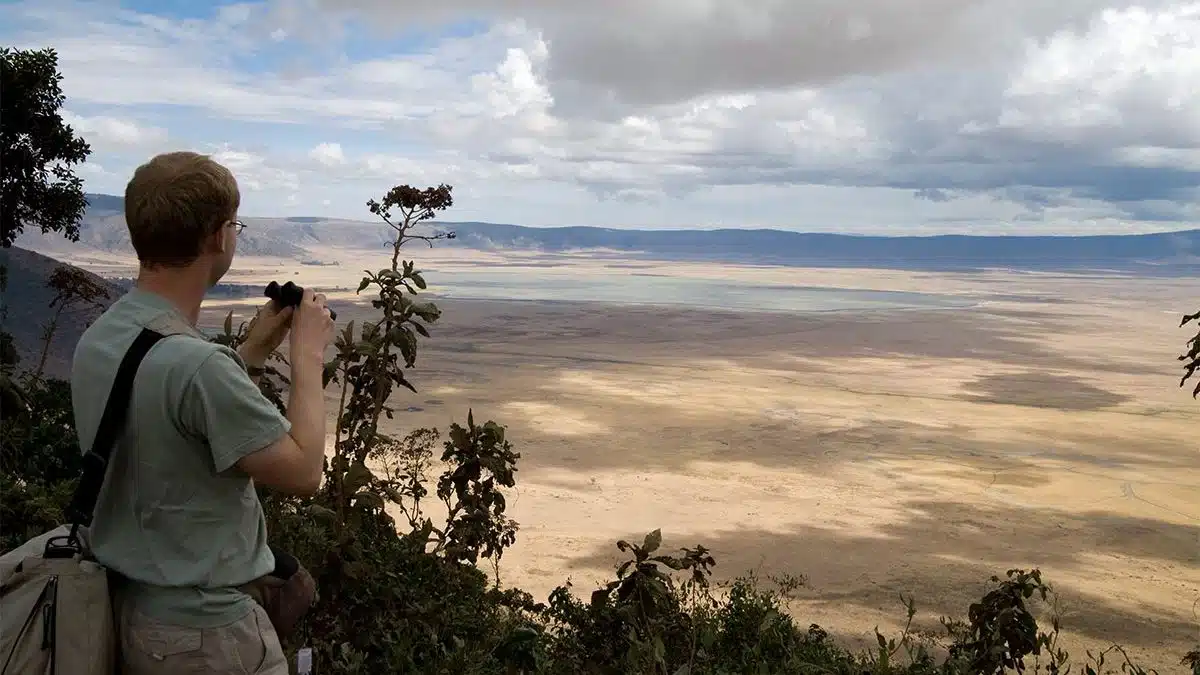
For a visitor trying to picture 260 square kilometres in more familiar terms, the crater floor is roughly comparable in area to the island of Manhattan multiplied by nearly five, or to a square measuring approximately sixteen kilometres on each side, a scale large enough to comfortably contain a mid sized town and its surrounding farmland, yet small enough that a driver guide can reach almost any point on the floor from either descent road within forty five minutes to an hour. The crater wall, at up to 610 metres high, is tall enough that a visitor standing on the rim looking down is viewing the floor from roughly the height of a sixty storey building, a genuinely dramatic vertical drop rarely matched at any other wildlife viewing site in Africa.
How long it actually takes to see
A full circuit of the crater floor’s main game viewing tracks, without stopping for extended sightings, takes a driver guide familiar with the terrain somewhere in the region of an hour and a half to two hours at the enforced 25 kilometre per hour speed limit, though in practice no visit proceeds without frequent stops, meaning the typical five to six hour game drive covers only a portion of the full floor’s track network in any single visit. This is one reason experienced guides tend to plan a route toward specific zones, such as the Lerai forest near the descent road or the areas around Lake Magadi, rather than attempting to cover the entire floor in one session, since the crater’s compact size can create a false impression that everything is within easy reach when in practice a thorough single day visit still requires deliberate route planning.

How the measurements are actually taken
Modern figures for the crater’s diameter, floor area and wall height come primarily from satellite imagery and aerial survey data rather than ground based measurement, a considerable improvement over the estimates made by early twentieth century surveyors working with theodolites and manual triangulation from the rim. Satellite derived digital elevation models allow researchers to measure the crater’s irregular rim with far greater precision than was possible even a few decades ago, which is part of the reason more recent sources tend to converge on the 260 square kilometre floor area figure and the 16 to 19 kilometre diameter range, even though slightly older or less rigorously sourced material sometimes still circulates with the wider 22 kilometre figure attached to it.
What the scale means for choosing a rim lodge
The crater’s compact floor also has a direct bearing on which rim lodge makes sense for a given stay, since every property on the rim is separated from the descent gates by a road distance measured in single digit kilometres rather than the hour long transfers common at Serengeti camps positioned deep inside a much larger park. A lodge on the western rim near the Seneto descent road sits closer to that gate than one positioned on the eastern side near Lemala, a genuinely small difference in absolute distance given the crater’s overall size, but one that can still shift a pre dawn departure time by twenty or thirty minutes, worth factoring in for anyone specifically trying to beat the bulk of the day’s vehicles onto the floor.
Why the numbers matter for planning a visit
Knowing the crater’s actual scale helps set realistic expectations before a visit. A floor of 260 square kilometres, while enormous by ordinary standards, is genuinely small enough that the same handful of well known sightings, a particular lion pride, a black rhino sighting, a large elephant bull, tend to draw the bulk of visiting vehicles on any given day, which is the underlying reason for the vehicle clustering problem some visitors report at the crater’s best known sightings. Understanding the crater’s compact scale relative to its enormous wildlife density is the single most useful piece of context for anyone deciding how much time to allocate to a visit and what kind of experience to realistically expect once inside. A traveller expecting a Serengeti scale landscape, where a single vehicle can drive for an hour without encountering another, is likely to be surprised by how quickly a busy morning at Ngorongoro can feel comparatively crowded, simply because the same wildlife density that makes the crater so rewarding also concentrates every visiting vehicle into a genuinely small, enclosed space rather than spreading them across open country. Recognising this trade off before arrival, rather than discovering it mid visit, is the most practical benefit of understanding the crater’s true scale in the first place.