Questions to Ask Your Operator Before a Serengeti Safari before paying a deposit fall into a shorter, more specific list than most first time travellers expect, and the answers matter more than the glossy photography on any given website. Tanzania’s safari industry has no shortage of skilled, properly licensed companies, but it also has resellers with no ground presence, unlicensed brokers borrowing another company’s credentials, and operators who quote a low headline price while leaving out costs that surface only after the deposit has cleared. The questions below are the ones a knowledgeable traveller, or an experienced guide advising a friend, would actually ask before committing to a Serengeti itinerary.
Ask for the operator’s TALA licence number directly
Tanzania requires every company running tours, treks or vehicle hire to hold a licence issued through the Ministry of Natural Resources and Tourism, commonly referred to in the industry as a TALA licence (the Tourist Agents Licensing Authority framework). This is the legal permission to operate as a tour company in Tanzania, and it is not the same as a general business registration certificate, which only confirms a company name exists, not that it is authorised to run safaris. A genuine operator provides their licence number without hesitation. Reluctance, vague answers, or a claim that the licence is “in process” is a serious warning sign, particularly for a company asking for a large upfront deposit.
There is no single public online database where this can be instantly verified, which is precisely why asking directly matters. A traveller can also check whether the company appears on the membership list of the Tanzania Association of Tour Operators, known as TATO, which is a further sign of an established, accountable business, though TATO membership on its own does not replace the legal requirement for a TALA licence.
Ask exactly which camps are included, not just which zone
A quote that reads “three nights in the Serengeti” without naming the camp is not yet a firm itinerary. The Serengeti is roughly the size of Massachusetts, and central Seronera, the Western Corridor, the Ndutu area in the south and Kogatende in the north offer genuinely different experiences depending on the month. A camp named in advance can be checked independently: its location, its guest reviews, whether it has a permanent structure or moves seasonally, and whether it matches the wildlife the traveller actually wants to see. Operators sometimes leave camp names vague in early quotes so they can substitute a cheaper property later without technically breaking the agreement. Naming the camp in writing closes that gap.
Ask which sector the itinerary covers and why that sector was chosen for the travel dates
A good operator explains, unprompted, why a given sector suits the specific week of travel. If the trip falls in February, an operator should be steering the itinerary toward Ndutu in the southern Serengeti for the calving season. If it falls in August, the conversation should turn north toward Kogatende for the Mara River crossings. An operator who proposes the same central Seronera itinerary regardless of month either has not checked the calendar closely or is defaulting to whichever camp gives them the easiest commission, and it is worth asking the question directly rather than assuming the itinerary has already accounted for seasonal movement.
Ask about vehicle type and maximum group size
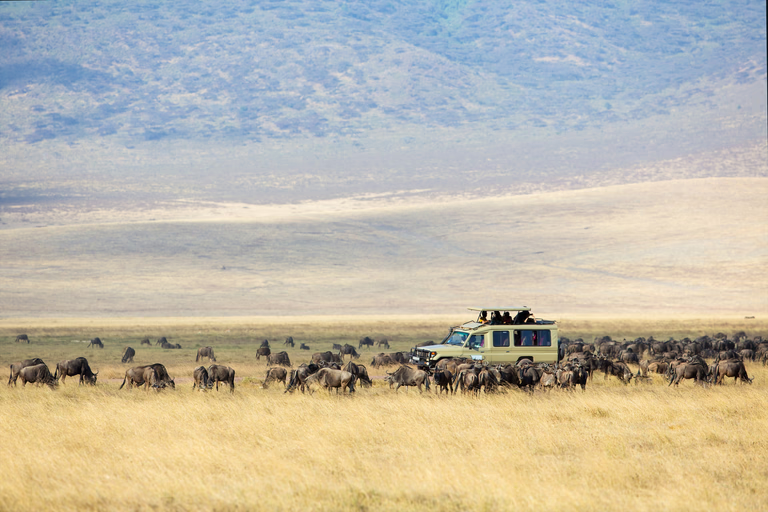
Serengeti game drives happen almost entirely from the vehicle, so the vehicle itself shapes the whole day. A properly equipped 4×4 with a pop up roof allows standing photography and better visibility over long grass; a closed saloon car does not belong in the park at all, though it occasionally still appears on the cheapest budget quotes. Ask how many guests will share the vehicle. A private vehicle for one travelling party gives full control over pacing and stops; a shared vehicle with strangers on a fixed group departure is cheaper but means compromises on timing that some travellers mind and others do not. Neither is wrong, but the traveller should know which one they are booking.
Ask about the guide’s certification level and years of experience
Tanzania’s guide certification system runs through tiers broadly described as Bronze, Silver and Gold, reflecting increasing years of field experience, training and examination. A guide with genuine multi year experience in the specific sector being visited reads tracks, anticipates predator behaviour and knows which side tracks lead to sightings that a newly qualified guide simply has not learned yet. It is entirely reasonable to ask an operator how many years their assigned guide has worked in the Serengeti specifically, rather than East Africa generally, since experience in one country’s parks does not automatically transfer to fluency in another.
Ask exactly what is included and what is not
Park entry fees, government levies, all meals, laundry, house wine and spirits, airport transfers and twice daily game drives are included at most established camps, but the details vary enough between operators that assuming anything is risky. Balloon safaris, premium spirits, spa treatments and private vehicle supplements are commonly excluded even at high end properties. Ask specifically whether the TANAPA park entry fee and the concession fee, where relevant, are already built into the quoted price or added separately on arrival. A quote that looks unusually low compared to competitors is often missing one of these line items rather than genuinely cheaper.
Ask about the cancellation policy and what happens if the migration is elsewhere
Wildlife does not follow a printed schedule, and no honest operator promises a guaranteed river crossing or a guaranteed pride sighting on a specific date. What can be promised is a sector chosen on the best available seasonal pattern, and a fair, clearly written cancellation and rescheduling policy in case of illness, flight disruption or a family emergency. Ask what the refund structure looks like at ninety days, thirty days and inside two weeks of departure, and get the answer in writing rather than relying on a verbal assurance made during a sales call.
Ask how medical emergencies and evacuation are handled
Camps in remote sectors of the Serengeti, particularly the Western Corridor and Kogatende, are genuinely far from the nearest hospital. Ask whether the operator arranges membership with a flying doctor evacuation service, commonly AMREF Flying Doctors in East Africa, and whether that cost sits inside the safari price or requires separate travel insurance with medical evacuation cover written into the policy. This is not a theoretical question. Snake bites, falls, altitude related issues after a Ngorongoro or Kilimanjaro add on, and ordinary medical emergencies unrelated to the safari itself all happen, and the response time depends entirely on whether an evacuation plan already exists before it is needed.
Ask where the payment is going
A deposit or final balance should be paid into a company bank account bearing the operator’s registered business name, never into a personal account, regardless of how convincing the individual sounds. Ask for the company’s bank details in writing on headed correspondence rather than a casual message, and cross check the account name against the company’s registration. This single check catches a meaningful share of the safari booking scams reported each year, most of which involve either an unlicensed entity or a legitimate sounding individual asking for payment outside proper company channels.
Ask how the operator handles a change in weather or road conditions
Long rains, typically falling between March and May, can make black cotton soil tracks around Ndutu and parts of the Western Corridor genuinely difficult to pass, occasionally closing specific routes for days at a time. Ask what the contingency plan looks like if a planned camp becomes inaccessible, and whether the guide has the authority to adjust the day’s route without needing sign off from an office hours away. Operators with their own vehicles and guides on the ground, rather than resellers subcontracting to a third party, tend to answer this question with far more specific detail, because they have actually managed the problem before.
Ask how internal transfers between sectors actually work
A Serengeti itinerary that moves between more than one sector, for example a few nights in Ndutu followed by a few nights near Kogatende, involves either a long road transfer of several hours across the park or a short scheduled flight between bush airstrips. Ask which method the itinerary uses, how long the road transfer genuinely takes given current road conditions, and if a flight is involved, which carrier operates it and what the luggage allowance is. Soft sided bags are required on almost all light aircraft serving Serengeti airstrips, and a traveller who packs a rigid suitcase without being warned in advance sometimes arrives at the airstrip to find it will not fit in the hold. A competent operator raises this before it becomes a problem rather than after.
Ask about single traveller pricing and room configuration
Most Serengeti camps price accommodation per person based on double occupancy, and a single traveller is usually charged a supplement on top of the per person rate rather than half the double rate. This supplement varies considerably between camps and seasons, and some properties waive it entirely during quieter months as an incentive to fill beds. Ask for the exact single supplement in writing before assuming a quoted per person price applies regardless of how many people are travelling. The same applies to families or friends travelling together who want to know whether a quoted rate assumes two people sharing a tent or genuinely reflects the room configuration requested.
Ask what happens between the deposit and departure
A firm deposit should be followed by a specific communication plan, not silence until a week before departure. Ask when the final, confirmed itinerary with named camps, guide details and vehicle registration will be issued, and how far in advance of travel any changes will be communicated. Established operators typically confirm final details somewhere between four and eight weeks before arrival, updated for any late seasonal shifts in wildlife movement, and provide a direct contact number for the ground team in Tanzania rather than only a head office abroad. A traveller who has this contact information well before departure has a genuine point of escalation if something changes at short notice, rather than discovering only on arrival that no one locally is expecting them.
What a strong answer sounds like versus a weak one
A strong operator answers each of these questions specifically, by name, number or written policy, without hesitation and usually before being asked. A weak operator answers in generalities: “we work with the best camps,” “our guides are very experienced,” “don’t worry, everything is included.” Vague reassurance is not the same as a verifiable fact, and a traveller who insists on the latter before paying a deposit avoids the overwhelming majority of problems that arise on Tanzania safaris booked in a hurry. None of these questions are unusual or difficult for a properly licensed, established operator to answer, and any hesitation in response to them is itself useful information.