A fly-in safari to the Serengeti replaces hours of rough road travel with a short domestic flight, typically landing at one of the park’s several bush airstrips rather than a single central airport. The process starts with an international arrival into Kilimanjaro International Airport or, increasingly, a direct connection from Zanzibar, followed by a domestic flight on a small aircraft carrying nine to thirteen passengers, and ends with a 4×4 transfer from the airstrip to camp. Understanding how each stage actually works, including the strict luggage rules that catch most first time visitors off guard, makes the difference between a smooth arrival and an unnecessarily stressful one.
The Route From International Arrival to the Serengeti
Most fly-in itineraries begin at Kilimanjaro International Airport, near Arusha, where international flights land and domestic connections to the Serengeti depart from a separate, much smaller terminal. Travellers arriving from Zanzibar increasingly skip Arusha entirely, with daily scheduled flights connecting Zanzibar directly to Serengeti airstrips such as Seronera in the centre of the park and Kogatende in the north, cutting out an overland or connecting leg altogether. For guests arriving via Dar es Salaam, a direct flight to the Serengeti of roughly two hours is also available on some routes, again avoiding an Arusha connection.
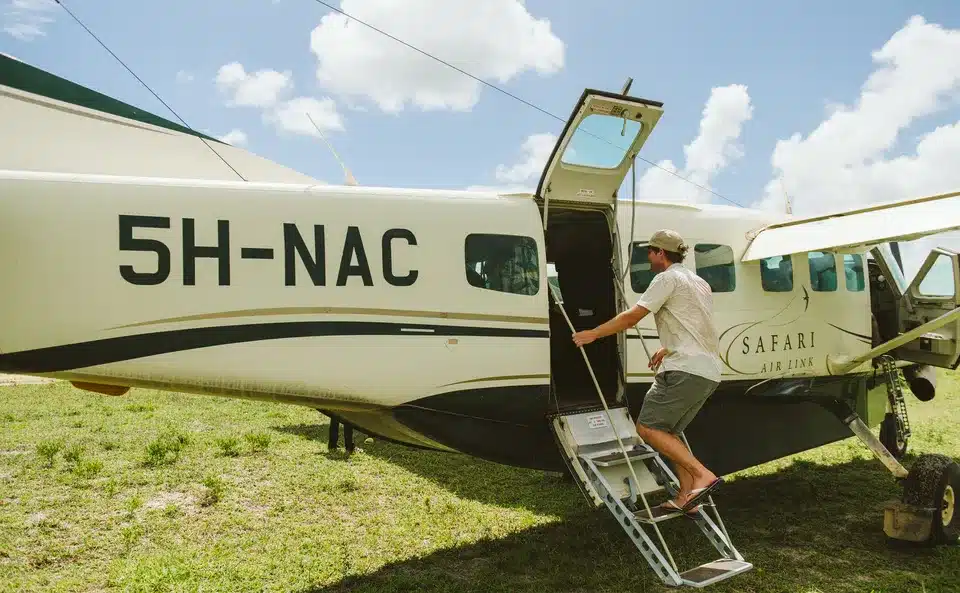
Regional flights are operated by a handful of established charter airlines, including Coastal Aviation, Air Excel, Auric Air, Flightlink and Regional Air, generally flying Cessna Grand Caravans seating nine to thirteen passengers. These are scheduled flights that call at multiple airstrips along a set route, meaning a flight from Arusha to a specific Serengeti camp’s nearest airstrip may include one or two intermediate stops at other airstrips to drop and collect other passengers, a detail worth knowing in advance so the total journey time is not judged solely by direct flying time between two points.
Which Airstrip a Guest Lands At
The Serengeti’s scale, more than 14,750 square kilometres, means there is no single airport serving the whole park. Instead, airstrips are scattered across the different zones, and which one a guest flies into depends entirely on where their camp is located. Seronera airstrip, in the centre of the park, serves camps around the Seronera valley and is the busiest and most frequently served strip given central Serengeti’s year round popularity. Kogatende airstrip, in the far north near the Mara River, serves camps positioned for the July through October migration season. Lake Manyara airstrip, further south near the edge of the Ngorongoro Conservation Area, typically serves itineraries combining the Serengeti with Ngorongoro and Lake Manyara National Park on a single circuit.
A travel designer or safari operator books the specific flight routing based on the confirmed camp, so this is not usually a decision a guest makes independently, but it is worth confirming which airstrip is booked and how far the subsequent road transfer to camp will take, since transfer times from an airstrip to a lodge or camp can range from fifteen minutes to well over an hour depending on the property’s exact location within its zone.

Booking a Charter Flight Step by Step
For most guests, the domestic flight is arranged by whichever operator or agent is handling the wider safari booking, rather than booked independently the way an international flight would be. The sequence typically runs: the operator confirms camp bookings first, then works out the airstrip nearest each property, then books scheduled flights on the appropriate route and date, coordinating timing so a guest’s arrival flight lands with enough daylight remaining for the road transfer and, ideally, an afternoon game drive on arrival day rather than a late arrival straight to camp.
Private charter is available as an alternative to scheduled flights for guests wanting to avoid multiple stops or fly on a schedule not matched by the standard daily routes. A private charter costs meaningfully more than a seat on a scheduled flight but offers a direct routing to any airstrip at any time during daylight hours, without the intermediate stops a scheduled flight often makes. This is worth considering specifically for a group combining several destinations in a short trip, where the cumulative time lost to multiple scheduled-flight stops would otherwise eat significantly into time actually spent on safari.
Luggage Rules That Catch First Time Visitors
The single most common surprise for first time fly-in safari guests is the luggage weight limit, strictly enforced at 15 kilograms per person across nearly all Tanzania domestic charter operators, and this figure typically includes hand luggage, camera bags, coats and even shoes carried onto the aircraft rather than only checked baggage. Hard-sided suitcases, particularly those with wheels or rigid frames, are generally not accepted at all, since ground crews must fit all guest luggage into small belly pods beneath the aircraft’s cabin, and a flexible, soft-sided duffel bag is the only practical shape that fits this storage space securely.
Guests arriving with standard international luggage typically resolve this by leaving the bulk of it in secure storage at a hotel in Arusha, Zanzibar or wherever their trip begins, packing only what is needed for the safari itself into a soft duffel well under the weight limit, and collecting the rest on return before an international departure. Most reputable safari operators either arrange this storage directly or can recommend a hotel that offers it as standard practice, so this is worth raising during initial trip planning rather than discovering the restriction for the first time at the domestic check-in counter.
What the Flight Itself Is Like
Bush planes flying into the Serengeti are unpressurised, fixed under-carriage aircraft designed specifically for short take-offs and landings on the park’s dirt airstrips, and the cabin experience reflects that purpose rather than a commercial airline’s comfort standards. Flights are noisier and more affected by turbulence than a larger pressurised aircraft, and because the planes fly at relatively low altitude, temperature inside the cabin can be cooler than expected, making a light layer worth having accessible rather than packed away in checked luggage. There is no room to move around once airborne and no under-seat storage, so anything needed during the flight, water, sunglasses, entertainment, needs to be within reach before boarding rather than retrieved from a stowed bag mid-flight.
Scheduled flight times can shift slightly from what appears on final trip documents, and camp staff typically relay any last minute changes the evening before departure rather than leaving guests to discover a change at the airstrip itself. Passengers who stay flexible about minor timing adjustments, rather than treating the printed schedule as fixed, generally find the process runs more smoothly, since bush flight scheduling has more built in flexibility than a commercial airline timetable by design.

Arrival and the Transfer to Camp
On landing, a Serengeti airstrip is typically a single dirt runway with a small shelter rather than a terminal building, and a guest’s camp driver-guide meets the flight directly at the strip, usually identifiable by the camp’s name on a vehicle or sign. The transfer from airstrip to camp happens in an open-sided 4×4 safari vehicle, and because many airstrips sit within or very close to prime wildlife areas, this transfer frequently doubles as the first game drive of the trip, with the guide stopping for sightings encountered along the direct route to camp rather than treating the drive purely as transport.
For a morning arrival, most itineraries build in time for lunch and a rest period at camp before an afternoon game drive, while an early afternoon arrival often flows straight into a game drive on the way in or shortly after settling into camp. Combining several airstrips within a single Serengeti trip, flying into one zone and departing from another after a road safari between camps, is a common way to cover more than one part of the park without doubling back over the same ground, and is worth discussing with a travel designer when planning a longer, multi-camp itinerary.
What a Fly-In Safari Costs Compared to Driving
Domestic flights within Tanzania’s safari circuit are priced per sector and per passenger, and a multi-leg fly-in itinerary covering several parks typically adds a meaningful amount to a trip’s total cost compared with a road-based safari covering the same ground by vehicle. In exchange, flying removes several hours, sometimes most of a full day, of rough, dusty driving on unpaved roads between parks, time that a road safari spends in transit rather than on game drives. For a trip of seven days or fewer, this trade-off usually favours flying, since road transfer time consumes a disproportionate share of a short itinerary. For a longer trip of ten days or more, a mix of flying between distant zones and driving between closer ones, such as the Serengeti and Ngorongoro, often balances cost against convenience more efficiently than flying every single leg.
Park entry fees, conservation fees and any government taxes are generally not included in the domestic flight price itself and are billed separately as part of the overall safari package, so a fly-in quote should be read alongside the full itinerary cost breakdown rather than assessed as a standalone figure.
Flying With Children and Larger Groups
Bush planes have limited seating capacity, and larger families or groups of six or more travelling together sometimes need to be split across two flights on the same route rather than seated together on one aircraft, particularly during peak season when scheduled flights are already carrying other passengers. Discussing group size with a travel designer well in advance allows this to be planned for, either by booking a private charter that guarantees everyone flies together or by confirming in advance that a scheduled flight has enough remaining capacity for the whole party on the same departure.
There is no minimum age restriction for domestic flights themselves, unlike the age restrictions that apply to activities such as balloon safaris, though the same 15 kilogram luggage limit applies per passenger regardless of age, which is worth factoring into packing plans for a family bringing separate bags for children.
Planning a Fly-In Trip for December 2026 or 2027
Fly-in safari capacity, particularly on the most popular routes serving Seronera and Kogatende, is limited by aircraft size and daily flight frequency, and demand rises sharply around the December calving season build up and the July through October migration window. Booking flights well ahead of a December 2026 or 2027 migration season trip, at the same time camps are confirmed rather than afterward, avoids the situation where accommodation is secured but the connecting flight on the preferred date is already full. Confirming the exact airstrip tied to each confirmed camp, and the realistic transfer time from that strip, is worth doing explicitly during planning so arrival day expectations match reality on the ground rather than being discovered for the first time once the plane has already landed and the transfer vehicle is waiting.