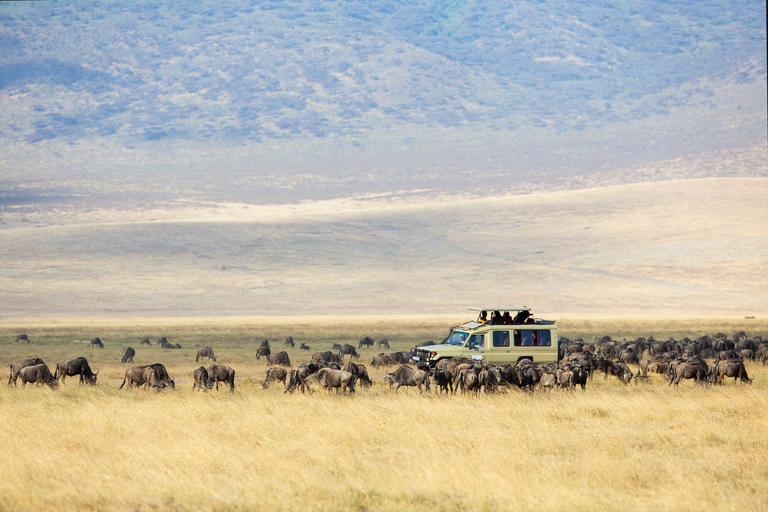
What makes the Serengeti ecosystem unique in the world is not simply that it is large or wildlife rich, since several other protected landscapes can claim both of those qualities, but that a specific combination of scale, connectivity and predator density exists here that genuinely has no equal anywhere else on Earth, and comparing the Serengeti directly against the other famous names travellers naturally measure it against makes this clearer than describing the park in isolation.
The migration itself has no real equivalent
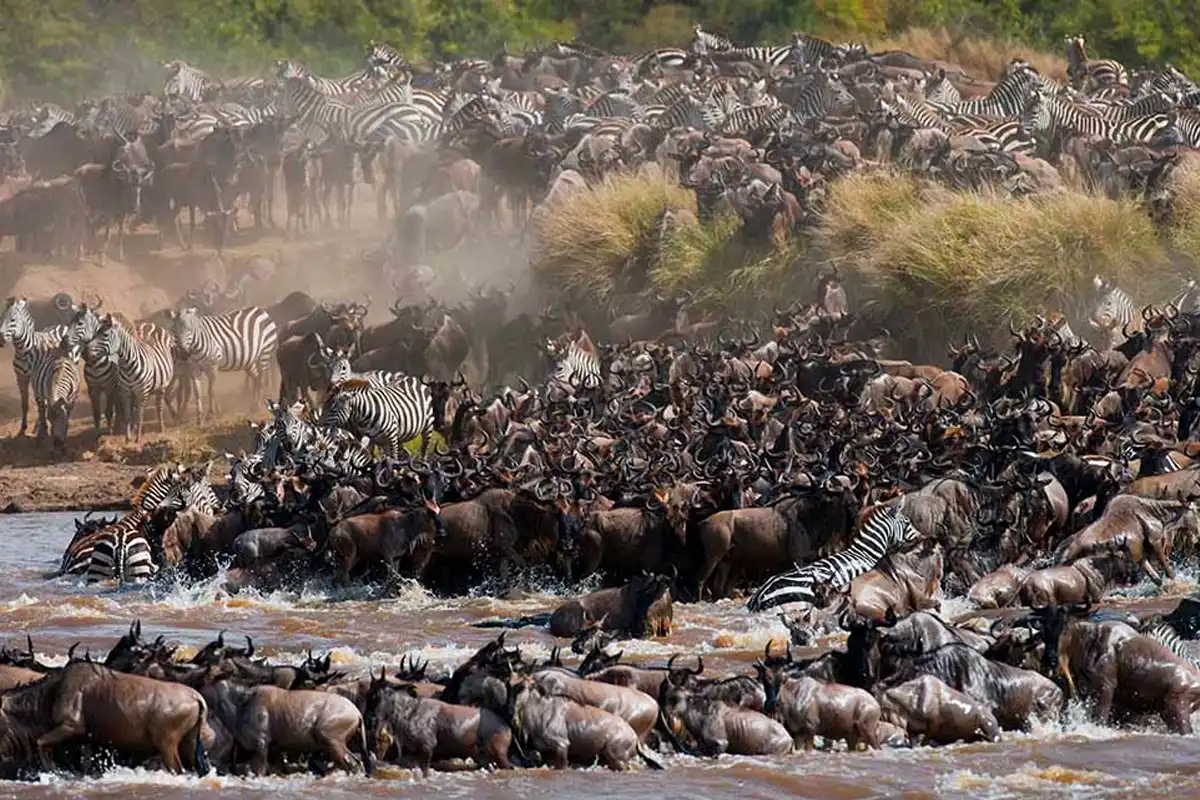
Large animal migrations exist elsewhere. North America’s Porcupine caribou herd migrates over similarly vast distances in the Arctic, and other wildebeest and antelope populations move seasonally across parts of southern Africa. What sets the Serengeti migration apart is the sheer number of animals moving as a single interconnected system rather than in separate, smaller herds. Estimates of the migratory wildebeest population have varied depending on methodology, with older figures citing well over a million animals and more recent satellite based counts suggesting closer to 600,000, but even at the more conservative end of that range, the combined movement of wildebeest, zebra and gazelle across the Serengeti Mara ecosystem each year remains the largest single mass movement of large land mammals anywhere on the planet, and it is followed continuously by one of the most complete predator populations left in existence, rather than migrating through a landscape where predators have been reduced or removed.
It remains genuinely unfenced, which most comparable parks are not
This is arguably the single most important difference between the Serengeti and its closest rivals for scale and fame. Kruger National Park in South Africa, for decades fully fenced along its western boundary, has only in recent years opened sections of that boundary into neighbouring private reserves as part of the Greater Kruger initiative, and much of its perimeter remains closed to wildlife movement. Yellowstone in the United States, though vast by American standards, is an island of protected land surrounded by private ranchland, roads and townships that block the kind of continent scale movement migratory species would otherwise undertake. The Serengeti, by contrast, connects without a fence line into Kenya’s Maasai Mara to the north, and its wildlife moves across that international boundary each year exactly as it always has. Very few ecosystems of comparable fame anywhere in the world retain this level of open, functioning connectivity between two entire countries’ protected areas.
Predator density that few places can match
According to UNESCO’s own assessment supporting the Serengeti’s World Heritage status, the ecosystem sustains the highest concentration of large predators anywhere in the world, alongside the greatest density of plains ungulates. This is a direct consequence of the volcanic soils beneath the eastern plains, deposited by the Ngorongoro highlands’ volcanic activity over hundreds of thousands of years, which produce unusually mineral rich, high protein grasses. Kruger and the wider southern African bushveld, by comparison, generally support lower grazing densities per square kilometre because the underlying soils are less consistently fertile across such a large area, and their predator populations, while healthy, do not reach the same concentration.

One of the oldest continuously functioning ecosystems on Earth
The Serengeti is frequently described by researchers as one of the oldest ecosystems in the world in its current form, meaning the basic pattern of rainfall, grass growth and animal movement that defines it today has operated largely unchanged for over a million years, predating most of the national parks and reserves it is now compared against by an enormous margin. Yellowstone’s ecosystem has been substantially altered by predator extermination and reintroduction programmes within the last century, most famously the removal and later reintroduction of wolves, while Kruger’s modern ecological management is a comparatively recent, actively engineered system built around fencing, culling programmes and artificial water points that have shifted repeatedly over the past several decades. The Serengeti’s basic ecological rhythm, by contrast, has needed remarkably little active management to sustain itself, because the system that produces it, seasonal rainfall driving grass growth which in turn drives herbivore movement, has simply kept functioning on its own terms since long before conservation as a concept existed.
Scale that still surprises first time visitors
The Serengeti National Park alone covers approximately 14,750 square kilometres, and the wider ecosystem, including the Ngorongoro Conservation Area, Maswa Game Reserve, several Game Controlled Areas and the Maasai Mara across the Kenyan border, extends to roughly 1.5 million hectares in total. This is comparable in scale to the entire state of Connecticut, and considerably larger than most protected areas visitors will have encountered elsewhere, including well known reserves in southern and East Africa that are frequently marketed with similarly grand language despite being a fraction of the size.
Why the comparison matters for travellers, not just ecologists
Understanding these differences helps explain why a Serengeti safari looks and feels different from a safari in a smaller, fenced or more actively managed reserve elsewhere. Wildlife here moves according to rainfall and grazing rather than being concentrated by fencing or artificial water points, which means sightings depend far more heavily on knowing which zone the animals are currently occupying in a given month than in a smaller, bounded park where game is more predictably found in the same areas year round. It also means the sense of scale visitors describe after visiting, the feeling of genuinely open horizon with no fence line in sight, is not a marketing description but an accurate reflection of one of the only ecosystems left of this size still functioning without one.
What the comparison does not mean
None of this is intended to diminish other celebrated ecosystems. Kruger and its surrounding private reserves offer exceptional Big Five viewing and, in the fenced sections, a level of predictability the Serengeti cannot match, which suits travellers on tighter schedules who want reliable sightings within a compact area. Yellowstone remains an extraordinary example of large scale ecosystem restoration achieved through deliberate human intervention, which is a genuinely different kind of achievement from the Serengeti’s largely self sustaining system. The point of comparison is simply to explain, in concrete terms, what specifically distinguishes the Serengeti from these other well known landscapes, rather than to suggest it is superior in every respect.
The Serengeti is not the same thing as the Maasai Mara, even though they are one ecosystem
A distinction worth making clearly, since it confuses many first time visitors, is that the Serengeti and Kenya’s Maasai Mara are technically part of a single continuous ecosystem, connected by the same migrating herds crossing the same unfenced border, yet they are managed as entirely separate protected areas under two different national governments and two different sets of park rules. The Mara covers a much smaller area than the Serengeti, roughly 1,500 square kilometres against the Serengeti’s 14,750, and its wildlife density during the migration season is correspondingly more concentrated, since the same number of animals passing through is compressed into a far smaller space for the months they are present. This is precisely why so much of the most dramatic river crossing photography associated with the wider ecosystem originates from the Mara side of the border rather than the Serengeti side, despite both parks technically hosting the same migrating population at different points in the year.
The scientific history behind the Serengeti’s protection
The Serengeti’s current legal protection owes a great deal to the German born zoologist Bernhard Grzimek and his son Michael, who spent years in the 1950s conducting aerial surveys of the migration and using the resulting data to argue for the national park’s boundaries to be drawn around the full extent of the migratory route rather than a smaller, more convenient area. Their book, published under the English title Serengeti Shall Not Die, became an internationally influential argument for large scale ecosystem protection rather than protecting isolated, smaller reserves, and it directly shaped the boundaries of the park as it exists today. This history matters because it explains why the Serengeti’s protected area is drawn the way it is, following the migration’s actual range rather than more arbitrary administrative lines, a rationale not every comparably famous protected area in the world can claim.
Comparing scale with other biome types entirely
Placing the Serengeti’s migration alongside migrations in entirely different biomes helps illustrate quite how unusual its scale is. The Amazon basin, despite its vastly greater biodiversity in terms of species count, has no equivalent mass movement of large mammals of this kind, since its dense forest structure does not support the open grassland conditions such migrations depend on. The tundra migrations of North America’s caribou herds move impressive distances, in some cases exceeding what Serengeti wildebeest travel annually, but involve nowhere near the same total biomass moving as a single system, nor the same density of large predators following that movement continuously throughout the year. Very few ecosystems on the planet combine grassland scale, rainfall driven seasonality, and an intact top down predator structure in the same single, continuously functioning system, which is ultimately the most precise way to describe what makes the Serengeti specifically, rather than generally, unique.
The soil chemistry behind the numbers
The productivity underlying all of this traces back to a specific and somewhat unusual geological feature: ash deposited by volcanic eruptions from the Ngorongoro highlands over hundreds of thousands of years settled across the eastern Serengeti plains, creating soils unusually rich in calcium and other minerals that grasses readily absorb. This is why the short grass plains around Ndutu and the eastern Serengeti, rather than the taller grass areas further west, are where the vast majority of wildebeest calving takes place each year; the grass there carries a nutritional value that supports the intense energy demands of late pregnancy and early lactation in a way that grasses growing on less mineral rich soils elsewhere cannot match. Few other savanna ecosystems in the world sit on a comparable geological base, which is part of why attempts to compare the Serengeti’s carrying capacity directly with superficially similar grassland ecosystems elsewhere often understate quite how unusual the underlying soil conditions actually are.
Why none of this can simply be replicated elsewhere
A frequent question from visitors familiar with other African parks is why a similar migration has not been established or encouraged in a comparable landscape elsewhere on the continent. The honest answer is that this specific combination, volcanic soil chemistry, a rainfall pattern producing genuinely seasonal but predictable grazing gradients across an enormous connected area, and cross border political cooperation allowing wildlife to move unimpeded between two sovereign nations, cannot be engineered into an existing landscape after the fact. It depends on geological and climatic conditions that took hundreds of thousands of years to form, combined with a specific twentieth century conservation and diplomatic history between Tanzania and Kenya that allowed the border between the two countries’ protected areas to remain open. This is ultimately why the comparisons drawn earlier with Kruger and Yellowstone are comparisons of different achievements rather than a ranking: those ecosystems were shaped, protected and in places actively engineered by deliberate human management decisions, where the Serengeti’s defining qualities are largely the product of geological and climatic accident that conservation policy has simply chosen, wisely, not to interfere with.