Try: Serengeti · Kilimanjaro Lemosho · Zanzibar · Family Safari
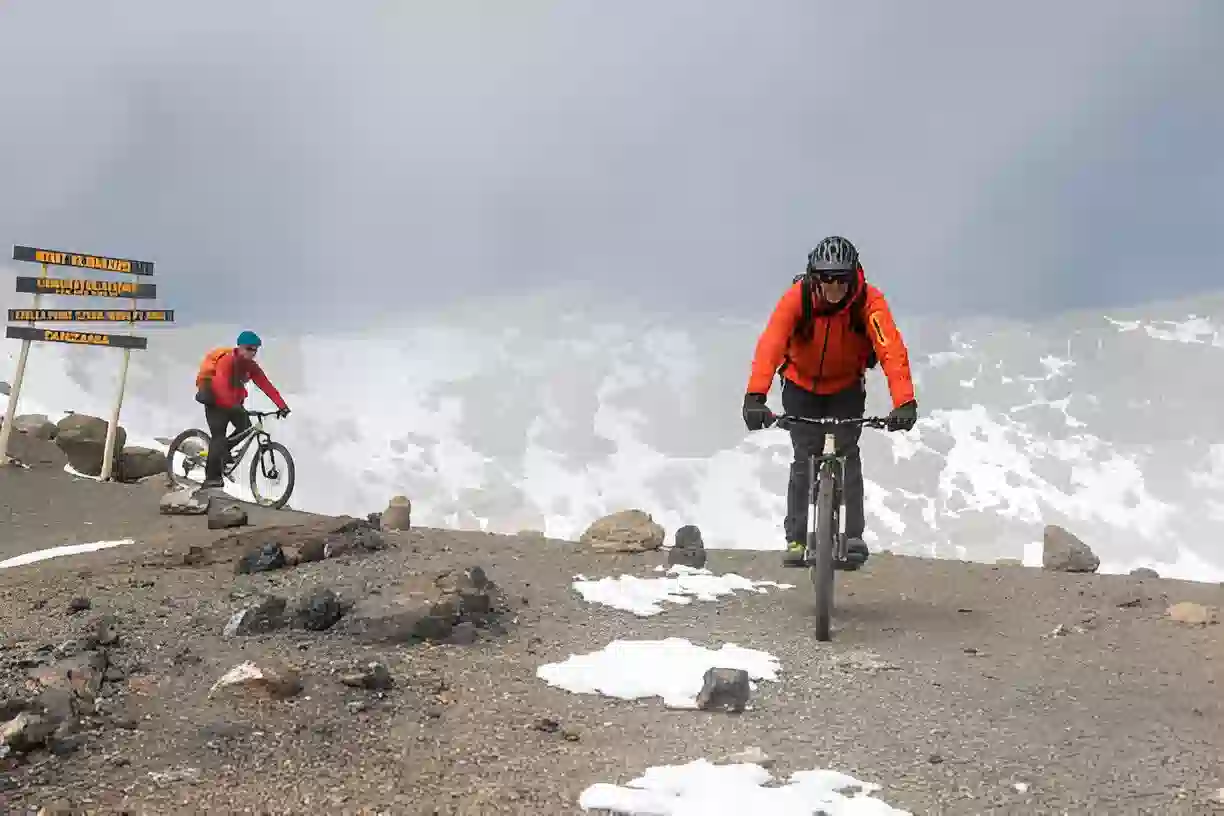
Kilimanjaro's only pure cycling ascent to the summit. Your bicycle goes wherever you go — a dedicated support porter carries the bike through any section where riding isn't possible, so your two wheels stand with you at Uhuru Peak.
The Kilema Route 6-day itinerary is Kilimanjaro’s only pure cycling ascent — a programme built around one defining principle: your bicycle accompanies you for the entire expedition. Wherever the trail allows, you ride. Wherever the gradient or surface makes mounting temporarily impossible, a dedicated bicycle support porter carries the bike and returns it the moment rideable ground resumes. The result is a continuous cycling presence all the way to the summit, culminating in one of the most unusual summit achievements on the African continent.
The cycling sections cover Kilimanjaro’s most extraordinary terrain: 12 kilometres of technical forest riding on Day 1 from Kilema Gate, the moorland transition to Horombo Hut on Day 2, a cycling acclimatisation ride to Zebra Rock (4,050m) on Day 3, and the atmospheric volcanic saddle crossing to Kibo Hut on Day 4. Above Kibo, the support porter carries the bicycle up the summit scree — meeting the rider at Gilman’s Point on the crater rim — before the final push to Uhuru Peak at 5,895m.
A dedicated acclimatisation day at Horombo (the Zebra Rock cycling excursion) applies the proven ‘climb high, sleep low’ strategy and is a core component of the route’s 80–85% summit success rate. Day 6’s cycling descent from Horombo through the forest back to Kilema Gate is the expedition’s thrilling finale.
Important: Strong intermediate to advanced mountain biking skills are required. Day 1’s 950-metre altitude gain over 12 kilometres of technical forest terrain is demanding even for experienced riders. This route is not suitable for beginner cyclists.
The only programme on Kilimanjaro where bikes reach the crater rim — a dedicated porter carries the bicycle through any section where mounting isn't possible.
From rainforest single track to volcanic saddle terrain — Kilimanjaro's most varied cycling landscape across four days of pure ascent.
A dedicated cycling acclimatisation ride to Zebra Rock (4,050m) using the proven climb-high-sleep-low strategy for 80–85% summit success.
Day 6's full cycling descent from Horombo through the forest is Kilimanjaro's most rewarding summit return — riding back the same mountain you rode up.
| Day | Stage & Destination | Elevation | Distance | Duration | Meals |
|---|---|---|---|---|---|
Meal Key: B = Breakfast · L = Lunch · D = Dinner
The ascent plays automatically once you scroll to it, looping through the whole route. Click any day card to jump straight to that point, or use Play Ascent to start another lap.
Shaded map rings are approximate distance bands for orientation, not surveyed boundaries. Elevation-profile colors group this route's own zone labels, entered per stop, or an elevation-based guess where none was given. Route distances are calculated straight-line between known points, not surveyed trail distance.
Arrival Day · Welcome to Tanzania
Cycling Ascent Begins
Upper Mountain Cycling
Acclimatisation Cycling Day
Saddle Crossing by Bike
★ Summit Day
★ Summit Day
Departure Day
Forest Zone
Your Kilimanjaro cycling expedition begins at Kilimanjaro International Airport (JRO), where a RYDER Signature representative transfers you to Moshi. The expedition briefing this evening covers the Kilema Route’s core concept: a pure cycling ascent of Africa’s highest mountain. Wherever the terrain allows, you ride. Wherever the gradient or surface makes mounting temporarily impossible, a dedicated bicycle support porter carries the bike until rideable ground returns — ensuring your two wheels are with you all the way to the summit zone.
Mountain bikes are fitted and adjusted to your specifications. Guides review Day 1’s forest profile, the altitude management strategy specific to cycling at elevation, and the support porter system that makes this continuous bike companionship possible across the full ascent.
After breakfast, transfer to Marangu Gate for mandatory KINAPA park registration — required for all Kilimanjaro climbers regardless of entry point — then continue by vehicle to Kilema Gate at 1,800m, where tyres meet trail and the pure cycling ascent of Kilimanjaro officially begins.
The opening section crosses cultivated Chagga farmland at the park boundary before the trail enters pristine montane rainforest — podocarpus and camphor trees draped with old man’s beard lichen creating a cathedral canopy above root-laced paths. Pedalling through this forest is an experience found nowhere else on Kilimanjaro: 12 kilometres of technical single track gaining nearly 950 metres, with the air thinning noticeably as altitude accumulates.
In sections where the gradient or terrain makes mounting temporarily impossible — steep rock steps, fallen obstacles, waterlogged root crossings — your dedicated bicycle support porter steps forward to carry the bike, returning it the moment conditions allow. Colobus monkeys crash through the canopy; giant ferns and impatiens flowers line the trail. The forest cycling ends at the tented camp in a clearing where the support team has prepared a full camp in the wilderness.
The second day continues the cycling ascent through the upper montane forest where the canopy gradually thins, giant heathers appear among the trees, and the trail character opens toward the moorland boundary above.
Emerging from the enclosed forest onto open moorland is one of the Kilema Route’s defining moments — a sudden panoramic revelation after two days beneath the canopy. Kibo Peak appears ahead for the first time and the highland landscape spreads in every direction. The bikes continue rolling through heather and giant lobelia zones, the vegetation growing increasingly extraordinary as altitude increases.
In rockier sections through the transition zone, your support porter steps in as needed before returning the bike as gradient moderates. The approach to the Horombo Hut complex brings the first views of the upper mountain and the glaciers that mark the summit zone above. A cycling day that traverses two of Kilimanjaro’s most distinctive ecological zones from a saddle — something no other route on the mountain makes possible.
The Kilema Route’s dedicated acclimatisation day follows the proven ‘climb high, sleep low’ strategy — riding to Zebra Rock at approximately 4,050 metres then returning to sleep at the lower elevation. Cycling acclimatisation is more physiologically potent than passive rest at the same altitude: the cardiovascular effort at altitude triggers stronger red blood cell adaptation, while sleeping lower avoids the stress of overnight high-altitude exposure.
The Zebra Rock formation — named for its striking black-and-white volcanic banding — sits at the alpine desert boundary where vegetation has almost entirely disappeared. The panoramic views across the saddle toward Mawenzi Peak provide a compelling reward for the effort. Support porter assistance is available for the steepest sections of the approach.
The afternoon return to Horombo allows the body to consolidate its altitude response. This day is not optional — the physiological gains from the cycling excursion to Zebra Rock directly contribute to the route’s 80–85% summit success rate, and the cycling effort builds specific cardiovascular reserves for the summit push ahead.
Today’s saddle crossing on bicycle is one of Kilimanjaro’s most atmospheric riding experiences. The vast volcanic plateau between Kibo and Mawenzi stretches ahead where the last vegetation disappears and the landscape becomes purely mineral — compacted lava soil and scree terrain across which no other cyclists on the mountain travel at this stage of ascent.
Wide sections of the saddle trail are rideable on compacted volcanic soil, with the support porter carrying the bike over the most technical rock sections before returning it as smoother ground resumes. Mawenzi’s crumbling spires create jagged silhouettes to the left; Kibo’s massive dome grows steadily larger with every pedal stroke. The thin air at this altitude makes each revolution of the cranks a conscious effort — the body’s two nights of acclimatisation at Horombo proving their value with every kilometre ridden.
At the base of the summit cone, the bicycle is secured at the highest practical storage point. Your guide conducts the summit briefing: midnight departure timing, layering strategy for -15°C to -25°C temperatures, pacing protocols on the summit scree, and the support porter’s role in carrying the bike up the cone above.
Between 11 PM and midnight, guides wake the group for hot drinks, final layering, and the midnight departure. Above the hut, terrain transitions to steep scree and volcanic ash where the support porter takes the bicycle — carrying it up the summit cone alongside the group as riders ascend on foot through the coldest and most demanding section of the entire expedition.
The ascent to Gilman’s Point (5,681m) on the crater rim typically reaches its conclusion near sunrise — the dawn breaking across Africa’s plains thousands of metres below is among mountaineering’s most permanently memorable experiences. Your support porter arrives at Gilman’s Point with the bicycle, having carried it up the summit cone throughout the pre-dawn hours. The bike has reached the crater rim of Kilimanjaro.
Uhuru Peak (5,895m) waits approximately one hour further along the crater rim. The summit sign, the retreating glaciers, the complete silence at Africa’s highest point — and the knowledge that your bicycle has accompanied you to this elevation — creates a summit achievement available to almost no one else in the world. Descent from Gilman’s Point with the support porter managing the bike on the upper scree before mounting resumes on firmer ground below, cycling all the way back toward the moorland and Horombo.
The final day delivers the Kilema Route’s most exhilarating reward: a full cycling descent from Horombo through moorland and forest back to Kilema Gate. The descent character is entirely different from the ascent — flowing downhill trails replace grinding upward effort, speed replaces endurance, and the physical sensation of descending at altitude creates an elation that combines summit achievement with the pure joy of cycling.
Support porter assistance manages the bike over steep technical sections on the upper descent before the forest section opens into flowing single track all the way to Kilema Gate. Below the treeline the riding becomes fast and free through root-laced forest tracks, with the same rainforest that greeted you on Day 1 now rushing past at speed.
At Kilema Gate, bikes are packed by the support team as the cycling programme concludes. Transfer to Marangu Gate follows for the official summit certificate ceremony — the formal recognition that marks both achievement and park exit, presented to one of the very few climbers to have taken a bicycle to the summit of Africa’s highest mountain.
After breakfast, your RYDER Signature representative transfers you to Kilimanjaro International Airport for your onward journey. The summit you reached by bicycle is visible above the clouds on a clear morning — Africa’s highest peak, conquered on two wheels.
Optimal altitude acclimatisation before the Kilema Route — reaching 4,566m on Meru provides excellent physiological preparation for high-altitude cycling.
Four-season sleeping bag for the mountain nights if you prefer not to carry your own.
Tropical beach recovery — RYDER Signature coordinates flights and accommodation seamlessly.
Pre-climb immersion through the Chagga coffee highland that the Kilema Route begins on.
Strong intermediate to advanced mountain biking skills are essential. Day 1 involves 12km of sustained technical climbing gaining nearly 950 metres through forest terrain. Thin air at altitude significantly affects cycling performance — the body works considerably harder above 3,000m. Good cardiovascular fitness, experience with sustained technical climbing, and minimum 2–3 hours endurance capacity are required. This route is not suitable for beginner cyclists.
The dedicated bicycle support porter accompanies the group on all cycling days and manages the bike on any terrain where riding isn’t possible — steep scree, rocky steps, very narrow technical sections. On the summit push from Kibo Hut, the porter carries the bike up the cone to Gilman’s Point on the crater rim while riders ascend on foot. On the descent, the porter manages the bike on the upper scree until mounting becomes safe again.
All Kilimanjaro climbs require formal KINAPA registration at a designated main gate. Marangu Gate handles registration for Kilema Route climbers on Day 1 entry, and the summit certificate ceremony and exit formalities on Day 6. This administrative requirement applies to all Kilimanjaro routes.
Personal bikes can be accommodated with advance arrangement and appropriate transport logistics. RYDER Signature’s provided bikes are specifically selected for Kilimanjaro’s forest and mountain terrain and fully maintained by our dedicated mechanic. Most clients find the provided equipment excellent.
Genuine wilderness, exceptional scenery, and the acclimatisation profile that delivers summit success.