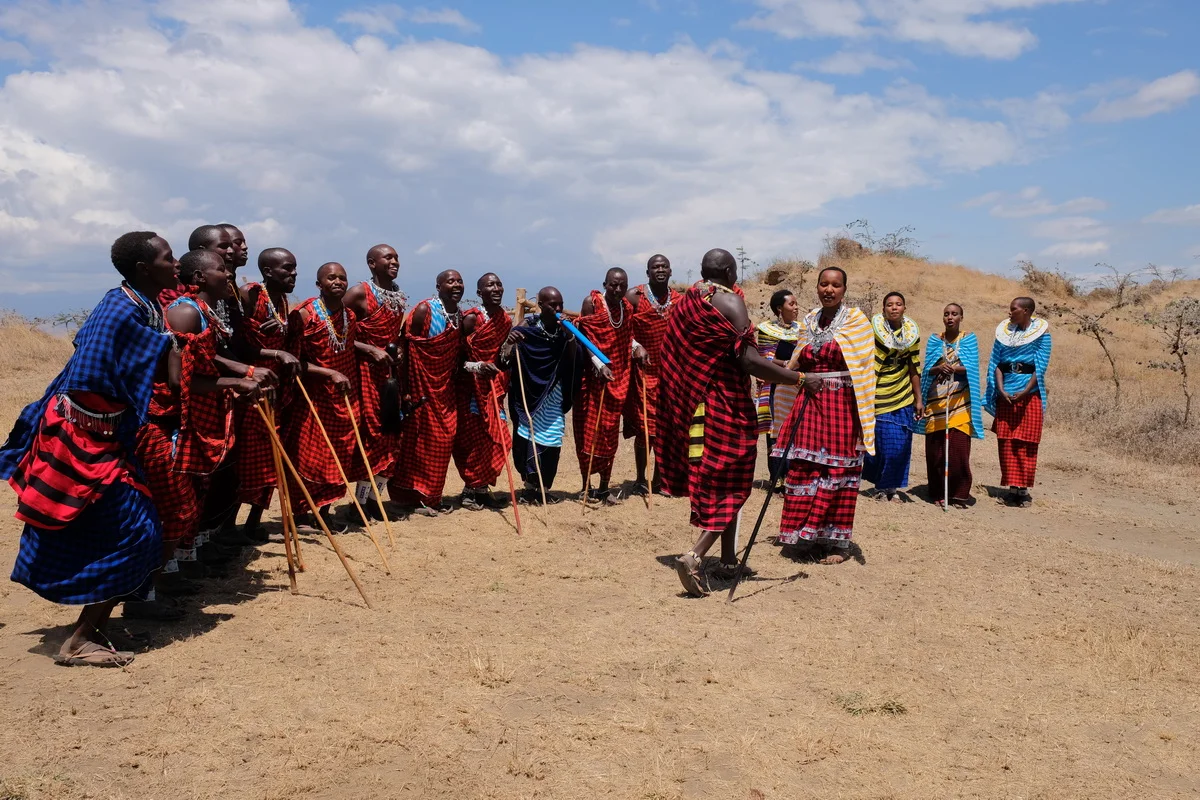
8-Day Cultural & Wildlife Safari: Tanzania's Oldest Living Culture Meets Its Greatest Wildlife Stage
The Hadzabe — Africa's last hunter-gatherers — before dawn. The Datoga metalsmith's forge at noon. The Ngorongoro Crater's black rhinoceros. The Serengeti's leopard at golden hour. One journey, no equal.
Overview
10,000 Years of Human History Meets Africa's Greatest Wildlife Stages.
NT-C5 pairs two of Africa's most extraordinary human encounters with Tanzania's greatest wildlife parks. The Hadzabe of Lake Eyasi are one of the world's last remaining hunter-gatherer communities — approximately 1,500 individuals maintaining a lifestyle tens of thousands of years old, living in the same Rift Valley basin where the earliest evidence of modern human behaviour was discovered.
The program opens with two nights at Lake Eyasi — a full day dedicated to the Hadzabe morning hunt and an afternoon Datoga village visit. These encounters are genuine, community-led, and directly benefit participating families. RYDER Signature works exclusively with community-approved operators and guides. All cultural activity fees are fully included in the program price at all tiers.
From Lake Eyasi, the route continues to the Ngorongoro Crater for a full-day descent — Big Five and black rhinoceros — before two nights in the Central Serengeti complete the program with multiple game drives in the Seronera predator zone.
Africa's last hunter-gatherers — up to 1,500 individuals maintaining a lifestyle tens of thousands of years old. A pre-dawn encounter in the dry woodland around Lake Eyasi.
The Datoga community's brass jewellery and arrowhead craft — forged using ancient techniques, providing the tools the Hadzabe hunt with.
A full crater descent with picnic lunch — Tanzania's most reliable Big Five encounter, including the endangered black rhinoceros.
Multiple drives in the Seronera predator core — resident lion prides, the highest leopard density in the Serengeti.
All Hadzabe and Datoga community fees are included in the program price at all three tiers — no surprise extras.
NT-C5 operates every month of the year — the Hadzabe and Datoga encounters are not seasonal.
Itinerary at a Glance
Six Days, Three Parks, One Lifetime Memory
The table below outlines the daily progression of your safari, including overnight locations and meal arrangements.
| Day | Route | Overnight | Meal Plan | Highlights |
|---|---|---|---|---|
| 1 | Arrive JRO → Arusha | Arusha | D | Meet & greet · Rest · Cultural briefing |
| 2 | Arusha → Lake Eyasi | Lake Eyasi | B L D | Scenic Rift Valley route · Karatu highlands · Lake arrival |
| 3 | Full Day — Lake Eyasi Cultural Experiences | Lake Eyasi | B L D | Hadzabe morning hunt · Datoga metalsmith village · Sunset on the lake |
| 4 | Lake Eyasi → Ngorongoro Rim | Crater Rim | B L D | Transfer via Karatu · Rim arrival · Crater rim sundowner |
| 5 | Full Day — Ngorongoro Crater Descent | Crater Rim | B L D | Big Five · Black rhino · Flamingos · Full day on crater floor |
| 6 | Ngorongoro → Central Serengeti | Central Serengeti | B L D | Scenic transfer · Naabi Hill Gate · Evening game drive |
| 7 | Full Day — Central Serengeti | Central Serengeti | B L D | Predator tracking · Leopard · Lion · Bush breakfast · Sundowner |
| 8 | Serengeti → Ngorongoro → JRO | B | Return drive · Airport transfer · Departure |
B = Breakfast · L = Lunch · D = Dinner
Explore the Route
Your Safari Route, Mapped
Follow the animated route from Arusha through the parks.
Investment
Choose Your Safari Style
Every tier delivers the same exceptional guiding, the same game drives, and the same parks. The difference lies in where you sleep.
Mid-Range · MID
Explorer
USD 4,500 per person
Accommodation Portfolio
🏨 Arusha(1): Arusha Planet Lodge
🏨 Lake Eyasi(2): Tindiga Tented Camp
🏨 Ngorongoro(2): Ngorongoro Serena
🏨 Serengeti(2): Tamu Tamu Tented Lodge
- All nights accommodation as specified
- All game drives and park / conservation area fees
- All meals as indicated in the itinerary
- Private 4x4 Land Cruiser with pop-up roof and expert guide
- Flying Doctors emergency evacuation coverage
- All cultural activity fees included
Luxury · LUX
Signature
USD 7,800 per person
Accommodation Portfolio
🏨 Arusha(1): Gran Meliá Arusha
🏨 Lake Eyasi(2):
🏨 Ngorongoro(2): Ngorongoro Meliá
🏨 Serengeti(2): Salinero Serengeti Camp
- All nights accommodation as specified
- All game drives and park / conservation area fees
- All meals as indicated in the itinerary
- Private 4x4 Land Cruiser with pop-up roof and expert guide
- Flying Doctors emergency evacuation coverage
- All cultural fees included
- Bush breakfast
High-End Luxury · HEL
Pinnacle
USD 11,500 per person
Accommodation Portfolio
🏨 Arusha(1): Arusha Coffee Lodge
🏨 Lake Eyasi(2): Kisima Ngeda (best available)
🏨 Ngorongoro(2): Angama Ngorongoro
🏨 Serengeti(2) : Four Seasons Safari Lodge
- All nights accommodation as specified
- All game drives and park / conservation area fees
- All meals as indicated in the itinerary
- Private 4x4 Land Cruiser with pop-up roof and expert guide
- Flying Doctors emergency evacuation coverage
- All cultural fees included
- Private bush breakfast + sundowner
- VIP arrangements
Day-by-Day
Your Journey, Day by Day
Arrival
Arrive Kilimanjaro Airport → Arusha
Your RYDER Signature guide meets you at Kilimanjaro International Airport and transfers you to your Arusha overnight accommodation — approximately 45 minutes from the terminal. Arusha sits at 1,400 metres on the flank of Mount Meru, and the evening air has a highland freshness entirely different from the coastal humidity of Zanzibar or the lowland heat of Dar es Salaam. Arrival day at RYDER Signature is an absolute rest day: no game drives, no early departures, and no pressure. The evening briefing, conducted at the accommodation over dinner, introduces the seven-day circuit in full — the Lake Eyasi Hadzabe and Datoga encounters, the Ngorongoro Crater, and the Serengeti — and the guide answers questions about the cultural encounters’ logistics and etiquette before the early morning departure the following day.
Lake Eyasi lies in the Rift Valley south of the Ngorongoro Highlands, and the Hadzabe who live on its shores are considered among the last remaining hunter-gatherer communities in East Africa — a way of life continuous since before the agricultural revolution that transformed every other society on the continent. Understanding the context of what Day 2 and 3 will deliver is part of the Day 1 briefing: the Hadzabe are not a performance, and the encounter requires some preparation. The guide walks through the community’s language (a click-consonant tongue unrelated to any Bantu language), their hunting methods, their daily rhythm, and the RYDER approach to respectful engagement before the departure at dawn the following morning.
Lake Eyasi
Arusha → Lake Eyasi
After breakfast, the vehicle heads southwest through the Karatu highlands — coffee and banana country at 1,600 metres — before descending toward the Rift Valley floor and the broad alkaline basin of Lake Eyasi. The drive takes approximately 3.5 hours with a Karatu market stop if timing allows. The landscape transformation is dramatic: from the lush, cool highlands to the dry, flat-bottomed Rift Valley, the thorn scrub and baobab trees announcing the ecosystem that the Hadzabe have hunted for millennia. Arrival at the Lake Eyasi lodge in the early afternoon allows a rest before the late-afternoon Datoga village encounter.
The Datoga — pastoralists who moved into the Lake Eyasi basin after displacement from the Ngorongoro highlands by Maasai expansion — are the Hadzabe’s neighbours and traditional trading partners. The late-afternoon Datoga visit focuses on their extraordinary blacksmithing tradition: working iron with no mechanised tools, the Datoga forge arrowheads and jewellery from scrap metal with techniques unchanged for generations. These arrowheads are traded directly to the Hadzabe — the Datoga cannot hunt effectively, and the Hadzabe cannot forge metal — a symbiosis that has sustained both communities across the centuries. Watching a Datoga blacksmith work is a lesson in pre-industrial metallurgy and in the specific interdependencies that define this corner of the Rift Valley.
Hadzabe & Datoga
Full Day — Lake Eyasi Cultural Experiences
The day begins before sunrise. The vehicle reaches the Hadzabe meeting point as the sky lightens from black to deep blue — the hunters are already up, and the morning’s hunt is their priority, not a visitor’s introduction. Your RYDER guide and a community liaison facilitate the encounter: a Hadzabe guide leads the morning hunt walk through the thorn scrub, demonstrating how poison is prepared from the Adenium desert rose bark applied to the handmade arrows, how animal tracks are read in the red dust, and how birds are called toward the hunters using a skilled vocal mimicry that takes years to develop. Participation is welcomed — guests who attempt the bow under Hadzabe instruction consistently describe the experience as one of the most technically humbling of their lives.
The return to camp for a mid-morning meal is followed by a slow afternoon at the lodge — swimming, birding at the lake’s edge, and the specific contemplative quality that the Lake Eyasi encounter tends to produce. The Hadzabe experience is not easily categorised: it is neither zoo nor performance nor academic exercise, but something more complex — an encounter with a way of knowing the world that modern life has systematically replaced, and an implicit question about what is lost in that replacement. RYDER Signature guides facilitate the encounter and its aftermath with this in mind: the afternoon’s unhurried pace is a deliberate choice, giving guests time to absorb what the morning delivered before the circuit moves on.
To the Crater
Lake Eyasi → Ngorongoro Crater Rim
The transfer northward from Lake Eyasi to the Ngorongoro Conservation Area rim passes through Karatu — the highland town that serves as the staging point for crater visits — and climbs steadily through the coffee-growing villages of the Ngorongoro outer slopes. The air cools noticeably with each kilometre of elevation gain, and by the time the vehicle reaches the crater rim the temperature is 10–15 degrees lower than Lake Eyasi’s Rift Valley floor. The rim arrival in the late afternoon provides the program’s first view of the caldera — 260 square kilometres of enclosed volcanic ecosystem, visible in its entirety from the rim viewpoint, the wildlife on the floor visible as small shapes against the short-grass plains 600 metres below.
The crater rim sundowner — a RYDER Signature ritual at this specific moment of the circuit — is arranged at the viewpoint rather than at the lodge. The guide parks at the designated viewpoint, opens drinks, and the group stands at the rim edge as the late afternoon light crosses the caldera floor. The contrast with the previous two days is deliberate: Lake Eyasi’s human depth answered by Ngorongoro’s geological grandeur, the intimate hunter-gatherer encounter balanced by the crater’s ancient scale. The rim lodge dinner that follows — cool highland air, the caldera in darkness below — closes the program’s cultural chapter and opens the wildlife one.
Ngorongoro Crater
Full Day — Ngorongoro Crater Descent
Pre-dawn departure from the rim lodge for the Lodoare Gate descent — the crater floor by 06:15, before the Arusha day-trip vehicles arrive from 08:30 onward. After two cultural days, the Ngorongoro Crater floor delivers a complete tonal shift: the focus is purely wildlife, the landscape is enclosed and concentrated, and the encounter quality is unlike any open park. Lion prides are the morning’s first priority — the crater’s resident prides occupy specific territories that the guide knows precisely, and the dawn drive targets the most active area from overnight ranger network communication. The black rhinoceros — approximately thirty critically endangered individuals resident in the caldera — is the specific mammal that most guests have come to see, and your guide heads to the Munge Stream acacia thickets or the short-grass margins of Lake Magadi where morning rhinoceros activity is most reliably concentrated.
A full caldera day across two drives with a picnic lunch inside the crater maximises the floor time available before the afternoon Serengeti transfer. The crater’s wildlife inventory is extraordinary in its completeness: lion, leopard, cheetah, rhinoceros, elephant, buffalo, hippopotamus, hyena, jackal, flamingo, and over 500 bird species — the Big Five and much more in a contained area that makes encounters almost continuous. The afternoon Serengeti transfer after the crater exit takes approximately 3 hours via the Naabi Hill Gate — the transition from the crater’s enclosed intensity to the Serengeti’s infinite open horizon being one of the Northern Circuit’s most satisfying landscape progressions.
Into the Serengeti
Ngorongoro → Central Serengeti
The drive westward across the Conservation Area delivers Tanzania’s great landscape transition — the enclosed volcanic highlands opening suddenly at Naabi Hill into the flat, infinite Serengeti plain. The Seronera Valley arrival game drive introduces the resident predator population: lion prides mapped to specific territories, leopards in the Seronera River fig trees, cheetah on the open plain. After the cultural depth of Lake Eyasi and the geological grandeur of Ngorongoro, the Serengeti’s wildlife feels immediate and purposeful — animals living their lives without reference to any agenda beyond the daily requirements of their ecology.
A complete day in the Seronera zone — two game drives, a mid-morning bush breakfast on the open plain, and the golden-hour circuit — delivers the Central Serengeti’s full predator program. Morning lion at kills, mid-morning leopard in the fig trees, afternoon cheetah on the termite mounds. Your guide’s field intelligence, built from the arrival drive the previous evening and the overnight communication with the RYDER field network, makes this day’s targeting significantly more precise than a first-arrival drive could achieve. Wild dogs pass through the Seronera area regularly, and the guide checks current pack locations from network communication before each drive.
Full Serengeti Day
Full Day — Central Serengeti
A final morning game drive in the Seronera zone before the return drive to Kilimanjaro International Airport via the Ngorongoro Conservation Area. The morning drive is the program’s last wildlife session, and the guide uses the overnight intelligence to target the specific subjects identified from Day 6’s drives: the lion pride at its morning position, the Seronera fig tree with a resident leopard, the cheetah coalition’s dawn circuit. After approximately four hours of morning driving and a lodge brunch, the return route follows the Conservation Area road through the Maasai-inhabited moorland and the highland descent to the Arusha plain.
The return drive via the Ngorongoro Conservation Area passes through the same highland landscape that began the cultural circuit on Day 2 — Karatu, the coffee farms, the Rift Valley descent — but experienced in reverse from a completely different position of knowledge. What was background scenery on the way to Lake Eyasi is now a landscape with specific meaning: the Datoga villages visible from the road, the baobab trees that frame the Eyasi basin, the crater rim that shelters the caldera below. The drive to Kilimanjaro International Airport takes approximately 4 hours from Seronera, arriving in time for international departures.
Departure
Serengeti → Ngorongoro → JRO
Morning at leisure in Arusha before the airport transfer, timed precisely to your departure flight. For guests with late international departures, RYDER Signature arranges a half-day optional activity — Arusha National Park game drive, Coffee tour at a local Meru-slope farm, or a cultural visit to the Maasai Market in Arusha town — before the airport transfer. The 3-hour buffer to Kilimanjaro International Airport is built into the schedule to account for the variable road conditions between Arusha and JRO.
For guests connecting to Zanzibar or Dar es Salaam for a beach extension, RYDER Signature coordinates the onward domestic connection from Kilimanjaro International Airport. The transition from the Serengeti’s wildlife intensity and Lake Eyasi’s cultural depth to a Zanzibar beach or a Dar es Salaam coastal hotel completes the most dimensionally complete Tanzania experience available in a 7-day program — wildlife, culture, geology, and the ocean, sequenced in deliberate contrast.
Where to Stay
Where You Stay Matters as Much as Where You Go
Every property on this route is one we know personally. Here is what's waiting for you each night.
What's Included
Inclusions & Exclusions
✓ What's Included
- Airport meet & greet at Kilimanjaro International Airport (JRO)
- All road transfers in private 4x4 Toyota Land Cruiser with pop-up roof hatch
- Professional English-speaking private safari guide throughout
- All nights accommodation as specified per tier
- All meals as indicated in the itinerary
- All national park entry and Ngorongoro Conservation Area fees
- Bottled water during all drives
- Flying Doctors emergency evacuation coverage
- 24/7 RYDER Signature support access
✗ What's Not Included
- International flights
- Tanzania entry visa (USD 50)
- Travel insurance with medical evacuation (mandatory)
- Tips and gratuities (USD 30–50/day per vehicle)
- Personal expenses and alcoholic beverages
- Optional supplements below
Elevate Your Journey
Signature Additions
Optional experiences your specialist can layer into this itinerary — search and select any addition from our full collection.
Common Questions
Frequently Asked Questions
The Datoga (sometimes spelled Datooga or Mangati) are a Nilotic agro-pastoralist group with a territory overlapping the Hadzabe’s Lake Eyasi basin. They are known across northern Tanzania as skilled metalworkers and blacksmiths — the Datoga forge iron arrowheads (often traded with the Hadzabe), bracelets, and other metal objects using traditional bellows and hammers in a craft that has been passed across generations. The Datoga women are known for their distinctive leather garments and beadwork. The visit to a Datoga blacksmith involves observing the forging process at close range — the hand-operated bellows, the charcoal fire reaching working temperature, and the transformation of scrap iron into finished tools. It provides a context for the pre-industrial metalworking traditions that shaped East African material culture for thousands of years.
NT-C5 combines the cultural program (Days 2–3) with a standard Northern Circuit wildlife program (Days 4–7): Ngorongoro Crater full descent (Big Five caldera experience), Tarangire National Park (elephant herds and baobabs), and the Serengeti (resident predator intelligence, two nights). The cultural program is specifically timed to the Lake Eyasi basin area, which is on the route between Arusha and the Ngorongoro-Serengeti circuit — the detour to Lake Eyasi adds approximately half a day of travel rather than a full additional transfer. The wildlife program that follows is RYDER Signature’s standard Northern Circuit quality — private guide, private vehicle, and the full park access that characterises all NT programs.
The Maasai people’s traditional territory covers much of northern Tanzania’s wildlife landscape — their cattle rangelands historically included much of what is now Serengeti National Park, the Ngorongoro Conservation Area, and Tarangire. The Maasai were displaced from the Serengeti when the park was gazetted in 1951, a history that shapes the relationship between conservation areas and local communities across the northern circuit. NT-C5 includes a Maasai community visit that covers: the traditional boma structure, the cattle herding practices, the beadwork and dress traditions, and the specific context of Maasai land rights and conservation policy in northern Tanzania. The guide provides the historical and contemporary framework for the Maasai’s relationship with the national parks — a context that enriches the subsequent park visits significantly.
NT-C5 is available year-round. The wildlife component performs best in the standard Northern Circuit windows (June–October for dry season wildlife, January–March for Serengeti calving). The cultural visits at Lake Eyasi are not season-dependent — the Hadzabe hunt year-round and the Datoga blacksmiths work in all seasons. The main consideration is the Lake Eyasi road access, which is best in the dry season (June–October) and can be challenging during the long rains (April–May). RYDER Signature has operated the Lake Eyasi visit in all seasons and advises on road conditions at booking.
NT-C5 is priced from USD 3,200 per person (MID tier) to USD 7,500 per person (LUX tier) and USD 14,000 per person (HEL tier), based on double occupancy. Included: private 4×4 and guide throughout, all road transfers from Arusha, 6 overnight nights, full board, cultural community visit fees (Hadzabe, Datoga, Maasai), all park fees (Ngorongoro, Tarangire, Serengeti), and Flying Doctors coverage. International flights, Tanzania visa, and personal items are not included.