Overview
A civilisation written in stone and spice
Zanzibar layers African, Arab, Persian, Indian and European influence into something singular. Away from the beaches sits an island shaped by a thousand years of trade, once ruled by sultans, home to a Swahili civilisation that predates most of the resorts along its coast. A cultural excursion turns a week of sun and sand into something with real depth.
RYDER Signature builds these experiences around people rather than checklists. Guides walk you through the courtyards their own families once lived in, point out door carvings that reveal three centuries of trade, and introduce you to the artisans, farmers and fishermen still practising traditions passed down for generations. Whether you are threading Stone Town’s alleys, standing beneath a clove tree, or watching a red colobus monkey feed just metres away, these mornings reveal a side of Zanzibar the beach rarely shows.
Cultural mornings and beach afternoons pair naturally. Book activities before the heat sets in, then spend the rest of the day by the water, culture and coastline complementing each other across a single stay.

Activities
2 to 3 hours · From $70 per person in a small group, private tours run higher
Stone Town Walking Tour
Stone Town holds UNESCO World Heritage status, recognised for its unbroken record as a Swahili trading settlement built largely from coral stone. Walking its narrow lanes means walking through centuries of exchange, past the site of the old slave market, beneath carved doorways that mix Omani and Indian craftsmanship, and into courtyards where daily life still unfolds much as it always has.
A local guide turns the maze into a story. They explain how one building served in turn as a merchant’s house, a colonial office and now a small hotel, and point out details a visitor would otherwise miss: the difference between an Omani door and an Indian one, the small upper windows once used by women to watch the street unseen, and the brass studs added less for decoration than to slow attackers.
The Old Fort (Ngome Kongwe): raised by Omani forces in the late seventeenth century on the ruins of an earlier Portuguese chapel, now home to craft stalls and occasional live performance.
House of Wonders (Beit al Ajaib): once Sultan Barghash’s ceremonial palace and the first building in East Africa wired for electricity, its grand facade still dominates the seafront while restoration continues.
Palace Museum (Beit el Sahel): the former sultans’ residence, displaying furniture, photographs and personal effects from the decades before the 1964 revolution.
Forodhani Gardens: a quiet harbourside park by day, transformed each evening into Zanzibar’s best known street food market.
Christ Church Cathedral and the former slave market site: the cathedral’s altar stands where the market’s whipping post once did, covered in full on our dedicated Slave Market and Cathedral Tour.
Freddie Mercury’s childhood home: a modest stop for music lovers passing through, now home to a small museum of its own.
Streets are cobbled and uneven in places. Guides generally time the route to avoid the busiest midday hours around the market.
Our Stone Town guides grew up within these walls, several from families who have lived in the old town for generations, so the history arrives as lived memory rather than recited fact. We build in a Swahili coffee stop along the way and can arrange entry to sites not normally open to visitors.
Licensed local guide, walking route through Stone Town’s key landmarks

2.5 to 3 hours including transport · From $70 per person including transport and tastings
Spice Farm Tour
Zanzibar earned its old nickname, the Spice Island, through generations spent as one of the world’s leading clove producers, alongside cinnamon, nutmeg, black pepper and a long list of other aromatics. A spice farm visit puts you inside that legacy directly, among the plants that once shaped global trade routes and still flavour Zanzibari cooking today.
Farms welcome visitors into shaded groves where a guide peels bark from a cinnamon tree, cracks open a cardamom pod, and hands you leaves and fruit to smell, rub and taste. You’ll see how vanilla actually grows on its vine, how nutmeg yields two separate spices from a single fruit, and why Zanzibar cloves still command a premium worldwide.
Spice identification: recognise more than twenty plants growing in the wild, clove trees, climbing pepper vines, cardamom in flower.
Tropical fruit tasting: depending on season, jackfruit, starfruit, passion fruit, rambutan and custard apple, picked and tasted on the spot.
Traditional medicine: guides explain long standing local uses, ginger for digestion, cloves for toothache, turmeric for inflammation.
Cooking demonstration: many farms prepare a simple dish using spices harvested that morning.
Coconut climbing demonstration: young farm workers scale the palms barefoot and open a fresh coconut for you on the spot.
Wear closed shoes. Paths can be muddy after rain.
We work with family run farms rather than large commercial operations, so your visit supports local households directly. Tours include a generous spice sample to take home and a Swahili lunch made from what the farm grows.
Transport, guided farm walk, spice and fruit tasting

Half day, 4 to 5 hours including the boat crossing · From $70 per person including boat transfer and island entrance
Prison Island Tour
Prison Island, known locally as Changuu, sits about twenty five to thirty minutes by boat from Stone Town. Despite the name, it was never used to hold prisoners; it served briefly as a quarantine station in the 1890s before becoming the tortoise sanctuary and beach getaway it is today.
The island suits a half day out well, mixing history with wildlife and a swim. Its giant Aldabra tortoises, introduced from Seychelles in the late nineteenth century, are the main draw. Some individuals are recorded at over 190 years old, their ages marked in paint on their shells.
Giant tortoise sanctuary: walk among the tortoises, feed them under a keeper’s guidance, and photograph animals that predate most living memory.
Former quarantine buildings: the coral stone structures built for the island’s brief spell as a quarantine station still stand, in varying states of repair.
Snorkelling: calm, clear water around the island makes it a gentle introduction for first timers and children.
Beach time: a quiet stretch of sand for swimming between activities.
Peacocks: they wander freely across the grounds and rarely mind an audience.
Bring cash in small denominations for the island entrance fee, payable locally.
We arrange a private boat and time the crossing to beat the main tour rush, so you get the tortoise sanctuary without a crowd around you. Quality snorkel gear is included, and our guides cover the island’s full history, including its lesser known role sheltering people freed from slave trading dhows intercepted by the British navy.
Boat transfer, guide, island entrance fee
2 to 3 hours · From $70 per person including guide and entrance
Jozani Chwaka Bay National Park
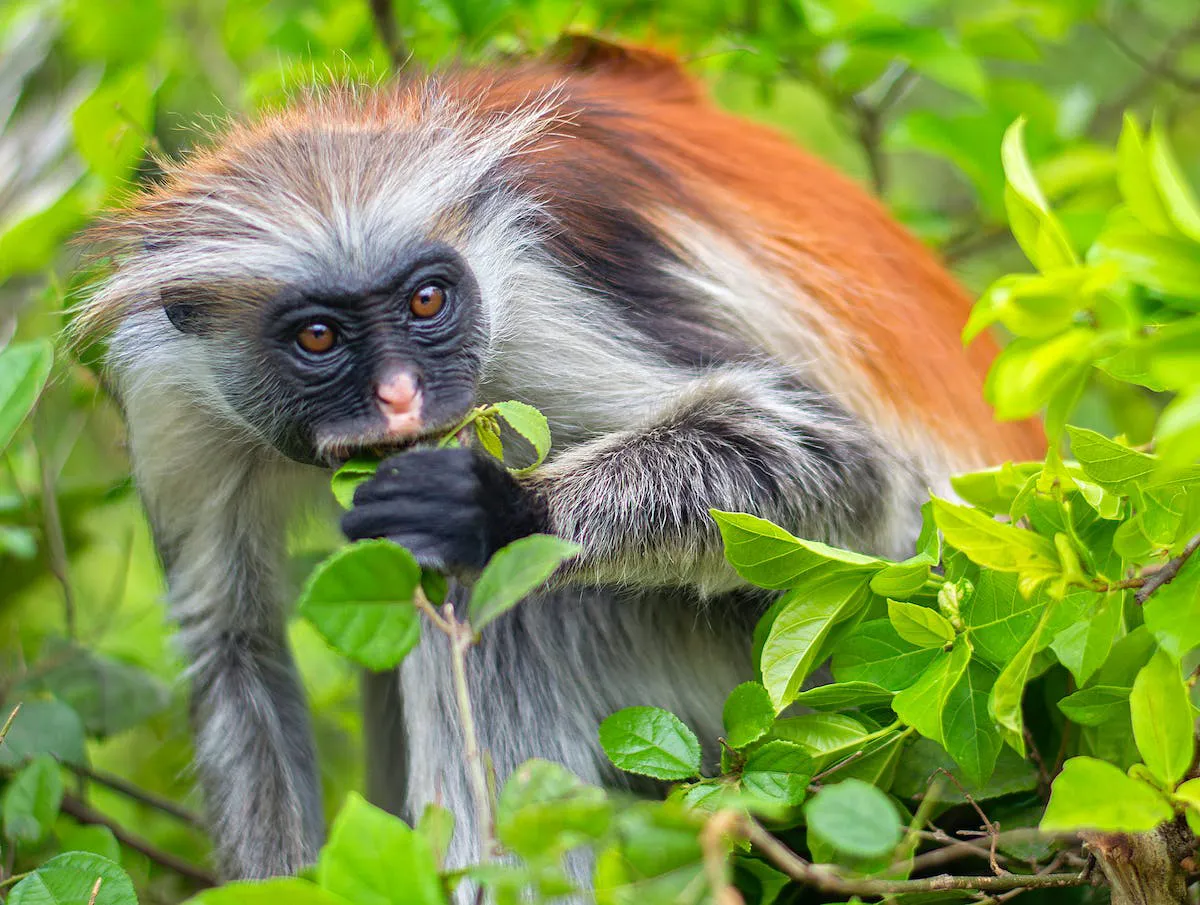
Jozani Forest protects the last significant stretch of Zanzibar’s native forest and is the only place on earth to see the Zanzibar red colobus monkey in the wild. With a russet back, white underside and striking pink lips, it ranks among Africa’s rarest primates, and encountering a troop here, often just a few metres off the trail, is one of the island’s most memorable wildlife moments.
The park stretches beyond the forest itself into the mangrove boardwalk at Chwaka Bay, giving a fuller picture of Zanzibar’s ecosystems in one visit. Guides point out Sykes’ monkeys, small duiker antelope and a long list of birdlife along the way.
Red colobus monkeys: habituated troops allow close, quiet observation as they feed and move through the canopy.
Forest ecology: guides identify medicinal plants and explain how the forest’s different habitats fit together.
Mangrove boardwalk: an elevated walkway through the mangroves at Chwaka Bay, useful for understanding how the coastline protects itself.
Birdlife and butterflies: look out for Fischer’s turaco and the African pygmy kingfisher among many others.
Community conservation: park fees support the villages bordering the forest, part of why the colobus population has recovered from earlier decline.
Arrive early, ideally before 9am. The monkeys settle into the canopy by late morning and the site gets busier from then on.
We schedule visits for the cool early morning window when the colobus troops are most active, and extend the standard walk into quieter sections of the park where other primate species are easier to find. A portion of every visit supports the community conservation fund protecting the forest boundary.
Park entrance, ranger guide, mangrove boardwalk access
1 to 1.5 hours · From $70 per person including guide and entrance
Slave Market and Cathedral Tour
Understanding Zanzibar means reckoning with its role as East Africa’s largest slave trading hub through the eighteenth and nineteenth centuries. This tour centres on the site of the old slave market in Stone Town, closed in 1873 under British pressure, and now occupied by Christ Church Cathedral, built deliberately on the same ground as an act of remembrance.
Construction ran from Christmas Day 1873 to Christmas Day 1879, led by Bishop Edward Steere. The cathedral’s altar stands where the market’s whipping post once did, and the underground holding chambers where enslaved people waited to be sold have been preserved as a memorial rather than restored away.
Underground chambers: descend into the cramped rooms where enslaved men, women and children were held before sale, presented with historical context rather than left to speak for themselves alone.
Memorial sculpture: a monument outside depicts figures bound at the neck, standing on the site of the whipping post.
Christ Church Cathedral: Gothic Victorian in structure with Islamic and Swahili detailing, its interior holds a wooden crucifix carved from the tree under which David Livingstone’s heart was buried in Zambia.
Museum displays: photographs, documents and personal accounts trace both the trade itself and the abolition movement that ended it.
Guided context: our guides are trained to handle this history with care, weaving individual stories through the visit rather than presenting numbers alone.
This is a solemn, working church; modest dress covering shoulders and knees is expected. Stairs to the underground chambers are not wheelchair accessible.
We choose guides trained specifically in sensitive historical interpretation, so the tone stays respectful throughout. We can extend the visit to include the former British Consulate nearby, where abolitionists once worked to end the trade.
Entrance to the cathedral and chambers, guided historical tour
1.5 to 2 hours for the walking portion, evening music events run longer · From $70 per person including a guided walk and museum entrance
Freddie Mercury House and Music History
Farrokh Bulsara, known to the world as Freddie Mercury, was born in Stone Town on the 5th of September 1946 to a Parsi family who practised Zoroastrianism. He left the island as a teenager and never returned, but his childhood home on Kenyatta Road, also known locally as Shangani Street, opened as the world’s first Freddie Mercury museum in November 2019, on the 28th anniversary of his death.
Beyond Mercury himself, Zanzibar has its own musical tradition worth exploring: taarab, a blend of African rhythm, Arab melody and Swahili poetry that still has active performers on the island today.
Mercury House museum: photographs, handwritten lyrics, stage costumes and childhood memorabilia, including items loaned by Queen Productions Ltd.
Mercury’s Stone Town: the surrounding streets, including the Zoroastrian temple his family once attended, place his childhood in context.
Taarab music: an introduction to Zanzibar’s own musical tradition, with recordings or, when arranged in advance, a live session.
Optional evening music: several venues around Stone Town host live taarab or contemporary Zanzibari music after dark.
The museum is small; allow 45 minutes to an hour inside.
We can arrange a private taarab performance for groups and connect visitors with local musicians for a proper conversation rather than a passing photo stop.
Guided walk past key sites, museum entrance where applicable
Half day · From $70 per person, part of which supports the host community directly
Local Village Cultural Visit
Away from Stone Town’s tourist routes, rural villages give a clearer picture of everyday life in Zanzibar today: farming, fishing, cooking and craft. A well run village visit is a genuine exchange rather than a staged performance, and the difference shows in how a village receives its guests.
RYDER Signature works only with villages that have an established, willing tourism arrangement in place, built up over years rather than negotiated on the day. Seaweed farming, one of the island’s largest industries after tourism itself, features heavily on the coast, alongside traditional cooking, weaving and small scale fishing.
Seaweed farming: watch, and often join, women harvesting seaweed at low tide, one of the coast’s main sources of income.
Traditional cooking: grind spices by hand, shape dough, and help prepare a meal you’ll then share.
Craft demonstrations: mat weaving, basket making and wood carving, done much as they have been for generations.
Traditional homes: coral stone and mangrove pole construction, still in everyday use.
School visits: arranged in advance, a chance for genuine exchange with village children.
Dress modestly, shoulders and knees covered. Ask permission before photographing individuals.
Every village partnership channels part of your visit toward a specific community project, a school improvement, water access or similar, so your visit leaves something behind rather than just passing through.
Guide, transport to the village, community contribution