Activities

2 to 3 hours · From $70 per person including guide
Lamu Old Town Walking Tour
Lamu Old Town earned its UNESCO listing in 2001 as the oldest and best preserved Swahili settlement in East Africa, a title backed by more than seven hundred years of continuous habitation. Walking its streets is not a curated museum experience; it is a working neighbourhood where the architecture, the trades and the rhythms of daily life have changed remarkably little.
The town’s coral stone houses, ornately carved doors and shaded inner courtyards reflect centuries of exchange between Swahili, Omani, Persian and Indian builders. A good guide reads these details for you: which door pattern signals a merchant family, why some houses have small upper windows built for women to watch the street unseen, and how the town’s narrow, shoulder width lanes were shaped as much by shade as by defence.
Coral stone architecture: carved doors, arched verandas and courtyards built from coral rag and mangrove timber, some homes still inhabited by the families who built them generations ago.
Working streets: donkeys carrying goods, dhow builders repairing sails, and a waterfront market that runs on the same daily rhythm it always has.
Historic mosques: Old Town holds more than twenty mosques, including the Riyadha Mosque, a centre of Islamic scholarship and the focal point of the annual Maulidi festival.
Craftsmen at work: woodcarvers and dhow builders practising skills passed through generations rather than performing for visitors.
Private courtyards: with the right introduction, step into homes not normally open to outsiders and experience Swahili hospitality firsthand.
Streets are narrow, uneven and occasionally sandy underfoot. Some sections receive very little shade, so plan around the cooler hours where possible.
Several of our Lamu guides grew up inside Old Town, and their family connections open doors, literally, that a casual visitor would never see. We can extend the walk to include a private home visit or a meeting with a local elder, arranged in advance.
Licensed local guide and a walking route through Old Town’s key landmarks.

45 minutes to 1 hour · From $70 per person including guide
Lamu Museum
Set inside a grand stone veranda building on the Lamu waterfront, dating from the early twentieth century, the Lamu Museum holds one of the most complete Swahili ethnographic collections on the East African coast. It gives context to everything you will see walking through Old Town: the trade goods, the domestic objects and the ceremonial pieces that shaped daily Swahili life for centuries.
Its single most treasured object is the Pate Ivory Siwa, a ceremonial horn carved from brass and ivory and historically used to announce important occasions such as weddings and the installation of a new ruler. Alongside it, the museum’s galleries cover boat building, traditional dress, door carving styles and the archaeology of the wider Lamu archipelago.
The Siwa horns: ceremonial ivory and brass horns, among the most celebrated Swahili artefacts on the coast.
Door carving gallery: a close look at the Swahili, Omani and Bajuni door styles you will already have spotted on your walk through town.
Maritime and dhow building displays: models and tools explaining how Lamu’s boat builders have worked for generations.
Kijumwa gallery: the work of Mohammed Kijumwa, celebrated Swahili poet and wood carver.
The museum is compact; allow about an hour to see it properly. Entrance fees are payable locally and are often included in combined tickets covering the museum, fort and other Old Town sites.
Our guides walk you through the collection in the order the objects would have mattered to a Lamu household, tracing trade, craft and ceremony as one connected story rather than a room by room list.
Museum entrance and a guided walkthrough of the collection.

45 minutes to 1 hour · Entrance usually included within a combined Old Town ticket or guided tour
Lamu Fort
Lamu Fort was built between 1813 and 1821 with support from the Sultan of Oman, following Lamu’s victory over the combined forces of Pate and Mombasa at the Battle of Shela in 1812. Standing at the southern edge of Old Town, it once garrisoned Omani troops and later served as a prison from 1910 until 1984, before passing to the National Museums of Kenya.
Today the fort’s thick coral stone walls house cultural exhibitions, a library and a resource centre used for community events, from craft workshops to gatherings during the annual Maulidi celebrations.
Military architecture: two storey coral stone walls built to project Omani authority along the coast, now home to a far gentler cultural role.
Rotating exhibitions: displays covering Lamu’s history, contemporary Swahili art and the fort’s own turbulent past as a prison.
Community events: during festivals, the fort courtyard hosts performances and gatherings open to visitors.
Views over Old Town: upper levels look out across the rooftops toward the harbour and channel beyond.
Visits pair naturally with the Old Town walking tour, since the fort sits directly on that route.
We fold the fort into a single Old Town itinerary alongside the museum and walking tour, so the history reads in the right order rather than as three disconnected stops.
Entrance to the fort, typically bundled with an Old Town guided tour.
20 to 30 minutes · Donation based entry; no fixed charge
Lamu Donkey Sanctuary
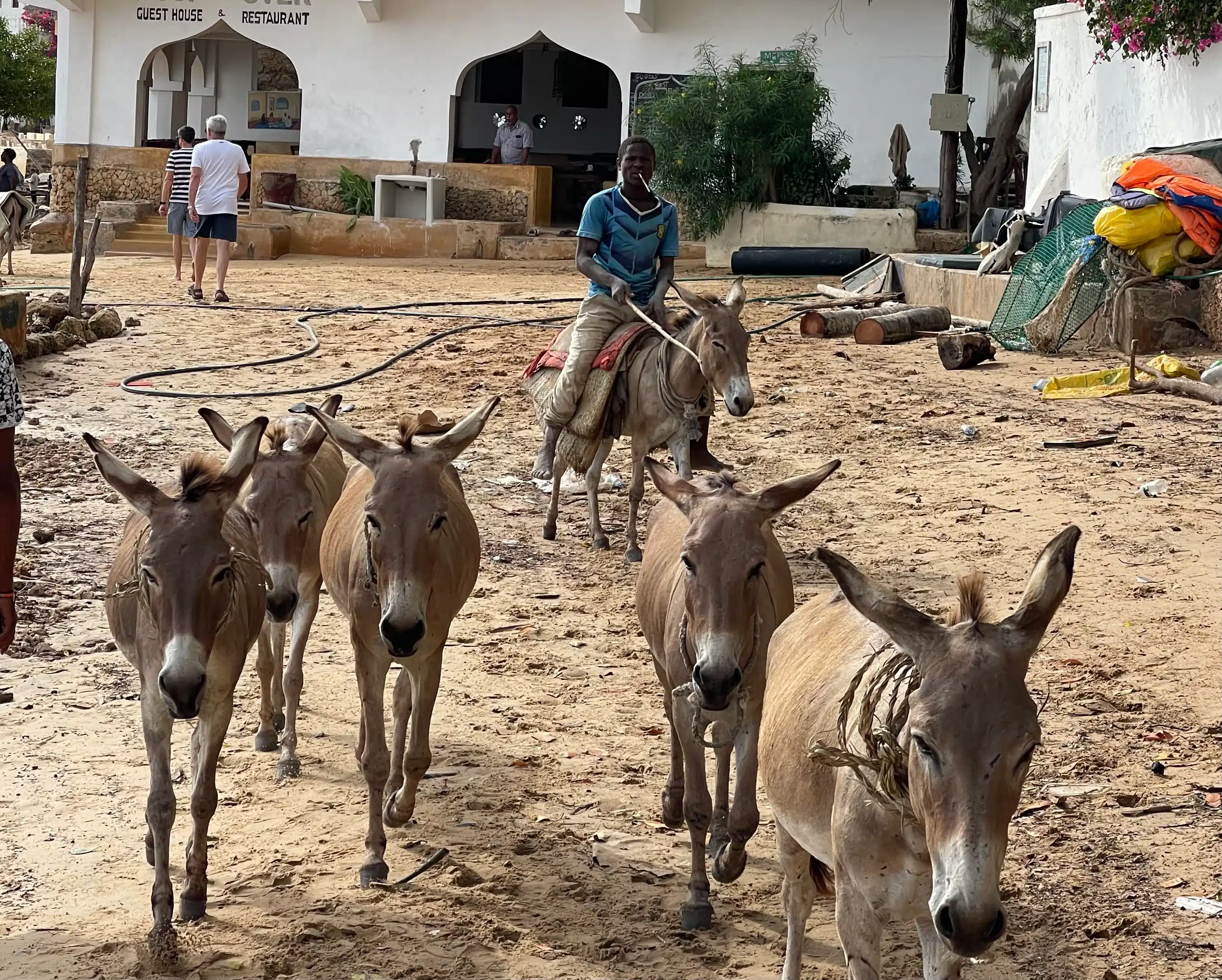
With no cars permitted on the island, Lamu depends on an estimated three thousand donkeys to move everything from building sand to market produce through its narrow streets. The Donkey Sanctuary, an international charity that established a free clinic in Lamu in the mid 1980s after its founder saw how hard the island’s working animals had it, has provided veterinary care to Lamu’s donkeys ever since at no cost to their owners.
A visit here is a quick, quietly moving stop rather than a full excursion: you see the animals that make Old Town function, understand why they matter so much to daily life, and support a charity that keeps them healthy.
Veterinary care in action: see the clinic that treats injury, disease and exhaustion in Lamu’s working donkeys free of charge.
The island’s true workforce: understand how donkeys function as Lamu’s delivery trucks, carrying water, construction materials and shopping through streets no vehicle can enter.
Direct interaction: meet, and with staff permission feed, the donkeys currently in the sanctuary’s care.
Entry is by donation. This is a working veterinary clinic rather than a tourist attraction, so visits are kept brief and respectful of ongoing treatment.
We include the sanctuary as a short, unhurried stop within a longer Old Town morning, since it says as much about how Lamu actually works as any museum does.
Access to the sanctuary grounds; donations go directly to the charity’s veterinary work.

2 to 3 hours including time in Shela · From $70 per person for a guided walk; self guided access is free
Shela Village Walk
Shela sits roughly three kilometres (two miles) south of Lamu Old Town, reached by a coastal path or a short boat ride across the channel. Where Old Town feels dense and mercantile, Shela is quieter: a cluster of grand old Swahili houses, many now restored as private homes and boutique stays, fronting one of the finest beaches on the Kenyan coast.
The walk between the two settlements is a gentle way to see how the island’s geography and architecture shift over a short distance, ending at a beach that runs for roughly twelve kilometres along Lamu’s seaward edge.
Coastal path: a waterfront walk between Lamu Town and Shela, passing dhows at anchor and views across the channel to Manda Island.
Restored Swahili houses: some of the coast’s best preserved historic homes, many converted into boutique guesthouses over recent decades.
Shela Beach: a long, largely uncrowded sweep of white sand, among the best swimming beaches in Kenya.
Peponi Hotel: a Lamu institution since 1967, and a pleasant, atmospheric stop for a drink or lunch on the waterfront.
The walk is easy but exposed to sun for long stretches; time it for early morning or late afternoon where possible.
We time this walk for late afternoon so it ends with the day’s best light on Shela Beach, and can arrange a sundowner at Peponi to close out the day properly.
Guide for the walk between Lamu Town and Shela village.