Activities

2 to 3 hours · From $70 per person including guide, transport and community contribution
Kaya Kinondo Sacred Forest
Kaya Kinondo is a sacred forest belonging to the Digo, one of the nine Mijikenda communities of Kenya’s coast. It is sometimes described as part of the UNESCO listed Sacred Mijikenda Kaya Forests, though that is worth correcting here: the eleven sites formally inscribed by UNESCO in 2008 lie further north around Kilifi, and Kaya Kinondo is not among them. What makes it remarkable regardless is that it is the only kaya in the Diani area open to outside visitors at all, kept intact for generations by belief rather than by law.
The Digo consider the forest a dwelling place for the spirits of their ancestors, and access has always been controlled by a council of elders. Roughly 30 hectares of largely undisturbed coastal forest survive here, home to more than 180 recorded plant species, several used in traditional medicine, alongside monkeys, birds and the occasional glimpse of a shy antelope.
Elder led walk: a guide from the local community leads you along shaded paths, explaining which plants treat which ailments and which trees carry particular significance.
Ritual entry: visitors remove hats before entering, wrap a black kaniki cloth around the waist, and agree to a few simple rules of respect for the duration of the walk.
Ancient trees: some specimens are estimated at close to a thousand years old, including a palm said to be among the forest’s oldest living things.
Traditional medicine: the guide points out specific plants long used for common ailments, part of a body of knowledge held almost entirely within the Digo community.
Kinondo village stop: many visits extend into the neighbouring village, adding a short look at daily life outside the forest itself.
This is a living sacred site, not a nature reserve, and the forest’s own rules take priority over sightseeing. Guides ask visitors not to point at trees, not to kiss inside the grove, and to keep voices low.
Entrance to the forest itself is a modest local fee, but we build the visit into a fuller half day: a private vehicle rather than a shared shuttle, an experienced guide who takes real time over the plants and their uses, and a contribution that goes directly to the Kaya Kinondo Ecotourism Project the elders themselves run. We also add a short stop in Kinondo village so the morning doesn’t end the moment you leave the treeline.
Return transport from your hotel, entrance and guiding fee, the required kaniki wrap

1 to 1.5 hours · From $70 per person including guide and transport
Colobus Conservation Centre
Colobus Conservation has worked out of Diani since 1997, when local residents concerned about vanishing forest and rising numbers of monkeys killed on the roads formed a trust to do something about it. Its focus is the Angolan black and white colobus, a striking primate with a flowing white cape of fur, now reduced to isolated pockets of forest along this stretch of coast.
The centre is not a zoo. Its work centres on rescue, rehabilitation and release, alongside one particularly visible piece of infrastructure: rope bridges strung across Diani’s roads at treetop height, nicknamed colobridges, which let monkeys cross safely above the traffic that used to kill so many of them.
Guided primate walk: roughly an hour through the centre’s forest trails, with a guide explaining colobus behaviour, the road mortality problem, and the rescue work underway.
Rescued residents: some colobus, Sykes’ and vervet monkeys living at the centre are permanent residents, unable to return to the wild due to old injuries; others are mid rehabilitation.
Colobridge explanation: see the rope bridge system up close and understand how a simple piece of engineering has measurably cut road deaths.
Five primate species: beyond the Angolan colobus, look out for Sykes’ monkeys, vervets, baboons and, more rarely, bushbabies at night.
Information centre: displays cover the wider coastal forest loss driving the conservation work.
This is a working conservation centre, not a photo opportunity venue, and animal sightings vary depending on rescue and rehabilitation needs at the time of your visit.
The centre’s own entrance fee is a small local rate that goes directly to rescue and rehabilitation work. We build the visit into an unhurried private morning rather than a quick stop between other bookings, and time it for the best chance of seeing colobus active in the canopy rather than resting through the heat of the day.
Return transport, guided primate walk, entrance fee

Full day, roughly 8 to 9 hours including transport from Diani · From $150 per person including transport, park fees, ranger and lunch
Shimba Hills Day Trip
Shimba Hills National Reserve covers roughly 192 square kilometres of coastal rainforest in Kwale County, about an hour’s drive from Diani. Gazetted in 1968 to protect its wildlife, it holds Kenya’s last breeding herd of the Roosevelt’s sable antelope, a striking, dark bodied animal with long, scimitar shaped horns found nowhere else in the country. This is not a Big Five reserve, and sightings take patience in dense forest rather than open plains, but that is much of its appeal.
Beyond the sable, Shimba shelters several hundred forest adapted elephants, along with leopard, buffalo and an exceptional range of coastal forest birds. The reserve’s best known feature is Sheldrick Falls, a 21 metre waterfall reached via a guided walk of around two kilometres through the forest, ending at a pool where swimming is possible.
Sable antelope: Shimba is the only place in Kenya to see this rare, matriarchal antelope, typically encountered in herds of 15 to 20.
Forest elephants: several hundred elephants move through Shimba’s dense vegetation, often appearing at close range rather than across open ground.
Sheldrick Falls walk: a ranger guided hike of about two kilometres through forest to the 21 metre falls, with swimming possible at the base.
Ocean View and Pengo viewpoints: lookout points across the forest canopy toward the coast, good for spotting elephants from above.
Birding: the coastal forest supports species not found in Kenya’s savannah parks, a genuine draw for serious birders.
Roads inside the reserve are steep and can be rough after rain; a 4×4 vehicle is standard. Because elephant and buffalo are present, the Sheldrick Falls walk is only done with a Kenya Wildlife Service ranger.
We use drivers and guides who know Shimba’s forest well, which matters here more than in open savannah parks, since sable and elephant sightings depend on genuinely local knowledge of where animals tend to move. Lunch is arranged at the reserve’s lodge overlooking a waterhole, so the meal itself becomes part of the wildlife watching rather than a break from it.
Return transport from Diani, reserve entrance fees, game drive, ranger guided Sheldrick Falls walk, lunch
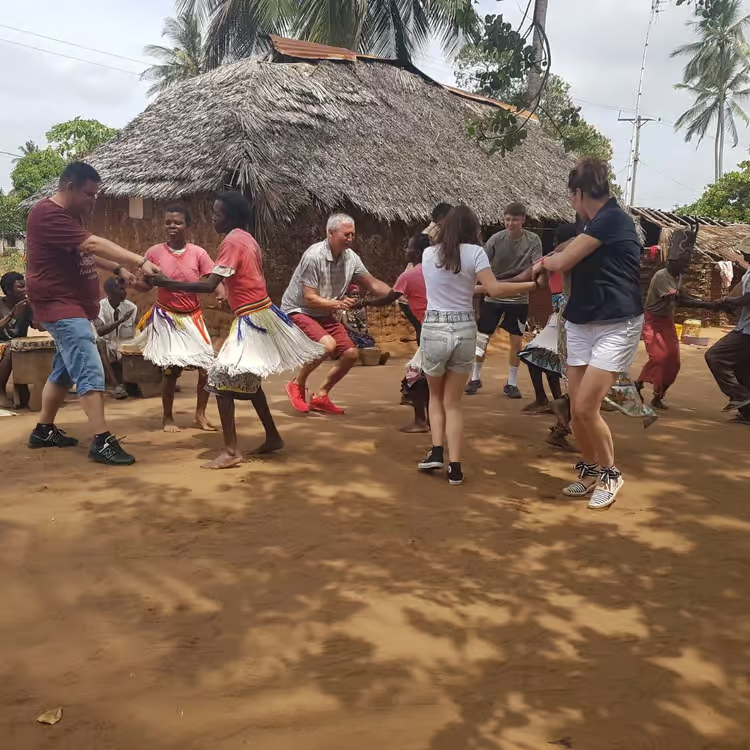
2 to 3 hours · From $70 per person, with a direct contribution to the host community
Local Village Cultural Visit
Away from Diani’s hotel strip, villages along the Kwale coast carry on daily life largely unchanged by tourism: farming, fishing, small scale trade and craft work passed down through families. A well run village visit trades the checklist feel of a formal tour for something closer to a genuine introduction, meeting people going about an ordinary day rather than watching a performance staged for visitors.
RYDER Signature works only with villages that have chosen, as a community, to welcome visitors on agreed terms, rather than arrangements negotiated informally on the day. What you see varies with the season and the village itself, but usually includes some combination of food preparation, craft demonstration and conversation with residents willing to share their part of the story.
Community welcome: a village elder or designated host greets visitors and gives context on the community’s history and daily rhythms.
Daily activities: depending on timing, this might mean watching or joining food preparation, farm work or fishing related tasks.
Home visits: a look inside a family home, showing how traditional coral stone or mangrove pole construction meets contemporary daily life.
Craft demonstrations: weaving, basket making or woodworking, done much as it has been for generations.
School stop: where arranged in advance, a brief, respectful visit to a local school.
Ask permission before photographing individuals. This is someone’s home and workplace, not a display, and visits are kept small and unhurried out of respect for that.
We work with a small number of villages with an established, willing arrangement in place, and avoid communities that have shifted toward a more staged, commercialised version of this experience. Part of every visit is directed toward a specific project the community has chosen, whether that is a school improvement or water access, so your visit leaves something behind rather than simply passing through.
Transport, guide and community contribution