The question is asked at every pre-departure briefing, in every online forum dedicated to Kilimanjaro, and in every conversation between someone who has climbed it and someone considering it: how hard is it, really? The answers span an extraordinary range. “It nearly killed me.” “My seventy-two-year-old mother managed it without much trouble.” “Nothing in my life has been harder.” “I expected worse.” All of these are true. All are also, in important ways, misleading.
Kilimanjaro is uniquely difficult to assess because the challenge is almost entirely altitude-dependent, and altitude response is one of the most individually variable physiological phenomena known to medicine. The physical fitness required is modest by the standards of serious mountaineering. The technical difficulty is genuinely low there are no ropes, no crampons, no technical climbing sections on the standard routes. What Kilimanjaro tests, above everything else, is how your body responds to being deprived of oxygen at progressively higher elevations.
The Altitude Problem: The Core of the Challenge
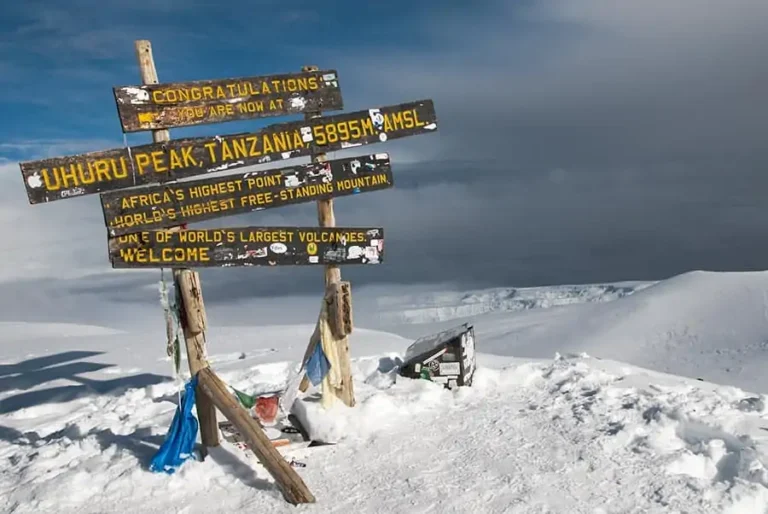
Uhuru Peak stands at 5,895 metres above sea level. At this elevation, the atmospheric pressure is roughly half that at sea level, which means each breath delivers approximately half the oxygen of a breath taken at the coast. The human body responds to this by doing several things: breathing more rapidly, increasing heart rate, and over days and weeks beginning to produce more red blood cells. These adaptations take time. A healthy person who ascends from sea level to 5,895 metres in six days is asking their body to begin an adaptation process that would normally take three to four weeks.
The result is that virtually everyone who climbs Kilimanjaro will experience some degree of altitude-related symptoms. Headache is universal. Fatigue disproportionate to the physical effort is the norm. Nausea affects a significant proportion of climbers, particularly in the final two days. Sleep above 4,000 metres is typically disturbed and unrewarding. None of these are signs that something is going wrong; they are the expected responses of a human body to an environment it was not evolved to inhabit.
What distinguishes a successful summit attempt from a failed one is usually whether these symptoms remain in the manageable category uncomfortable, limiting, but not dangerous or progress to something more serious. The more serious conditions, acute mountain sickness and its rare but dangerous complications, are discussed in a separate guide. What matters here is understanding that the altitude discomfort is the hard part of Kilimanjaro, not the walking.
The Walking: Genuinely Accessible
The walking itself stripped of the altitude would be considered a moderate-to-strenuous hiking experience by most standards. The daily stages on the Lemosho and Machame routes average four to seven hours of walking, typically ascending five hundred to eight hundred metres. The terrain is varied: forest paths, open moorland, rocky scree, a steep wall section at Barranco that requires hands and feet. None of it requires technical skill, specialist equipment or prior mountaineering experience.
The Barranco Wall which sounds alarming in guide descriptions is a steep, scrambling section of about 250 vertical metres that takes most parties ninety minutes to two hours to complete. It requires using hands for balance in some sections but is not a technical climb. A reasonably active person who is comfortable on uneven terrain will manage it without anxiety. Those with a fear of heights may find it uncomfortable at points; the actual risk of falling, with appropriate footwear and a guide nearby, is very low.
Summit night, in terms of walking, is the hardest section not because the terrain is technically difficult but because it is the longest single ascent, covering roughly 1,200 vertical metres over five to six hours in cold and darkness. The scree slope between Barafu Camp and Stella Point is where most climbers experience the full weight of altitude. Each step requires more conscious effort than it should. Progress is slow. The temptation to stop and rest is powerful and frequent.
Who Succeeds and Who Does Not
The statistics on Kilimanjaro summit success are often cited without the context that makes them meaningful. Overall success rates across all routes and all operators are estimated at between sixty and seventy per cent. This figure includes five-day Marangu itineraries which have notoriously low success rates and includes climbers who turned back for reasons unrelated to physical capacity: a sprained ankle, a scheduled departure, a travel companion in difficulty. It also includes climbers with inadequate preparation, inappropriate equipment, and poor operator selection.
Among climbers who choose appropriate routes (seven-day Lemosho or Machame), work with qualified operators, carry adequate equipment, and arrive with reasonable baseline fitness, success rates are considerably higher credible operators report seventy-five to eighty-five per cent or better on these itineraries. The gap between overall success rates and operator-specific success rates on good itineraries is large enough to be significant: the decision of which route and which operator to choose has more impact on whether you reach the summit than most factors within your control.
Fitness: What Is Actually Required
The fitness requirement for Kilimanjaro is often overstated in both directions. Some sources describe it as accessible to anyone; others suggest months of intensive training. The honest answer is that a person who is regularly active who walks or cycles or swims several times per week and who is capable of sustained physical effort for five to six hours can climb Kilimanjaro on a well-designed itinerary without extraordinary preparation.
A person who is sedentary, who does not exercise regularly, and who has never spent a night at altitude will find the combination of physical demand and altitude response significantly harder. This does not mean they cannot summit they may well but the margin is narrower and the discomfort is greater. For such a person, a three to four-month preparation programme that builds aerobic fitness progressively will make a material difference to the summit experience.
Age is less of a determining factor than fitness level. Kilimanjaro has been summited by children and by people in their eighties. Children under ten are prohibited by TANAPA regulations; the minimum age is ten, with parental consent and operator discretion. Older climbers typically have slower acclimatisation responses but often compensate with experience, pacing discipline and psychological resilience. A fit sixty-year-old will out-perform an unfit thirty-year-old on this mountain.
The Psychological Challenge
Summit night on Kilimanjaro is as much a psychological test as a physical one. The combination of altitude, cold, darkness, fatigue and the seemingly endless scree slope produces a quality of mental strain that experienced mountaineers describe as unique to very high altitude. The body is performing below its normal capacity; the brain, also deprived of oxygen, is less effective at the motivational processing that sustains effort under hardship.
The climbers who succeed are often not the fittest but the most mentally persistent. The determination to take one more step, and then another, in conditions where the rational brain is calculating how much easier it would be to turn around this is the quality that the mountain most reliably tests. Guides who work on Kilimanjaro year-round report that the climbers who surprised them most with successful summits were often not the ones who looked strongest at camp the night before.
Preparation for this psychological dimension is possible. Hikers who train in conditions that require sustained effort when tired long day walks that continue beyond the point of comfort, pre-dawn training sessions, any activity that habituates the body and mind to continued effort under fatigue will find the summit night more manageable. The mental rehearsal of what summit night will feel like, and of the decision point where turning back becomes possible, is worth doing explicitly before you leave home.
Comparison with Other Mountains
Kilimanjaro is often compared with the other Seven Summits the highest peaks on each continent and with the Himalayan trekking peaks. Against these benchmarks, its position is clear: technically, it is the most accessible of the Seven Summits, requiring no ropes, ice axes or technical mountaineering skills. Against Himalayan trekking peaks like Island Peak or Mera Peak, it is comparable in altitude but more straightforward in approach. Against Aconcagua at 6,962 metres, it is considerably lower and less technically demanding; against Denali, it is in an entirely different category.
The fair comparison is with very high altitude trekking, such as the Annapurna Circuit in Nepal reaching 5,416 metres at Thorong La pass. A Kilimanjaro summit is approximately 480 metres higher than this pass, achieved more rapidly, which explains why the altitude impact is typically more pronounced. Trekkers who have crossed Thorong La without difficulty will likely have a positive Kilimanjaro experience; those who experienced severe AMS on Himalayan treks should take medical advice before attempting Kilimanjaro and should discuss Diamox use with their doctor in advance.
What Makes It Worth It
After all of this the altitude discomfort, the summit night cold, the disturbed sleep at high camp what Kilimanjaro delivers at the top is genuinely remarkable. The summit at sunrise, with Africa spread below in every direction, the glaciers beside you and the crater behind you, is an experience that justifies the preceding difficulty in a way that is hard to articulate to someone who has not been there. The physical and psychological effort required to reach that point gives the summit a quality of meaning that a cable car could not provide.
Kilimanjaro is hard in the way that worthwhile things are often hard not through technical danger or specialist requirement, but through sustained demand on the body and the will. Most people who attempt it on a well-designed itinerary, with appropriate preparation and honest expectations, either summit or come very close to it. Most who summit describe it as the most significant physical achievement of their adult life. That assessment, from people across an enormous range of fitness levels and backgrounds, is worth taking seriously.
How RYDER Signature Prepares Clients
Every RYDER Signature Kilimanjaro client receives a detailed pre-departure briefing that covers altitude physiology, training guidance, gear requirements, and a realistic description of what each day and summit night will feel like. We do not minimise the difficulty or promise summits. We do explain the specific factors route choice, itinerary length, guide quality, pacing that most reliably predict a successful outcome, and we design every itinerary with those factors optimised for the individual client’s profile.
Do I need previous mountaineering experience?
No. Kilimanjaro’s standard routes involve no technical mountaineering. What is helpful is experience of multi-day hiking, comfort with early starts and sustained physical effort, and ideally some exposure to moderate altitude. Previous experience at over 3,000 metres provides useful information about your personal altitude response, which is more valuable preparation than any technical skill.
Is Kilimanjaro harder than Everest Base Camp?
The Everest Base Camp trek reaches approximately 5,364 metres Kilimanjaro’s summit is 531 metres higher, achieved over a similar or shorter number of days. EBC is generally considered a less intense altitude experience because the trek takes longer to ascend, allowing more gradual acclimatisation. That said, the walking on EBC is longer in total duration and involves more technical terrain at lower elevations. Kilimanjaro is specifically more concentrated in its altitude profile; EBC is a longer physical commitment with better acclimatisation. Direct comparison is complicated, but a person who has done EBC comfortably is well-placed to attempt Kilimanjaro.
What percentage of people fail to summit Kilimanjaro?
Overall industry estimates suggest thirty to forty per cent of attempts do not reach the summit, though this varies significantly by route and operator. On a well-managed seven-day Lemosho or Machame itinerary with a reputable operator, failure rates are considerably lower credible operators report fifteen to twenty-five per cent non-summit rates on these itineraries. The most common reasons for turning back are altitude sickness symptoms that make continued ascent medically inadvisable, not voluntary decision or physical exhaustion.
Can I use Diamox to improve my chances?
Diamox (acetazolamide) is a medication that accelerates the acclimatisation process and reduces the severity of altitude sickness symptoms. It is widely used on Kilimanjaro and is medically endorsed for altitude prophylaxis. It should be discussed with your doctor before the climb, as it is a prescription medication with specific contraindications including sulpha drug allergy. Many experienced Kilimanjaro climbers use it as a precaution; others prefer to rely on itinerary design and pacing. The decision is individual and medical, not categorical your doctor and your operator can both contribute useful information to it.
The Day-by-Day Experience of Difficulty
One of the most useful things a pre-climb briefing can do is describe the difficulty progression day by day, so that climbers understand what to expect rather than measuring each day against an abstract sense of how hard it “should” be. On a seven-day Lemosho itinerary, the first two days in the forest and lower moorland feel like a moderately demanding hiking holiday. The challenge is real but accessible. By day three on the Shira Plateau, at around 3,800 metres, most climbers begin to feel the altitude in the form of reduced appetite, slightly heavier legs and a sleep quality that is noticeably worse than at home. Day four, with the acclimatisation ascent to Lava Tower at 4,600 metres and the descent to Barranco, is typically the day that most clearly reveals how the altitude is affecting each individual. The guides watch closely.
Days five and six bring the physical demands of the Barranco Wall and the long walk to Barafu, combined with altitude that is now above 4,600 metres. The body’s energy budget is being spent on altitude adaptation at the same time as walking; the result is a fatigue that feels disproportionate to the effort. Most experienced climbers describe these days as harder than they expected not because of the terrain but because of how much oxygen costs at this elevation. The summit departure at midnight on day six or seven is when the full complexity of the challenge becomes apparent, and when the quality of preparation, route design and guide support determines whether the attempt succeeds.
Understanding this arc in advance the gradual escalation, the day four altitude reveal, the summit night commitment allows climbers to contextualise their experience rather than interpreting day-three fatigue as a sign that they cannot complete the climb. Most people who turn back on Kilimanjaro do so not because they are genuinely incapable of continuing but because the experience was not what they expected, and the expectation gap produced anxiety that the altitude-depleted brain could not manage. Honest briefing before departure is one of the most effective tools available for improving summit rates.
Managing Expectations and Finding Your Pace
The phrase every Kilimanjaro guide uses and means is pole pole, the Swahili for “slowly slowly.” The most consistent error made by fit, motivated climbers is ascending too quickly, driven by the body’s natural inclination to find a sustainable aerobic pace. At altitude, that pace is not what it would be at sea level. The oxygen debt of moving quickly outweighs the benefit of covering ground faster, and the excess effort above a conservative pace costs more in recovery time than it saves in ascent time. Guides on well-run operations actively regulate pace; less experienced guides allow clients to set their own, which is how capable people walk themselves into an altitude crisis on day four that a more conservative ascent would have avoided entirely.
The climbers who manage Kilimanjaro’s difficulty best are often not the fittest or the most experienced hikers. They are the ones who trusted their guide’s pace, ate and drank consistently even when appetite failed, communicated honestly about their symptoms rather than minimising them, and treated rest days with the same discipline they applied to summit days. The mountain is hard in specific, manageable ways. Understanding those ways before you start the climb is the preparation that matters most.
Kilimanjaro’s difficulty is real, specific and well-documented. It is also genuinely surmountable by a wide range of people who approach it with the right information, the right route, and the right support. The honest answer to “how hard is it really?” is: harder than most people expect in the ways that altitude makes everything harder, and easier than most people fear in the ways that physical strength and technical skill are usually not the limiting factors. Prepare for the altitude. Respect the pace. Choose an itinerary long enough to acclimatise. Find a guide you trust. The summit is reachable from there.