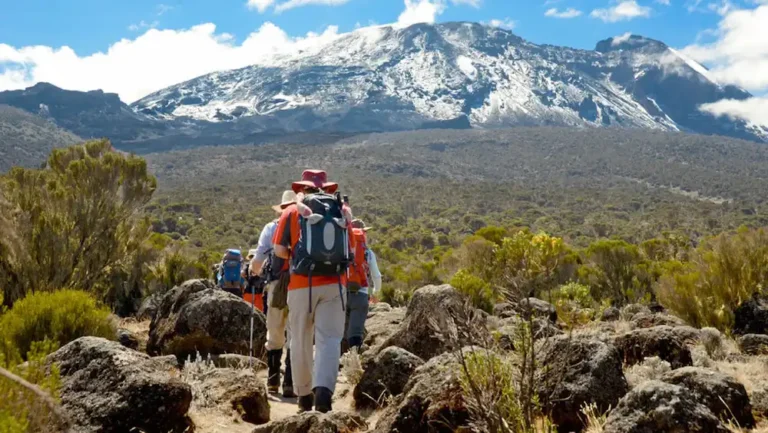
The crew that makes a Kilimanjaro climb possible numbers fifteen to twenty people for a party of four. Most climbers have no clear picture of this until they arrive at the Machame or Lemosho gate and watch their guide organise the assembly the porters dividing loads, the cook checking the kitchen equipment, the assistant guides completing permit paperwork. By the time the party sets off, each climber is supported by a small team they have not met and whose roles they may not fully understand. This is worth changing, both for the quality of the relationship during the climb and for the responsibility that comes with employing people whose welfare depends on the decisions made at booking.
The Lead Guide: The Most Important Person on the Mountain
The lead guide is the climber’s primary point of contact, safety manager, interpreter, natural history educator and, on difficult days, the person whose calm authority makes continuation possible when the rational brain is arguing for descent. They carry a final authority on summit decisions and descent decisions that supersedes the client’s preferences when medical safety is at stake. They are, in the most direct sense, responsible for every person in their party reaching the bottom of the mountain safely.
A qualified Kilimanjaro guide holds certification from the Tanzania Wildlife Management Authority (TWMA) and has typically completed hundreds of ascents across multiple routes before leading independently. The best guides have specialised knowledge in altitude medicine, wilderness first aid and natural history that they have accumulated over years of working on a specific ecosystem. The guides who have been with one reputable operator for ten or more years are typically among the finest mountain guides working in East Africa they have the accumulated knowledge of the specific mountain that comes only from repeated, attentive experience.
The lead guide sets the pace, manages the daily schedule, conducts the medical assessments at each camp, makes the go/no-go decision for summit night, and manages the descent if a climber deteriorates. They also, on a well-run operation, serve as the primary educator about the mountain its geology, ecology, cultural history and the conservation context that makes the climb possible. The quality of this role is the largest single determinant of the quality of your Kilimanjaro experience.

Assistant Guides: The Support Structure
Most responsible operators include one or two assistant guides per party, depending on group size. The assistant guide’s role is support: they walk at the rear of the group to ensure no one is left behind, provide additional medical monitoring capacity, assist the lead guide in camp setup oversight, and in emergency situations act as the second trained person needed to manage a simultaneous continue-and-descend scenario on summit night.
The assistant guide is typically less senior than the lead and may be accumulating the experience needed to qualify as a lead guide themselves. Many excellent Kilimanjaro lead guides spent three to five years as assistants before their first independent leadership role. An operator who employs assistants on a career pathway not merely as cheaper additional labour is investing in the long-term quality of their guide team.
The assistant guide should be confirmed in advance with any operator booking. A solo private climb may not require an assistant in all circumstances; a group of six or more on a responsible climb should have at least one. The absence of an assistant guide on a large group summit night is understaffed for the altitude risk and is a specific question worth raising with any operator.
Porters: The Physical Foundation
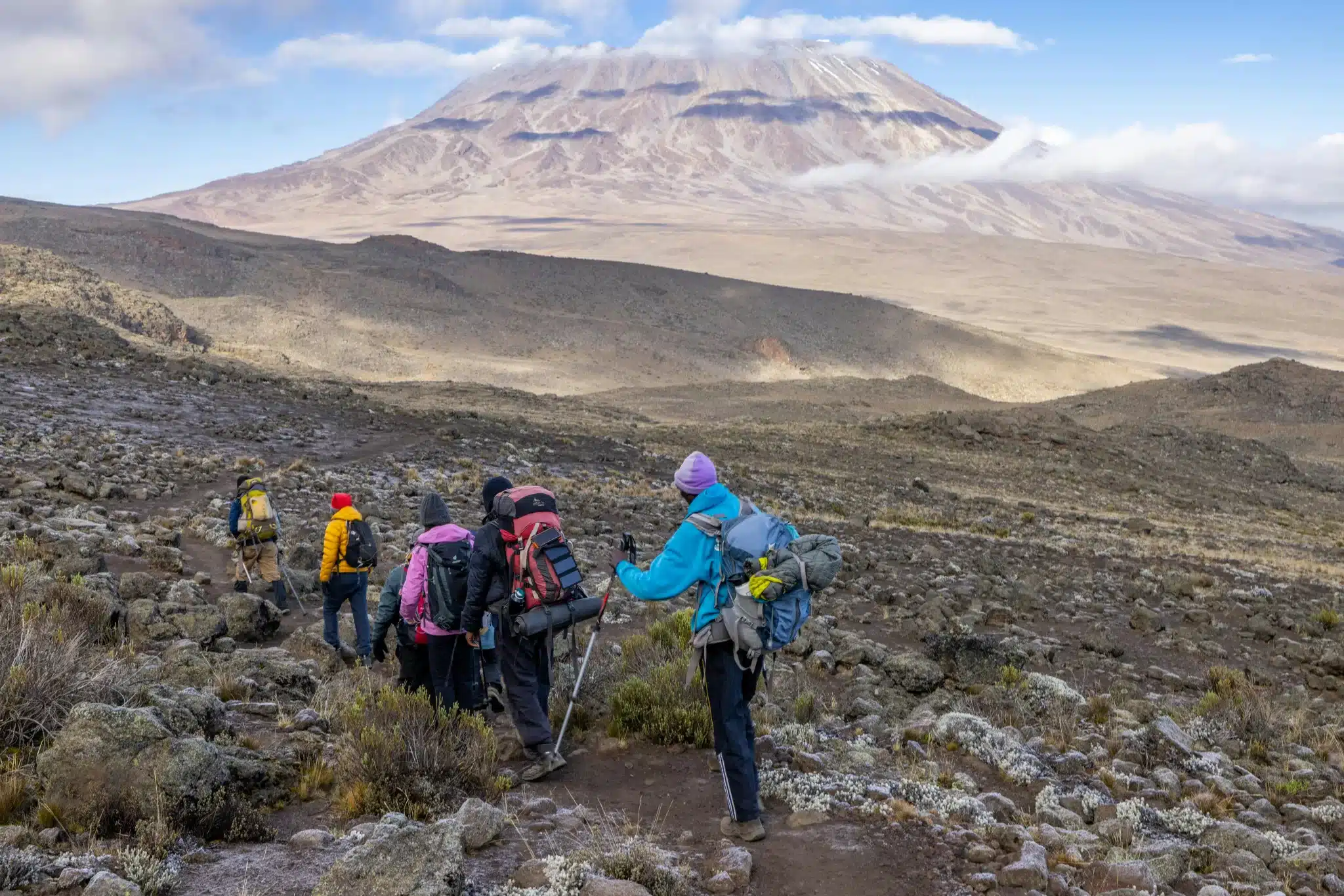
Kilimanjaro porters carry the equipment that makes comfortable camping at altitude possible. Each porter is assigned a regulated load twenty kilograms maximum under KPAP standards, comprising fifteen kilograms of client gear plus five kilograms of their personal equipment. They carry loads in a wide variety of ways: on their heads in the traditional East African style, in frame rucksacks, or in handmade rope harnesses of extraordinary ingenuity. Many ascend in sandals or basic trainers, covering in bare practicality the same terrain that climbers in technical hiking boots sometimes struggle with.
The porter’s working day is more demanding than the climber’s. They carry heavy loads at altitude, often moving faster than the client party to set up camp before the climbers arrive. They do not have the luxury of acclimatising slowly the porter’s schedule is determined by the client itinerary, not by their own physiological needs. Many porters work multiple climbs back-to-back, with minimal rest between descents and departures. The cumulative physical demand of this work, over a career that may span twenty years, is significant.
Understanding the porter’s experience changes the relationship. Most experienced climbers, looking back on their Kilimanjaro climb, describe an increasing respect for the porters as the days progress and the altitude makes the climbers themselves more aware of how hard the ascent is. By the time a porter jogs past a struggling climber at 4,500 metres carrying a load that would buckle most people’s knees at sea level, the admiration is unconditional.

The Cook: The Underrated Member
A skilled Kilimanjaro cook is, at altitude and under field conditions, producing meals of a quality that would be impressive in a domestic kitchen. Three meals a day for a party of eight, cooked on portable gas stoves in a tent kitchen, at elevations where water boils at temperatures far below the standard hundred degrees — the technical demands of high-altitude cooking are genuine. A good cook understands which dishes work at altitude, which cooking times require adjustment, and how to maintain food safety standards in conditions where contamination risk is higher than at sea level.
Food quality has a direct relationship with summit success. At altitude, appetite is suppressed and caloric demand is high. A cook who produces meals that remain palatable even when the climber has no appetite the right textures, the right flavours, the right portion calibration for altitude-depressed stomach capacity is doing work that affects the physiological state of every person in the party. This is not incidental to the climb; it is integral to it.
On a quality Kilimanjaro operation, the cook meets the party at base camp and introduces themselves, asks about dietary requirements and preferences, and produces a menu that accommodates them. The relationship between cook and party is less visible than that between guide and party but no less significant.

Porter Welfare: The Ethical Dimension
The economic conditions for Kilimanjaro porters have historically been poor enough to constitute a genuine ethical issue in the industry. Wages below living wage, weight loads exceeding safe limits, inadequate equipment for high-altitude cold, and end-of-trip non-payment have all been documented by the Kilimanjaro Porters Assistance Project (KPAP) in their research. These conditions are not universal many operators provide adequate wages and equipment but they are common enough to require active attention from climbers choosing an operator.
The porter wage question is the most direct. KPAP’s current recommended daily minimum is published on their website and is above Tanzania’s legal minimum wage for casual agricultural labour. A responsible operator pays at or above this level. An operator who cannot confirm their porter daily rate, or who pays at or below the legal minimum, is making a specific economic choice about crew welfare that the porter’s family experiences directly.
Equipment provision is the second critical dimension. Porters working above 4,000 metres in the Kilimanjaro dry season encounter temperatures that cause hypothermia in inadequately clothed workers. A responsible operator provides every porter with sufficient insulation for the altitudes they will work at. The KPAP inspection programme includes spot checks of porter clothing at the gate; operators whose porters consistently fail these checks are identified publicly.
Tipping: The Practical Mechanics
Tipping is a significant component of mountain crew income on Kilimanjaro and is expected by every crew member at the conclusion of the climb. KPAP publishes recommended daily tip rates by crew role guide, assistant guide, cook, porter and these are the most reliable reference point for estimating the tip envelope.
Tip amounts typically range from USD 20 to 30 per day for the lead guide, USD 15 to 20 per day for assistant guides and cook, and USD 8 to 12 per day for porters. For a seven-day climb with a crew of fifteen, the total tip envelope for a party of four is approximately USD 400 to 500 roughly USD 100 to 125 per climber. This should be budgeted as part of the total climb cost, not treated as an optional extra.
Tips are typically distributed at a ceremony at the gate on descent day, with the guide receiving their portion first and distributing to the crew. Many climbers find this ceremony one of the most emotionally resonant moments of the climb the acknowledgment of the collective effort that produced the summit is, on a good climb, genuinely moving.
How RYDER Signature Approaches Crew Relationships
Every RYDER Signature Kilimanjaro client receives a crew briefing before departure that covers the roles described above, the tipping framework, and a direct request to take the crew relationship seriously. We introduce the lead guide to clients before the first day and encourage conversations during the climb about the guide’s experience, the mountain’s character, the ecology of the specific zone. The quality of the guide-client relationship is one of the most reliable predictors of client satisfaction on any Kilimanjaro operation, and it is developed through genuine engagement rather than through passive reliance on the guide’s expertise.
We verify the crew welfare standards of every operator we work with and discontinue partnerships where those standards fall below the criteria we apply. The crew is not an invisible support service; they are the human foundation of the entire experience, and treating them accordingly is not a charitable impulse but an accurate recognition of what their work contributes.
How do I communicate with the guide during the climb?
Most Kilimanjaro lead guides speak fluent English alongside Swahili and have extensive experience communicating with international climbers. Daily briefings, the evening assessment and summit night preparation are all conducted in English. More informal communication the guide pointing out a bird species, explaining a geological feature, sharing a meal story happens throughout the walking day and enriches the experience significantly. Engage actively rather than passively; the guides who enjoy the work most are those whose clients are genuinely curious about the mountain.
Is it possible to request a specific guide?
With most reputable operators, yes for private climbs, requesting a guide by name whose background you have researched is entirely reasonable and should be accommodated where the guide is available. For group climbs, guide assignment is typically made by the operator based on scheduling; expressing a preference is worth stating but may not be accommodated if the preferred guide is committed elsewhere. RYDER Signature always confirms guide assignment with clients before departure and can facilitate a guide introduction call for clients with specific preferences or concerns.
Can I hire additional porters for personal carrying assistance?
Yes. Some climbers, particularly those with knee issues or limited upper body strength, hire an additional porter to assist with their day pack during the approach days. This is a normal and accepted arrangement. It provides employment, reduces the client’s physical burden, and can make the difference between a comfortable summit attempt and an exhausted one. Discuss the arrangement with your operator at booking; the additional porter is employed at the standard rate and included in the crew welfare provision.
What happens to the crew after the climb ends?
After a descent to the gate and the tip ceremony, the crew returns to Moshi or their home communities to rest before the next assigned climb. Lead guides with a full season may be on the mountain twenty or more days per month. Porters work more irregularly, dependent on operator demand. The best operators maintain long-term relationships with their crew, providing employment across multiple seasons rather than sourcing crew on a casual basis, which allows crew members to build skills, advance into higher roles, and develop the deep mountain knowledge that distinguishes the best teams.
The Long-Term Relationship Between Climbers and Crew
Something happens between the people who share a Kilimanjaro climb that is different from most service industry relationships. The intensity of the experience the shared difficulty, the vulnerability of altitude, the dependence on the crew’s skill and knowledge creates a quality of connection that persists. Many climbers maintain contact with their guides for years after the climb. Some return specifically to climb with the same guide a second or third time. The relationship is not equal in its economic dimensions, but it is genuine in its human ones.
The guides who work on Kilimanjaro for twenty years, who have led thousands of climbers to the summit, who know every campsite’s drainage pattern and every section’s altitude demand in their bones these are professionals of a high and specific order. The climber who recognises this, who engages with genuine curiosity and respect for what the guide knows, receives an immeasurably richer experience than one who treats the guide as a service provider navigating a transactional arrangement. This is not sentimentality; it is the straightforward observation that the guide who senses genuine engagement gives more of what they know. The mountain is the same for everyone. The experience of it is not.
The porter who carried your bag to Barafu and the cook who managed your calories through seven days at altitude are doing work that your summit depends on. Recognising this explicitly through conversation, through the tip ceremony, through the basic courtesy of learning names and saying thank you in Swahili costs nothing and enriches the experience in ways that cannot be quantified but are consistently described by experienced travellers as among the most memorable parts of any Kilimanjaro climb.
Understanding the Full Crew Economics
The total labour cost of a well-run Kilimanjaro seven-day climb wages, equipment, food, transport represents a significant proportion of the operator price, and this proportion is one of the clearest indicators of operator quality. An operator charging USD 1,200 per person for a seven-day private climb with a crew of fifteen is either using substandard equipment, paying below-welfare wages, or both. The arithmetic does not permit otherwise.
Transparency about crew economics which KPAP partner operators provide and which responsible operators can confirm independently is the most direct indicator of whether the people who make your climb possible are being treated with the respect their work deserves. The climber who asks these questions before booking is not being difficult; they are asking the operator to be accountable for the human dimension of an experience that depends entirely on human skill and effort. In an industry where this accountability is not universal, the question is one of the most powerful tools available to a traveller who wants their money to reflect their values.