Try: Serengeti · Kilimanjaro Lemosho · Zanzibar · Family Safari
Traverse the pristine western wilderness of Kilimanjaro through ancient rainforest and the breathtaking Shira Plateau. The 8-day Lemosho Route delivers unmatched scenic beauty, excellent acclimatisation, and the uncrowded experience discerning climbers seek.
Why the Lemosho Route Represents Kilimanjaro’s Finest
The Lemosho Route 8-day Kilimanjaro itinerary consistently ranks as the mountain’s premier climbing option among experienced guides and returning climbers. This western approach delivers what serious adventurers seek: pristine wilderness, exceptional scenery, manageable crowds, and acclimatisation profiles that translate directly to summit success rates exceeding 90%.
Where other routes funnel climbers through well-worn paths, the Lemosho enters Kilimanjaro from the remote western slopes via the lush Lemosho Glades. The first two days traverse genuine wilderness where elephant and buffalo sightings remain possible — a wild introduction unavailable on busier routes. The gradual ascent through the Shira Plateau provides extended acclimatisation impossible to replicate on faster approaches.
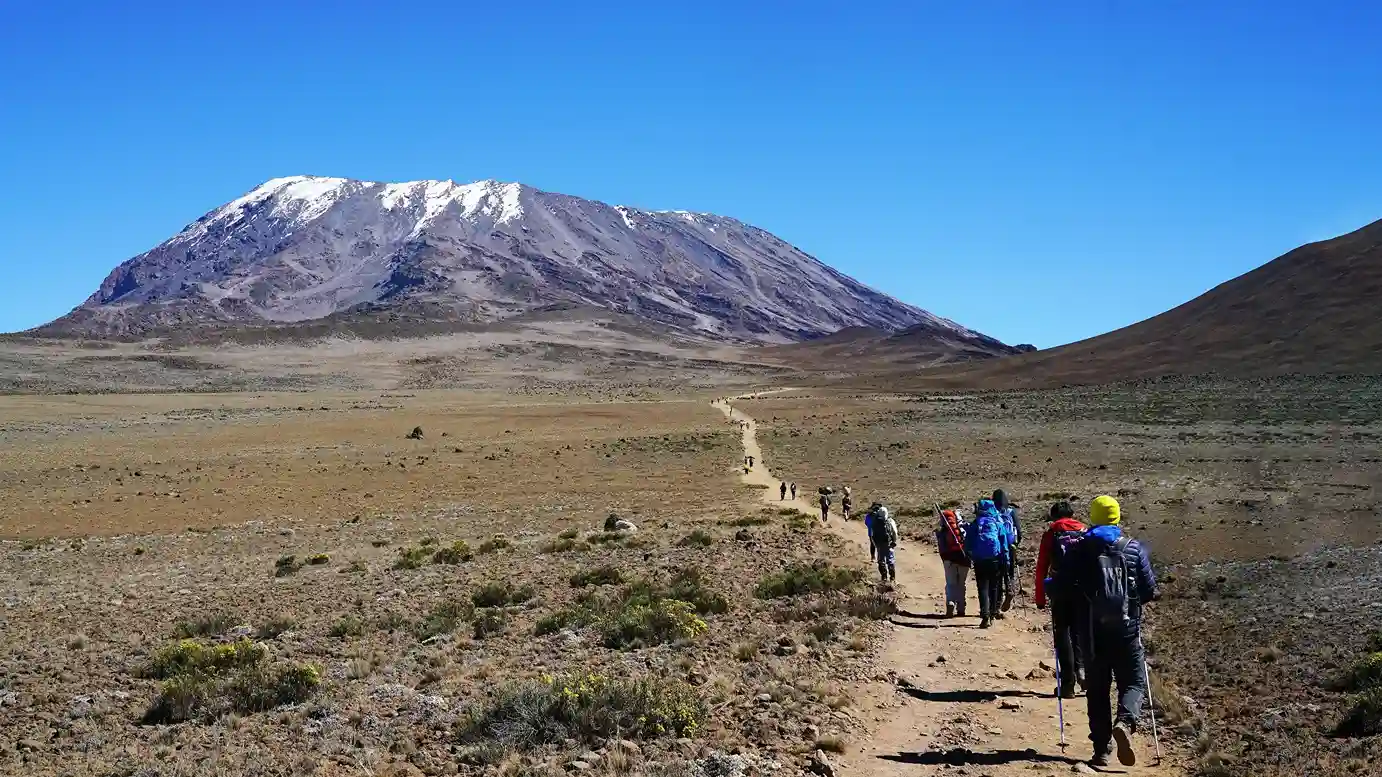
The Shira Plateau crossing defines this route’s character. This vast, otherworldly landscape — the collapsed caldera of Kilimanjaro’s oldest volcanic cone — stretches beneath Kibo Peak’s imposing western face. Nowhere else on the mountain offers such expansive vistas combined with relatively gentle terrain. Climbers consistently describe these days as transformative, the mountain’s scale becoming tangible through sustained immersion.
RYDER Signature particularly recommends the 8-day Lemosho Route for photographers, nature enthusiasts, those seeking uncrowded trails, and any climber prioritising experience quality alongside summit success.
Remote western trailhead with possible elephant and buffalo encounters in ancient montane forest.
The full Shira Plateau crossing — 16km beneath Kibo's western face — delivers Kilimanjaro's finest panoramas.
Gradual elevation profile with a dedicated "climb high, sleep low" day at Lava Tower boosts summit success.
Remote trailhead deters casual climbers, creating more intimate camps and quieter trails throughout.
| Day | Stage & Destination | Elevation | Distance | Duration | Meals |
|---|---|---|---|---|---|
Meal Key: B = Breakfast · L = Lunch · D = Dinner
The ascent plays automatically once you scroll to it, looping through the whole route. Click any day card to jump straight to that point, or use Play Ascent to start another lap.
Shaded map rings are approximate distance bands for orientation, not surveyed boundaries. Elevation-profile colors group this route's own zone labels, entered per stop, or an elevation-based guess where none was given. Route distances are calculated straight-line between known points, not surveyed trail distance.
Arrival Day
Wilderness Gateway
Forest to Moorland Transition
Plateau Crossing
The Altitude Challenge
Wall Conquest
High Camp Arrival
★ Summit Day — The Moment Everything Builds Toward
★ Summit Day
Departure
Forest Zone
Your Kilimanjaro adventure begins at Kilimanjaro International Airport (JRO), where a RYDER Signature representative awaits with a warm Tanzanian welcome. The 45-minute transfer to Moshi reveals coffee plantations framing your first glimpse of Kilimanjaro’s snow-capped summit through the clouds — a preview of what awaits.
At your hotel, our team conducts a comprehensive expedition briefing covering equipment checks, route expectations, and final questions. The Lemosho trailhead requires an extended drive tomorrow morning, so rest well tonight, hydrate thoroughly, and prepare your daypack for immediate access after breakfast.
The morning begins with a scenic 3–4 hour drive from Moshi, circling Kilimanjaro’s base through rural villages and lush farmland. Children wave from schoolyards, farmers tend their shambas (small farms), and the mountain appears and disappears behind clouds — a wonderful overture to the days ahead.
At Lemosho Glades (2,100m), registration proceeds while porters organize equipment. Unlike busier gates, this remote trailhead feels genuinely wild from the first step. Your guides lead into dense montane rainforest where massive trees draped in moss and lichen create cathedral-like spaces that filter golden morning light.
This forest harbours Kilimanjaro’s wildest character. Elephant and buffalo occasionally roam these slopes — while sightings aren’t guaranteed, the possibility adds genuine excitement to every trail bend. Black-and-white colobus monkeys are more reliably spotted, along with blue monkeys and a wealth of forest birdlife. The trail climbs gently, emerging at Mti Mkubwa (“Big Tree”) Camp as afternoon shadows lengthen.
Today’s trek continues through upper montane forest before emerging into the heath zone — a dramatic transition that reveals progressively broader views and a profound shift in Kilimanjaro’s character. The morning offers final wildlife encounters as you leave the forest’s protective canopy behind.
The vegetation transforms noticeably throughout the day. Dense rainforest yields to tree heathers and giant groundsels — the signature plants of Kilimanjaro’s middle elevations. Views expand as tree cover diminishes, and by afternoon, Kibo Peak’s western face dominates the horizon like a cathedral rising from the plateau.
Arrival at Shira 1 Camp places you at the western edge of the Shira Plateau — the vast collapsed remnant of Kilimanjaro’s oldest volcanic cone. This elevated plain stretches northward, and Kibo Peak rises majestically to the east. On clear evenings, the glaciers catch golden light and Mount Meru floats above western clouds.
This moderate day crosses the heart of the Shira Plateau — one of Kilimanjaro’s most remarkable landscapes and unique in all of African mountaineering. The vast caldera floor stretches in all directions, bounded by ancient rim walls and dominated by Kibo’s imposing western presence. The terrain feels genuinely otherworldly: a volcanic moonscape punctuated by hardy senecio plants and lobelias.
The relatively short distance allows a leisurely pace perfect for photography, wildlife observation, and the critical work of acclimatisation. Your guides share geological history, point out volcanic features, and monitor each climber’s condition as altitude quietly increases. The Shira Route merges briefly, though Lemosho climbers arrive better prepared thanks to their lower starting elevation.
Afternoon arrival at Shira 2 Camp provides time for optional acclimatisation walks to higher ground — a rewarding way to extend the day’s altitude exposure before descending back to sleep. The 360-degree views from camp — Kibo east, Shira Cathedral north, Meru west — create one of the mountain’s finest sunset settings.
This pivotal day implements the “climb high, sleep low” acclimatisation strategy that is central to the Lemosho’s exceptional summit success rate. The ascent takes you through increasingly barren alpine desert toward Lava Tower — a dramatic 300-foot volcanic plug rising at 4,630 metres — an elevation matching many significant world peaks.
The morning crosses the Shira Plateau’s eastern edge, entering terrain where vegetation becomes increasingly sparse. Hardy lichens and mosses represent life’s final outposts as you gain the lunar landscape surrounding Lava Tower. Your guides monitor each climber carefully — headaches and fatigue are normal responses to this elevation and signal your body adapting.
After lunch at Lava Tower, the afternoon descent into the Great Barranco Valley provides welcome physical relief while triggering crucial physiological adaptation. Losing approximately 650 metres, you arrive at Barranco Camp with the imposing Barranco Wall — tomorrow’s iconic challenge — rising directly ahead in the evening light.
Morning begins with Kilimanjaro’s most iconic challenge: the Barranco Wall. This 257-metre rock barrier appears impossibly steep from camp, but a well-established route navigates its natural weaknesses through Class 2–3 scrambling. No technical equipment is needed — just your hands for balance and complete trust in your guides’ experience.
The famous “Kissing Rock” section creates one of the trek’s most photographed moments, requiring climbers to press against the cliff while edging along a narrow ledge above a dramatic drop. The sense of accomplishment on cresting the wall is immediate and profound — a powerful confidence injection precisely when summit night looms ahead.
After conquering the wall, the trail traverses beneath the Heim and Kersten Glaciers, offering humbling close-up views of Kilimanjaro’s rapidly retreating ancient ice fields. The relatively short day allows afternoon rest and meal preparation at Karanga Camp, strategically positioned for tomorrow’s push to high camp.
Today’s climb delivers you to Barafu Camp — the launching point for your summit attempt. The trail ascends steadily through completely barren volcanic terrain where virtually no vegetation survives. Rock and scree dominate beneath vast African skies as the air grows noticeably thinner with every step.
Your body’s adaptation from the Lemosho’s gradual six-day approach becomes apparent now. Many climbers report feeling notably stronger at Barafu than expected — a testament to this route’s superior acclimatisation profile. This enhanced physiological condition proves invaluable during the summit push just hours away.
Arriving early afternoon allows essential time for rest, careful nourishment, and meticulous gear preparation. Your guides conduct a detailed summit briefing covering layering strategies for temperatures of -15°C to -25°C, pacing expectations on the scree, and turnaround protocols. Mental preparation during these quiet hours directly impacts your summit night performance.
Between 11 PM and midnight, guides rouse climbers for the moment your entire journey has built toward. Hot drinks and final layering precede departure into Kilimanjaro’s coldest, most magical hours. Temperatures plunge to -15°C to -25°C with wind chill — the proper gear you carefully prepared is now genuinely life-preserving equipment, not mere clothing.
Headlamps create a serpentine line ascending toward Stella Point through the pre-dawn darkness. The scree-covered trail zigzags relentlessly upward, each step a small victory against altitude and fatigue. Your superior acclimatisation from the Lemosho’s gradual approach manifests powerfully now — challenging as climbing remains, you possess physiological reserves that shorter routes cannot provide.
Stella Point (5,756m) marks the crater rim, typically reached near sunrise. The spectacle of dawn breaking across Africa — golden light flooding the plains stretching endlessly below — ranks among mountaineering’s most profound and permanent experiences. Uhuru Peak (5,895m) awaits approximately 45 minutes further along the crater rim. The famous summit sign, personal photographs, and quiet reflection mark brief moments at Africa’s highest point before guides initiate descent — extended time at extreme altitude poses genuine health risks.
The descent to Barafu Camp takes 3–4 hours, followed by continued descent to Mweka Camp through moorland and into upper rainforest. The rich oxygen at lower elevation feels almost intoxicating after six days above 3,000 metres.
The final mountain morning carries accomplishment and bittersweet emotion as your expedition concludes. Descent through Mweka’s rainforest reveals vegetation passed six days ago, now experienced through a summiter’s perspective — the same ancient trees, the same birdsong, but you are irrevocably changed.
Birdsong and monkey calls return as forest thickens. The rich scents of earth and vegetation feel amplified after days in thin, dry mountain air. Trails can be muddy and slippery after rains — trekking poles prove valuable on the descent.
Mweka Gate hosts the farewell ceremony. Guides present summit certificates — green for Uhuru Peak, brown for Stella Point — while you distribute gratuities expressing sincere gratitude to the porters, cooks, and guides who enabled every step of your success. A RYDER Signature vehicle returns you to Moshi, where hot showers, comfortable beds, and celebration dinners restore your body and crystallise your memories.
Breakfast precedes your transfer to Kilimanjaro International Airport for onward journeys. The drive offers final views of your conquered mountain — a peak that now holds permanent, personal significance. For many RYDER Signature climbers, this is not a farewell but a first acquaintance with a mountain they will return to.
High-quality 4-season sleeping bag rated to -15°C. Suitable for all mountain camps including Barafu and summit night.
Dedicated porter for your personal daypack on the mountain, allowing you to hike hands-free on all sections including the Barranco Wall.
4-day guided climb of Tanzania's second peak (4,566m). Outstanding wildlife and volcanic scenery while building superior altitude tolerance before Kilimanjaro.
3–5 nights of tropical recovery on Zanzibar's pristine beaches. Direct flights from Kilimanjaro, seamless post-climb extension with full concierge service.
Extend your Lemosho climb by 2 days for Kilimanjaro's full 360° circumnavigation via the Northern Circuit — the mountain's most comprehensive and uncrowded route.
3–7 day Northern Circuit safari (Serengeti, Ngorongoro, Tarangire). Complete the ultimate Tanzania adventure — summit Africa's highest peak, then witness its greatest wildlife spectacle.
Absolutely. The 3–4 hour drive passes through beautiful Tanzanian countryside and places you at a remote, uncrowded trailhead. The wilderness character of the first days — with possible elephant and buffalo sightings, colobus monkeys, and genuine forest solitude — justifies the extra drive time many times over. Lemosho climbers consistently rate the approach as among the most memorable parts of their entire experience.
No — wildlife moves freely and sightings cannot be guaranteed. However, elephant and buffalo do inhabit the western Kilimanjaro forests, and encounters occur regularly. Black-and-white colobus and blue monkeys are reliably spotted on most departures. The possibility of large mammal encounters adds genuine wild-Africa excitement that no other Kilimanjaro route offers.
The 8-day Lemosho Route achieves a 90–95% summit success rate with RYDER Signature — among the highest of any Kilimanjaro route. The superior acclimatisation profile, including the dedicated “climb high, sleep low” day at Lava Tower (4,630m) and the gradual western approach starting at 2,100m, are the primary drivers of this exceptional rate.
Both are excellent routes, but they serve different priorities. The Lemosho offers superior acclimatisation (starting 460m higher than Machame), lower crowds, fuller Shira Plateau crossing, and possible wildlife encounters — at the cost of a longer drive and slightly higher price. The Machame offers a shorter drive, more established trail culture, and is ideal for those with tighter budgets or schedules. For discerning climbers who prioritise experience quality and success rates, Lemosho is the clear recommendation.
Yes — after the Shira Plateau, Lemosho climbers can continue via the Northern Circuit rather than descending to Barranco. This adds 2 days and provides Kilimanjaro’s most complete 360° circumnavigation experience, including access to the remote northern slopes rarely seen by other climbers. Contact RYDER Signature at booking to customise your Northern Circuit extension.
While our 90–95% success rate reflects genuine altitude preparation and expert guiding, summit attempts are always subject to individual physiology and mountain conditions. Climbers who reach Stella Point (5,756m, the crater rim) receive a Stella Point certificate — a significant mountaineering achievement in its own right. Our guides are trained to make evidence-based turnaround decisions prioritising your long-term safety and health over summit statistics.
Genuine wilderness, exceptional scenery, and the acclimatisation profile that delivers summit success.