Snorkelling and Diving in Zanzibar: A Complete Guide
The Indian Ocean surrounding Zanzibar is one of Africa’s most ecologically complex and most rewarding underwater environments a system of fringing reefs, offshore atolls, deep-water channels, and sheltered bays that encompasses extraordinary marine biodiversity and provides snorkelling and diving experiences that, at their best, rival the world’s most celebrated tropical reef destinations. The reef system’s quality varies considerably across the archipelago from the near-undisturbed hard coral communities of Chumbe Island’s protected park to the more visited and consequently more variable reefs of the north coast’s dive centre hubs and understanding which sites are most appropriate for which purpose is the foundation of a genuinely excellent underwater experience in Zanzibar.
This guide covers the full picture: the principal dive and snorkel sites, their specific qualities and access logistics, the seasonal conditions that determine visibility and species presence, the certification options available on the island, and the criteria for choosing an operator whose standards match the underwater environment’s requirements.
Understanding Zanzibar’s Marine Ecosystem
Zanzibar’s reefs are part of the Western Indian Ocean’s broader coral reef system one of the world’s six major reef provinces, encompassing the reefs of the East African coast, the Mascarene Islands (Mauritius, Réunion, Rodrigues), and the island systems of the Mozambique Channel. The Western Indian Ocean’s reefs were assessed in the Global Coral Reef Monitoring Network’s most recent comprehensive survey as being under significant anthropogenic pressure, with bleaching events in El Niño years (1998, 2016) having caused significant coral mortality at shallower sites across the region.
Within this regional context, Zanzibar’s marine environment encompasses sites of very different ecological condition. The heavily visited reefs around Nungwi and the north coast show the impacts of decades of intensive diving pressure, unregulated anchor damage, and the water quality effects of the adjacent resort development. The protected sites Chumbe Island, the Mnemba Atoll’s managed zones, the Pemba Channel’s offshore walls maintain a quality that reflects effective management and, in Pemba’s case, very limited visitor pressure. The distinction between managed and unmanaged sites in Zanzibar’s marine environment is stark, and the visitor experience reflects that distinction directly.
Mnemba Atoll — Zanzibar’s Finest Marine Environment
Mnemba Atoll, sitting three kilometres offshore from Matemwe on the northeast coast, is the central jewel of Zanzibar’s marine environment and the site most consistently described by visiting divers and snorkellers as the finest Indian Ocean reef experience they have had outside of the Maldives or the Red Sea’s most celebrated reserves. The atoll is a partially submerged coral ring a crown-shaped coral structure whose outer slopes descend from shallow snorkelling depths through a series of distinct reef zones to deeper walls and sandy channels, creating a variety of underwater environments of exceptional quality within a geographically compact area.
Snorkelling at Mnemba
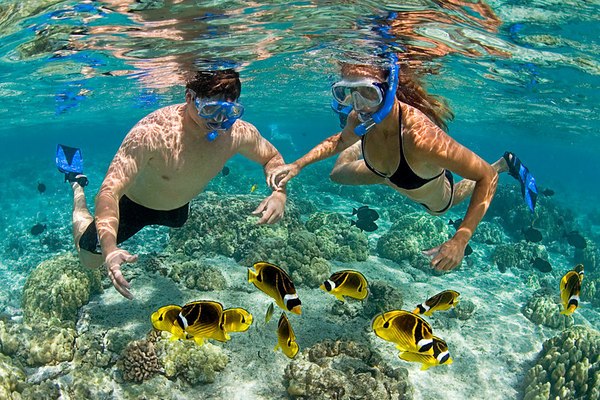
The outer reef’s shallow zone from the surface to approximately eight metres offers snorkelling conditions that are difficult to overstate in quality terms. The hard coral communities here, protected by the atoll’s managed status, are among the most intact in the western Indian Ocean at snorkelling depths, with brain corals of impressive diameter, table corals that spread over several metres, and branching Acropora formations in a density that has been lost from most more accessible reef systems. The fish diversity is extraordinary the shallow zones are simultaneously home to the smallest and most brilliantly coloured reef fish (the chromis, the anthias, the juvenile surgeonfish that appear as sparks of yellow and blue among the coral heads) and the passage routes of larger pelagic visitors (barracuda in hunting formation, a school of bumphead parrotfish grazing the reef edge with a sound audible underwater, occasional reef sharks working the current at the drop-off).
The resident green turtle population at Mnemba is one of the atoll’s most reliable and most affecting encounters. Individual turtles some of them identifiable to regular guides by distinctive markings have been using the atoll’s shallow feeding grounds for years or decades, and their comfort with human presence (the product of consistent non-threatening contact over extended periods) creates encounters of extraordinary proximity. A green turtle surfacing to breathe a metre from a snorkeller, rolling at the surface for a moment of mutual appraisal before descending again into the coral, is a wildlife moment of specific and repeatable wonder.
Diving at Mnemba
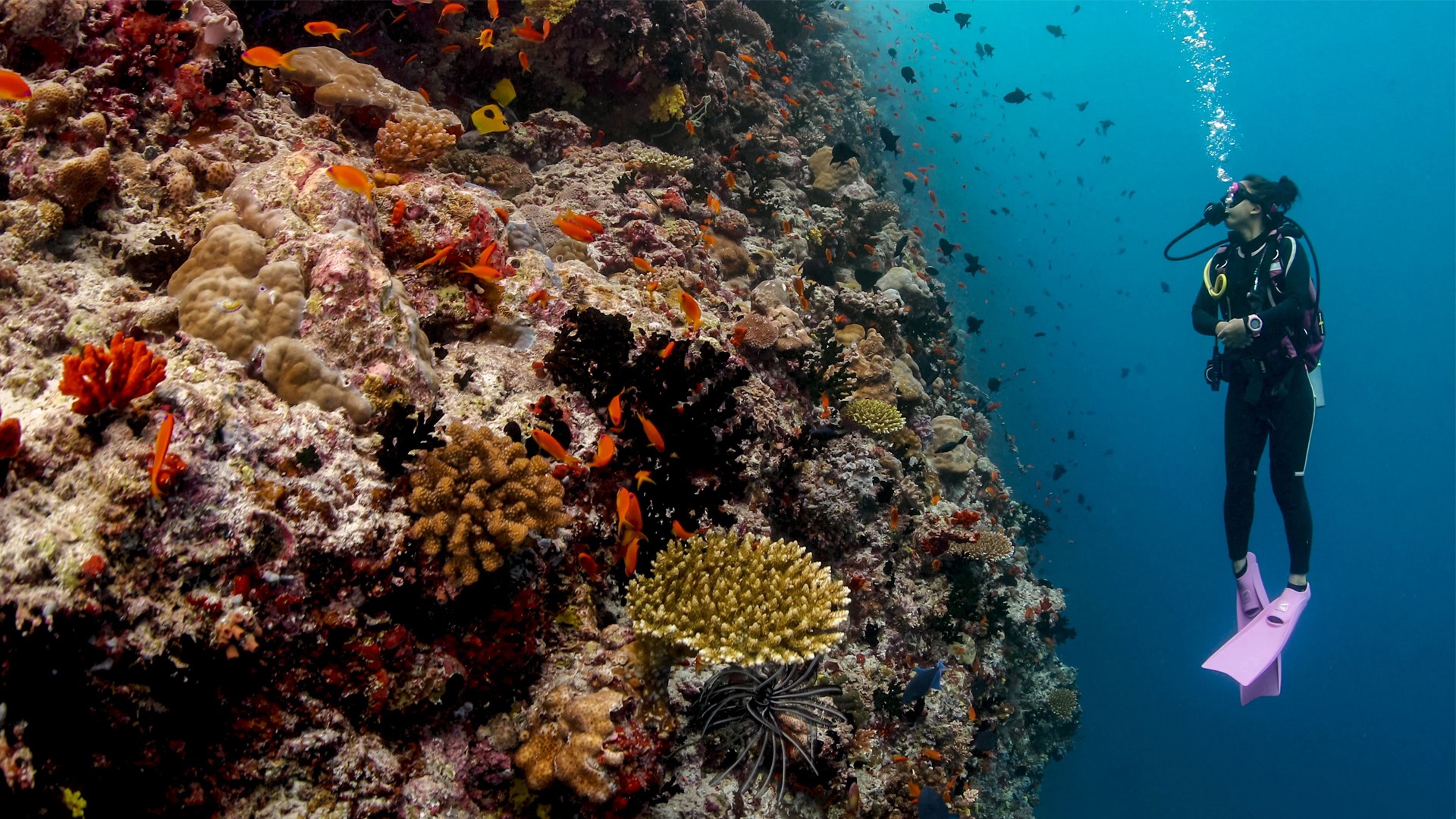
The atoll’s dive sites encompass conditions for every certification level the shallow reef (ten to eighteen metres) for Open Water and first-time divers, the outer wall dives (eighteen to thirty metres) for Advanced Open Water and more experienced divers, and the deeper drift dives in the atoll’s channel passages for experienced divers comfortable with current management. The outer wall at Mnemba a gradual slope and then a vertical drop into deep blue, covered in gorgonian sea fans, large sponge formations, and the encrusting soft corals whose colours at depth (the reds and oranges that are invisible without a dive torch) make underwater photography a specific challenge and specific reward is among the finest walls in the Indian Ocean at its depth range.
Pelagic encounters at Mnemba’s dive sites include dogtooth tuna patrolling the drop-off edge, wahoo and occasional yellowfin tuna in the blue water beyond the wall, and in the right season and conditions the whale shark. Mnemba is not primarily a whale shark site (Pemba, in the channel’s nutrient-rich water, provides more reliable large pelagic encounters), but sightings are recorded here several times a season, and the possibility is part of every dive at the outer wall.
Access and Operator Selection
Mnemba is accessed by boat from Matemwe village a fifteen-minute crossing in calm conditions. The northeast coast’s boutique properties can arrange excursions directly through their established operator relationships, and a direct booking through the property is generally the most reliable route to a quality experience. For guests staying elsewhere on the island, the drive to Matemwe (approximately forty minutes from Stone Town, one hour from Paje) is manageable and worth making the difference in dive and snorkel quality between Mnemba and the north coast’s more accessible sites is significant enough to justify the travel time.
Specify private boat access rather than joining a group excursion when booking group boats on the Mnemba route can carry eight to twelve divers or snorkellers, and the site quality decreases proportionally with the number of bodies in the water simultaneously. A private boat for two to four people costs more but provides an experience in a different register entirely.
Chumbe Island Coral Park — World-Class Reef in a Protected Park
Chumbe Island Coral Park, twelve kilometres south of Stone Town on a small coral island in the Zanzibar Channel, is one of the Western Indian Ocean’s most significant marine conservation success stories and one of Zanzibar’s finest snorkelling destinations arguably the finest, at a purely ecological level, for hard coral diversity and reef health. The marine park was established in 1994 as one of Africa’s first privately managed marine protected areas, created through a partnership between the Zanzibar government and a private conservation organisation that took on the responsibility of reef protection, ranger employment, and ecological monitoring in exchange for the right to build a small eco-lodge on the island.
The result of three decades of strict, effectively enforced no-take protection is a reef flat of extraordinary ecological quality. The hard coral communities on Chumbe’s reef flat accessible by snorkel in water ranging from less than a metre at low tide to five or six metres at high include over 200 coral species and provide habitat for over 400 fish species. The coral cover here the proportion of the reef surface occupied by living coral rather than algae or bare rock is among the highest recorded in the western Indian Ocean at accessible snorkelling depths, and the fish density reflects decades of protection from the extraction pressure that degrades most accessible reefs.
What the Day Visit Involves
Chumbe is only accessible through the park management day visits are pre-booked, limited to fourteen visitors per day, and include a return boat transfer from Stone Town (thirty minutes), a ranger-guided snorkel orientation on the reef flat, a guided forest walk through the island’s protected coral rag forest (home to the rare coconut crab, the largest terrestrial arthropod in the world), and a naturalist-led educational session on the reef’s ecology and the park’s conservation work. Lunch at the lodge is included. The full day runs from approximately 08:30 to 16:30.
The combination of marine quality and conservation education makes Chumbe not simply a snorkelling excursion but a genuinely enriching encounter with one of the region’s most important conservation projects. The ranger guides Zanzibaris trained specifically in marine ecology and reef interpretation are among the most knowledgeable and most articulate marine guides available anywhere in the archipelago. The advance booking requirement, which some visitors find inconvenient, is a direct consequence of the visitor limits that protect the reef, and the experience’s quality is inseparable from those limits.
Pemba Island — East Africa’s Finest Deep-Water Diving
Pemba Island, sixty kilometres north of Zanzibar’s Unguja, represents a different category of diving destination from anything the main island’s reefs can provide a place where the seabed drops from the coral shelf into the Pemba Channel’s extreme depths with dramatic immediacy, creating wall dives of extraordinary scale and encounters with large pelagic species that the more sheltered, shallower environment of Unguja’s reefs rarely generates. The Pemba Channel is one of the Indian Ocean’s deepest and most hydrodynamically active passages strong current flows deliver the nutrient-rich cold water from depth that supports the large fish biomass and the dense, vivid soft coral communities that make Pemba’s walls visually distinctive from the warmer, more current-sheltered reefs of the main island.
The site names at Pemba Mesali Wall, the Fundu Lagoon dive sites, the channels between the outer islands are known to specialist divers across East Africa and beyond as the region’s benchmarks for wall diving quality and large pelagic encounter probability. Grey reef sharks, whitetip reef sharks, and nurse sharks are routine encounters on Pemba’s outer walls; hammerheads are recorded in season; the channel’s strong currents create drift dive conditions that deliver divers in a continuous stream past walls of gorgonian fans, sea whips, and sponge towers of a scale and colour density that the warm, nutrient-poor water of Unguja’s reefs cannot support.
Pemba is a dedicated dive trip the island’s limited accommodation is primarily oriented toward dive visitors, the logistics of getting there (charter flight, limited boat transfer options) are more demanding than accessing Zanzibar’s main island sites, and the experience is most appropriate for Open Water certified divers with multiple dives logged who are specifically motivated by the quality of the marine environment rather than looking for a general beach-with-diving combination. The island and its diving are covered in full depth in the Island Hopping guide.
The Dolphin Experience
Kizimkazi, on Zanzibar’s southwest coast, is the primary location on the island for in-water dolphin encounters a year-round experience driven by the resident populations of Indo-Pacific bottlenose dolphins and spinner dolphins that aggregate in the shallow channel waters between Kizimkazi and the offshore reef. The encounter format is simple in principle: a boat from Kizimkazi village locates an active pod, approaches to a respectful distance, and snorkellers enter the water when the pod is moving slowly enough and in a posture relaxed enough to make an approach appropriate. The experience being in the water with a pod of twenty or thirty wild dolphins at various degrees of proximity, their movement through the water around you entirely on their terms is one that produces a specific quality of exhilaration and wonder that other wildlife encounters rarely duplicate.
The critical variable in the Kizimkazi experience is operator selection. The dolphins at Kizimkazi are a residual population present year-round because this is their range, not because they have been specifically attracted or conditioned. Operators who approach pods aggressively, chase them when they move away, or allow or encourage swimmers to pursue dolphins that are actively avoiding contact are both causing genuine harm to the animals and providing a significantly inferior experience to the visitors stressed dolphins do not linger in the vicinity of swimmers who have frightened them. Responsible operators maintain fifty-metre approach distances from the boat, enter the water only when the pod is stationary or slow-moving, and exit promptly if the dolphins move away without investigating. The standard of operator quality at Kizimkazi is genuinely variable; asking specific questions about approach protocols before booking is not pedantic but essential.
Whale Sharks
Zanzibar’s offshore waters receive seasonal whale shark visitors, primarily during the October-to-March period when cooler, more productive surface water creates the plankton concentrations that attract these filter-feeding giants. The most reliable whale shark encounters in the Zanzibar archipelago occur at Pemba, where the Pemba Channel’s productivity creates year-round aggregation zones, but sightings around Zanzibar’s main island particularly in the deeper water off the southeast coast and around the offshore banks south of Kizimkazi are recorded several times each season. Unlike Pemba’s more consistent encounters, whale shark sightings around Unguja are genuinely opportunistic they cannot be guaranteed, and any operator who guarantees a whale shark encounter is misrepresenting the nature of a wild marine animal’s behaviour. The possibility, combined with the dolphin encounter and the Kizimkazi reef snorkelling, makes a southwest coast excursion day worth incorporating into any Zanzibar itinerary during the October-March window.
Seasonal Conditions: When to Dive and Snorkel
| Season | Months | Conditions | Highlights |
| Kusi (SE monsoon) | June–Oct | Best clarity; wind-driven swell on east coast; excellent visibility 20–30m | Peak diving season; whale shark season begins Oct |
| Kasikazi (NE monsoon) | Dec–March | Calm, warm; excellent snorkelling; slight haze some years | Whale shark season peak; spinner dolphins active |
| Long rains | April–May | Reduced visibility; rough seas limit offshore access | Avoid for snorkelling/diving if possible |
| Short rains | Nov | Brief rains; generally manageable; pre-peak whale shark season | Good transition month; fewer visitors |
The practical conclusion from the seasonal pattern: June through October and January through March are the periods of best snorkelling and diving conditions around Zanzibar’s main island. October through March adds the probability of whale shark encounters. April and May are genuinely unsuitable for the marine activities that most visitors prioritise if a Zanzibar visit during the long rain period is unavoidable, the cultural and historical programme (Stone Town, spice tours, Jozani Forest) remains fully accessible while offshore marine activity is significantly curtailed.
Available Courses
PADI certification courses are available at multiple dive schools across the island, ranging from the introductory Discover Scuba Diving experience (a supervised introduction to scuba breathing and basic skills in a pool or shallow water, typically half a day, requiring no prior experience or certification) through the standard certification pathway. The principal courses of practical relevance to Zanzibar visitors:
- PADI Open Water Diver: The foundational recreational diving certification, valid for independent diving to 18 metres. Three to four days, combining theoretical content (available via e-learning before arrival), confined water skill sessions in a pool, and four open water qualifying dives. Available from age 10 as Junior Open Water. The qualification is globally recognised and provides the access required for the vast majority of Zanzibar’s best dive sites.
- PADI Advanced Open Water: Completed in two days, building on the Open Water qualification with five ‘adventure dives’ including a mandatory deep dive (to 30 metres) and navigation dive. Increases the depth limit to 30 metres and adds skills relevant to the more advanced Mnemba wall and Pemba channel sites.
- PADI Rescue Diver: The qualification most dive professionals consider the most genuinely educational in the certification pathway, developing the skills to prevent and manage dive incidents and emergencies. Two to three days. Particularly valuable for divers who plan significant time at more remote sites.
- PADI Divemaster: The entry-level professional qualification, requiring 40 logged dives minimum and a multi-week programme of supervised practical training. Relevant to visitors planning an extended Zanzibar stay with a specific interest in moving toward a professional diving role.
Choosing a Dive School
The quality of PADI-affiliated dive schools in Zanzibar varies considerably, and the PADI affiliation is a necessary but not sufficient quality indicator it establishes a minimum standard of certification course structure and equipment maintenance requirements, but it does not guarantee the quality of instruction, the condition of the equipment, the diver-to-instructor ratio actually maintained during open water sessions, or the operator’s approach to safety protocols beyond the required minimum. The criteria for evaluating a dive school that matter most in practice: the equipment’s visible condition and maintenance record, the instructor’s experience at the specific local sites (not just their certification level), the diver-to-instructor ratio during open water dives (maximum four students per instructor for certification dives), and the operator’s response when conditions are unsuitable a school that cancels dives for safety reasons is demonstrating judgment, not unreliability.
What equipment should I bring?
Most dive schools and boutique properties provide all essential equipment for snorkelling (mask, snorkel, fins) and scuba diving (BCD, regulator, wetsuit, tanks) as part of their excursion or dive course fee. The most important personal equipment to bring from home is a well-fitting mask the comfort and seal quality of a mask you have worn and adjusted before arrival is meaningfully better than a rental mask fitted hurriedly on the beach. If you are a regular snorkeller or diver, bringing your own mask is the single piece of personal equipment that most improves the Zanzibar underwater experience.
Is the water cold?
Zanzibar’s surface water temperature ranges from approximately 25°C in the cooler months (July-August, when the Kusi monsoon circulation draws slightly cooler water from depth) to 29-30°C at the warmest period (January-March). These temperatures are comfortable for snorkelling without a wetsuit for most people. Divers spending extended time at depth particularly on the 25-30 metre wall dives at Mnemba or in Pemba’s channel current will benefit from a 3mm shorty wetsuit for thermal comfort during the cooler months; a full 3mm suit is appropriate for sensitive individuals or for extended multiple-dive days in June-August.
Can I snorkel directly from the beach?
Direct beach snorkelling is possible and rewarding at several locations on the island. The northeast coast at Matemwe offers the most accessible reef snorkelling directly from the sand the fringing reef is reachable by a short swim from the beach at medium to high tide, and the quality of the reef in the immediate nearshore zone, while not at Mnemba Atoll’s standard, provides genuinely good coral and fish encounters accessible without a boat. The east coast’s tidal variation means that at low tide, the reef flat is too shallow for comfortable snorkelling; the medium-to-high tide window (typically four to six hours per tidal cycle) provides the best direct beach snorkelling conditions.