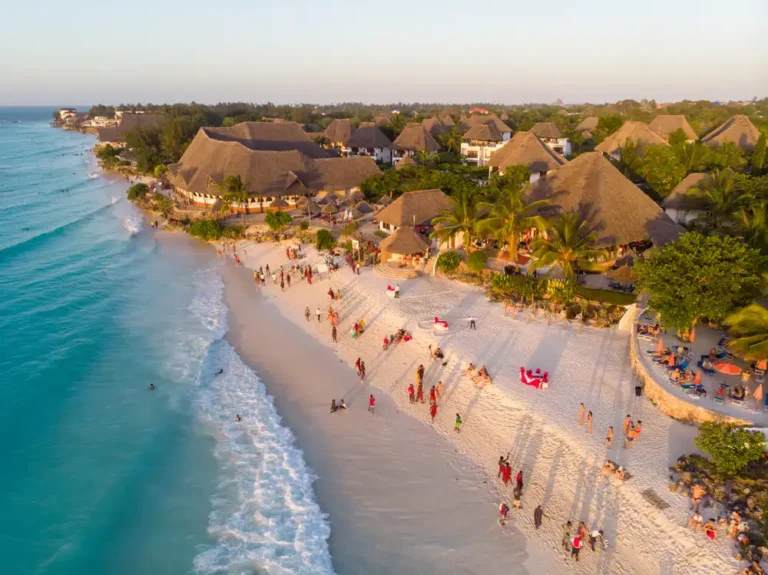
The boutique versus large resort decision on Zanzibar and across East African beach destinations generally is one of the most consequential choices in planning a beach extension, and one of the most poorly served by the resort comparison sites that most travellers consult. The metrics that comparison sites use star ratings, amenity lists, average review scores measure things that are measurable rather than things that determine quality of experience. A large resort can score highly on all measurable metrics and still provide an experience that falls flat for a post-safari traveller seeking a specific kind of rest.
What a Large Beach Resort Actually Provides
A large beach resort on Zanzibar in practice, any property with more than forty rooms provides a specific set of structural advantages and disadvantages that are consistent regardless of the brand or the location. The advantages: multiple restaurants, multiple pools, extensive spa facilities, activity programmes with many daily options, and a scale of infrastructure that absorbs large parties and families without any single group dominating the property’s character. Large resorts also benefit from economies of scale that allow competitive pricing, particularly on all-inclusive packages where the volume discounts on food and beverage provision are passed partially to the guest.
The disadvantages: the experience is systematically less personal. In a property with one hundred and fifty rooms, the restaurant cannot tailor the menu to the specific group that arrived yesterday. The pool is shared with other guests who have different schedules and different ideas of what beach holidays look like. The entertainment programme is designed for the average of the guest population rather than for the specific preferences of any individual or couple. The cumulative effect is an experience that is competent, often pleasant, and rarely exceptional.
What a Boutique Beach Property Provides
A boutique beach property in Zanzibar, typically a property with eight to twenty rooms provides something structurally different: a scale small enough that the specific preferences of each guest are known and can be accommodated. The kitchen that knows you do not eat seafood and has prepared an alternative without being asked. The staff who greet you by name on the second morning without referring to a list. The manager who sits with you at dinner and explains the history of the property’s relationship with the local fishing community. These are not incidental courtesies; they are the structural product of a scale that makes individual attention economically possible.
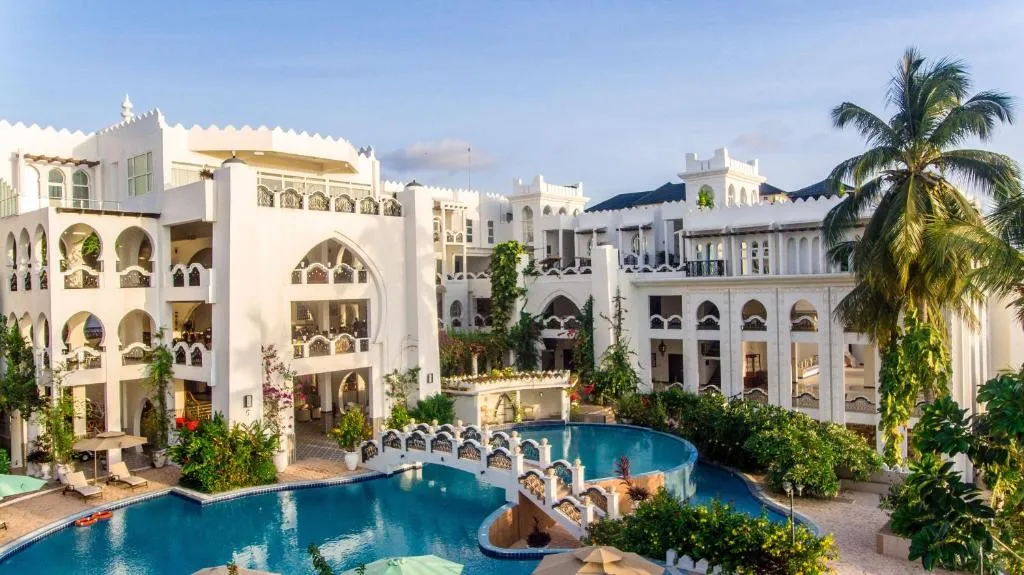
Boutique properties also, in the better cases, have a design and character that reflects a specific vision rather than the standardised formula of a hotel group. The best small properties on Zanzibar are architecturally interesting Swahili design elements, local materials, specific landscaping in ways that make the property itself part of the experience rather than a backdrop for it.
The Post-Safari Traveller’s Specific Needs
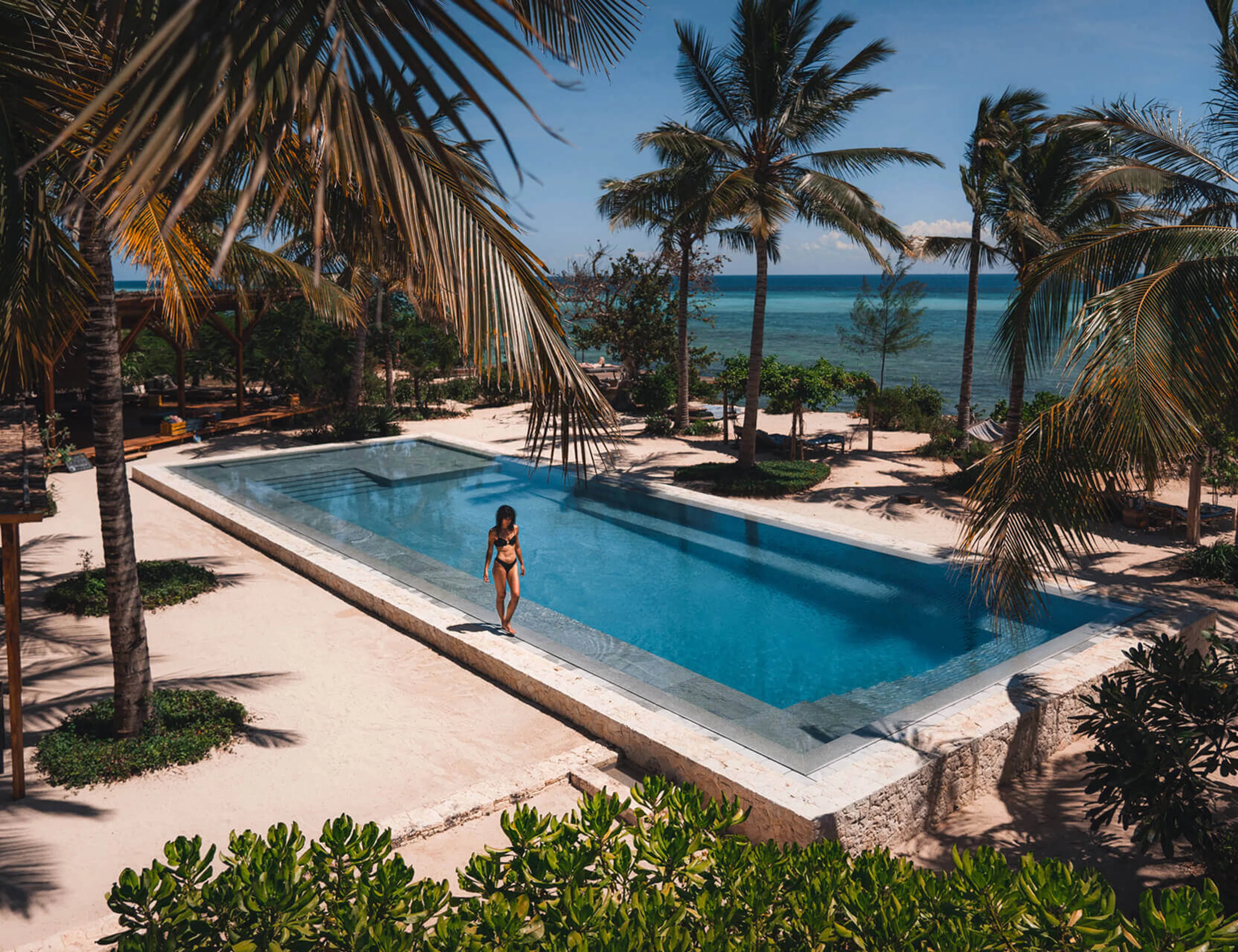
The post-safari traveller arriving at a beach extension has specific needs that the boutique model is better designed to meet than the large resort. They typically arrive tired from multiple early starts, sustained concentration and the physical exposure of open-vehicle safari driving. They want rest more than activity. They want food that is excellent without requiring navigation of a large buffet. They want service that is attentive without being intrusive. They want a beach that is theirs rather than shared with two hundred other guests.
The large resort’s advantages multiple restaurants, extensive activity programme, large pool are most valuable to travellers who arrive at a beach destination looking for energy and variety. The post-safari traveller, with three or four nights before a return flight, typically needs the opposite of energy and variety. The boutique property’s quieter, more personal character is a structural match for what the transition from safari to beach should feel like.
Food Quality: The Clearest Differentiator
Food quality is the area where the boutique-versus-large distinction is most reliably consistent. A small kitchen serving thirty guests per meal can produce food of a quality that a large kitchen serving three hundred cannot achieve with the same ingredients and the same budget. The specific excellence of Zanzibar’s culinary potential fresh seafood, Swahili spice traditions, local produce is most accessible in smaller kitchen operations where the chef has genuine discretion over sourcing and preparation.
Large resorts serving international guests often default to an international menu that neutralises the specific flavour of the location. A prawn curry at a well-run boutique property on the Zanzibar east coast, prepared with cloves from trees visible from the dining table, is a qualitatively different experience from the same dish produced in volume for a large resort buffet. This difference is consistent enough to be a reliable argument for the boutique model for any traveller for whom food is a significant component of the travel experience.
Value: The Price-Experience Calculation
Boutique properties on Zanzibar are typically more expensive per room than large resorts on a headline rate basis. The premium reflects smaller scale, higher staffing ratios and the cost of maintaining a level of personal service that volume cannot subsidise. Whether the premium represents value depends entirely on what is being valued. For a traveller whose priority is the measurable amenity list pools, spas, restaurants, activity options a large resort may provide better objective value per dollar. For a traveller whose priority is the quality of the personal experience the food, the service, the intimacy the boutique premium consistently earns its cost.
All-inclusive pricing changes this calculation. Large resorts often offer all-inclusive packages that bundle accommodation, food and activity at rates that appear competitive with boutique properties that charge individually for meals and activities. The comparison requires unpacking: if the large resort all-inclusive includes food that is average in quality and activities you would not have chosen, the bundled price is not the bargain it appears. The boutique property’s à la carte meals at higher per-item prices but exceptional quality may represent better actual value for a traveller who is specific about what they want.
Families and Groups: Where Large Resorts Excel
Large resorts have a genuine advantage for one specific traveller profile: families or larger groups with varied preferences within the party. A group of eight that includes two teenagers who want watersport activities, two grandparents who want a comfortable pool, and two couples who want a quiet beach involves competing demands that a boutique property with limited facilities cannot easily accommodate simultaneously. A large resort’s multiple pools, multiple dining options and organised activity programme absorbs this variety without any single preference dominating.
For families with young children specifically, the large resort’s children’s club, shallow swimming areas and activity structure designed for young guests is a genuine advantage. Boutique properties on Zanzibar are generally not optimised for young families their design, their quiet atmosphere and their limited formal activity provision reflects their primary market of couples and solo travellers. Knowing this before booking prevents the mismatch of placing a family with active children in a property designed for quiet retreats.
How RYDER Signature Approaches Property Selection
Our default recommendation for post-safari couples and solo travellers is a boutique property, because the match between the post-safari traveller’s specific needs and the boutique model’s structural characteristics is consistently better than the large resort alternative. For families, groups with diverse requirements, and travellers for whom specific amenities are non-negotiable, we assess the large resort options on their specific current quality rather than the category’s average.
We do not recommend large resorts as a default because they represent a safer choice we recommend them when the specific guest profile genuinely matches what the large resort model provides. The distinction matters because recommending a large resort to a couple seeking a quiet, personal post-safari retreat, simply because it is easier to recommend, is a service failure. The boutique-versus-large decision is one of the most important in beach extension planning and deserves the individual consideration we give it.
Are there all-inclusive boutique properties on Zanzibar?
Some boutique properties offer full-board or all-inclusive packages, particularly those in more remote locations where off-property dining is limited. These packages can represent good value when the food quality is high, which in well-run boutique properties it typically is. The all-inclusive model works better in boutique properties than in large resorts because the kitchen-to-guest ratio is lower and the quality can be consistently maintained. Ask specifically about what is included and whether the food has been cooked to order versus buffet service; these details reveal the quality intention behind the package.
What defines a truly boutique property?
For our purposes, a boutique beach property has fewer than twenty-five rooms, is independently owned or managed rather than part of a large hotel group, makes specific design and culinary choices that reflect a particular vision rather than a standardised formula, and maintains a staff-to-guest ratio that makes personal service structurally possible. The boutique label is used loosely in marketing some properties describe themselves as boutique while operating at sixty rooms with standardised international hotel service. The operational test is straightforward: after two nights, does the staff know your name and preferences without being prompted? In a genuine boutique property, they do.
Is a large resort appropriate for a one-night stopover?
For a very short stay one or two nights before or after a safari the large resort’s lower price point and reliable logistical infrastructure make it a pragmatic choice. The personal-experience premium of a boutique property is not fully realised in a one-night stay; the efficiency and predictability of a well-run large resort is more relevant for a brief transit. For three or more nights, the boutique model’s advantages accumulate in a way that justifies the premium consistently.
Design Quality: Why It Matters for the Post-Safari Transition
The design quality of a beach property affects the experience in ways that are not captured by any review metric. A property that has been designed with genuine architectural intelligence Swahili carved woodwork, local coral stone, openings positioned to capture the sea breeze without requiring air conditioning, landscaping that integrates the property into the beachfront rather than imposed upon it creates a different quality of physical environment from a property that has been built to a generic tropical resort template. The difference is not aesthetic snobbery; it is the difference between a property that makes the guest feel they have arrived somewhere specific and one that makes them feel they have arrived somewhere generic that happens to have a beach attached.
For post-safari travellers who have spent days in environments of extraordinary natural character the Serengeti plains, the Ngorongoro Crater, the Mahale Mountains the beach property design standard is set higher than it would be for a traveller arriving from a city hotel. A property that does not meet some threshold of design authenticity and quality creates a jarring downshift that undermines the overall journey experience. Boutique properties that have been designed with specific vision and care consistently avoid this jarring quality; large resorts, with their standardised formulas, less reliably do.
Service Ratios and What They Mean in Practice
Staff-to-guest ratios determine the quality of personal service in ways that are structural rather than motivational. A large resort with one hundred and fifty rooms and two hundred staff has a staff-to-guest ratio that, after accounting for back-of-house functions, produces approximately one direct service staff member per three to four guests at any given time. A boutique property with twelve rooms and fifteen staff a ratio that quality boutique properties typically maintain produces a staff-to-guest ratio of nearly one to one during the operational hours. The difference in what this enables is not a matter of effort or training; it is arithmetic.
The practical expression of this difference is in the texture of the stay. At a well-staffed boutique property, a request does not require locating the appropriate department and waiting for a response from a central system. The person who knows you needs sunscreen while the boat is being loaded is already watching for what else you might need. The cook who remembers that you asked for your fish grilled rather than sautéed last night applies that preference without prompting tonight. These are small things individually. Accumulated over three or four nights, they constitute a quality of experience that is genuinely different from the best-case large resort service.
The Quiet Factor
Large beach resorts are not quiet in the way that post-safari travellers often need. Pool music, children’s activity programmes, organised beach games, evening entertainment these are all features of a large resort that provides value to the guests who want them and constitute intrusion for those who do not. Boutique properties, by scale, do not have the economic incentive to programme activities that interrupt the silence; their guests are typically there for the silence. For a traveller arriving from a safari where the most valued moments were the quietest the still evening at the water hole, the silent morning drive in the fog the quiet of a well-chosen boutique property is not a secondary quality. It is one of the primary ones.
What should I ask a property before booking to assess whether it is genuinely boutique?
Four questions reveal the most: How many rooms does the property have? What is the guest-to-staff ratio? Does the kitchen prepare food to order or serve from a set menu or buffet? And: what is the ownership structure is the property independently owned and managed, or part of a hotel group? Genuine boutique properties have fewer than twenty-five rooms, higher staff-to-guest ratios than large resorts, kitchen-to-order food preparation, and typically independent or family ownership that reflects a specific vision rather than a group’s standardised product.
Are there boutique all-inclusive options on Zanzibar?
A small number of boutique properties offer full-board packages that represent genuine value the meals are prepared fresh, the food quality is high, and the bundled pricing reflects the actual cost of the meals rather than a volume-discounted filler package. These properties are worth identifying and in most cases offer a better actual all-inclusive experience than large resorts at a comparable or modestly higher price point. Our property-specific recommendations identify which boutique properties currently offer full-board packages and assess whether the meal quality justifies the package structure.
Is there a minimum stay requirement at boutique properties?
Many boutique properties on Zanzibar have minimum stay requirements of two or three nights, particularly in peak season. This policy reflects both economic reality a one-night boutique stay has high per-stay overhead cost and guest experience philosophy: the properties know that their value accumulates over multiple nights rather than in a single overnight. For post-safari beach extensions of three nights or more, minimum stay requirements are not a practical obstacle. For very short stopovers, a well-run larger property may be the more practical choice.