Night game drives in Tanzania are among the finest nocturnal wildlife experiences available in Africa — and one of the most structurally restricted. The national park regulations that prohibit night driving in Tanzania’s government-managed parks are rigorously enforced, which means the night drive experience in Tanzania is exclusively available in private concession areas and community wildlife management areas adjacent to the main parks. Understanding where this access is available, and what it provides, is the starting point for incorporating night drives into a Tanzania safari itinerary.
Where Night Drives Are Available in Tanzania
The relevant Tanzania ecosystems where night drives can be arranged: the Selous/Nyerere ecosystem’s private concession camps, which operate under specific TAWICO concession agreements that include night drive permissions; the Ruaha private concessions adjacent to the main park; the Tarangire’s private conservancy areas east of the park boundary; and specific community wildlife management areas adjacent to the Serengeti where camp operators hold concession permits including night drive access. The last category is the most variable — WMA night drive permissions change with concession agreements and should be confirmed with the specific camp before booking.
The most reliable Tanzania night drive access is in Nyerere National Park‘s private concession camps — properties including Jongomero, Sand Rivers Selous and similar — where the concession agreement explicitly includes night drive permission as part of the operator’s access rights. These camps offer night drives as a standard programme item, included in the nightly rate, without the bureaucratic uncertainty that WMA permissions sometimes introduce. For a Tanzania itinerary specifically designed to include quality night driving, including at least one Nyerere concession stay is the most reliable approach.
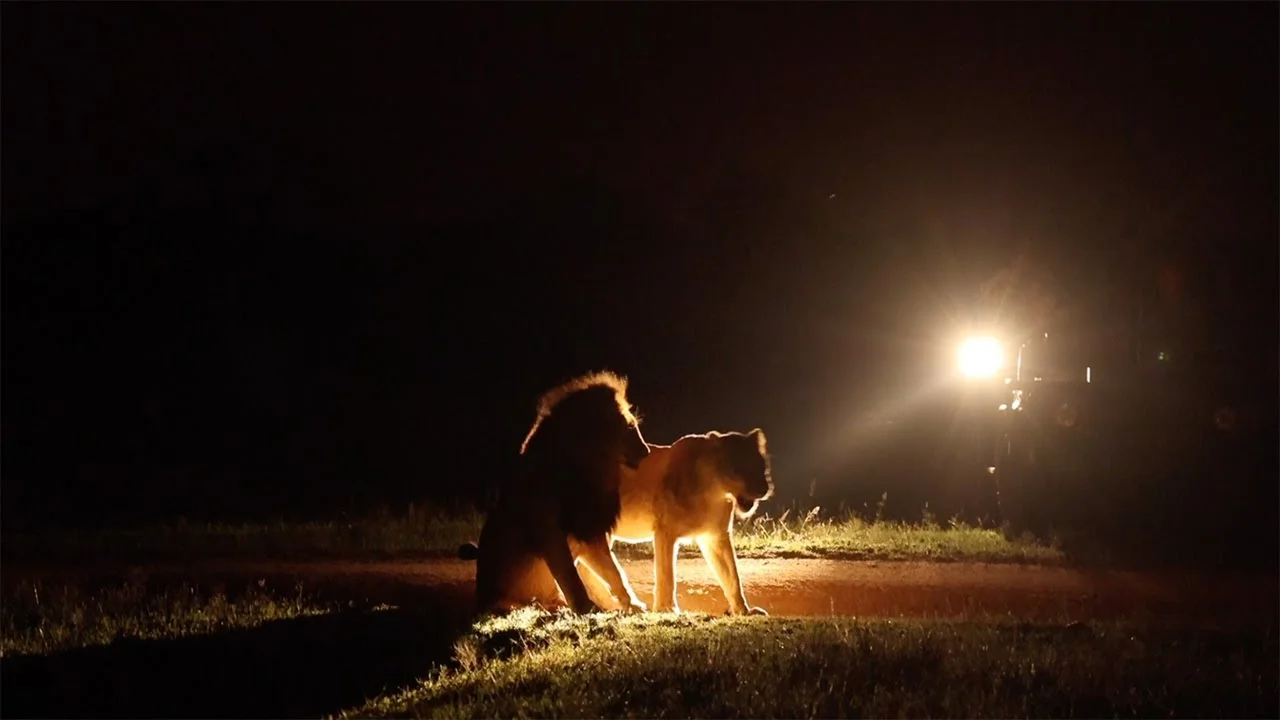
The Tanzania Night Bush: What to Expect
Tanzania’s nocturnal wildlife differs from Kenya’s Mara conservancy equivalent in specific ways. The southern Tanzania parks — Nyerere, Ruaha — hold higher densities of African wild dog than any Kenya ecosystem, and wild dog activity at night — the pack’s movements, their vocal communication, the alert postures that precede a hunt — provides a night drive dimension unavailable in any Mara conservancy regardless of how good the general nocturnal programme is. The honey badger, more commonly encountered in Tanzania’s woodlands than in the Mara grassland, is one of the most reliably entertaining and infuriating nocturnal wildlife subjects — relentlessly purposeful, apparently impervious to any obstacle, possessed of a confidence that its physical scale does not suggest.

The hippo, which spends daylight hours in river pools and emerges at night to graze, is one of Tanzania’s most accessible nocturnal species from the riverine camps of Nyerere and Ruaha. A night drive through the riverine woodland when the hippos are active — grazing on the floodplain grass, crossing paths with vehicles with casual indifference, occasionally registering alarm with the explosive snort that carries several hundred metres — provides a perspective on this species that the daylight river pool sighting cannot. The hippo at night is a grazing animal; the hippo by day is a floating animal. The nocturnal behaviour reveals what the species actually does with most of its active hours.

Night Drive Equipment and Technique in Tanzania
The same equipment standards that apply to Kenya’s night drives apply in Tanzania: a roof-mounted or handheld spotlight of 200,000 candlepower minimum, operated by a dedicated spotter or the guide; vehicle sides fully open or removed to allow 360-degree beam sweep; engine idling quietly rather than running at operating speed. Tanzania’s night drive environments add one consideration that some Kenya conservancy areas do not require: the density of the woodland in Nyerere and Ruaha means the spotlight often illuminates at closer range than the open Mara grassland requires, and the guide’s knowledge of the specific terrain — where the path opens into a clearing, where the overhang requires the vehicle to slow — is more critical than in open country.
Combining Night Drives with Other Tanzania Activities
The ideal Tanzania programme combining night drives with daytime activities uses a Nyerere or Ruaha stay as the night drive component and adds a northern circuit stay — Serengeti, Ngorongoro, Tarangire — for the migration and the landscape variety. This combination structure provides the nocturnal dimension that the northern parks cannot offer and the world-famous wildlife spectacle that the southern parks offer in a different register. The practical logistics are straightforward: a charter flight from the north to the south, or from Dar es Salaam into the southern park airstrips, connects the two circuits efficiently. RYDER Signature designs these combined northern-southern itineraries regularly and manages the airstrip connections as a standard itinerary component.
Can I do a night drive in the Serengeti?
Not in the national park itself — TANAPA prohibits night driving within the Serengeti’s boundaries. In the community wildlife management areas adjacent to the Serengeti, some operators hold concession agreements that include night drive permission. The Loliondo Game Controlled Area north of the Serengeti and the WMAs to the west have provided night drive access under specific operator concessions. The availability of this access changes with concession renewals and should be confirmed with the specific camp at the time of booking rather than assumed from previous guest reports.
What makes Tanzania’s night drives different from Kenya’s conservancy night drives?
The primary ecological differences are in the species composition and the terrain. Tanzania’s southern parks hold African wild dog, honey badger, aardvark and various nocturnal small carnivores in densities that the Mara ecosystem’s more open grassland does not replicate. The woodland terrain of Nyerere and Ruaha also provides a different sensory experience from the open Mara grassland — the night sounds are denser, the spotlight illuminates at closer range through the tree cover, and the sense of being inside a landscape rather than moving across it is more pronounced. Both are outstanding; they are experiences of different ecological characters rather than comparable experiences at different quality levels.
The Range of Nocturnal Wildlife in Tanzania
The aardvark deserves specific attention as Tanzania’s most compelling nocturnal target. This large, prehistoric-looking insectivore — weighing up to sixty kilograms, with its distinctive tubular snout and powerful digging claws — spends every daylight hour sealed underground and emerges only after dark to cover remarkable distances in its search for termite mounds. Encountering an aardvark on a night drive produces a reaction in most safari veterans that no amount of lion or elephant sighting history has prepared them for. The sheer improbability of the animal — its appearance, its movement, its specific ecological niche — creates a quality of surprise that the more familiar African species cannot replicate.
The African civet, a large, cat-like viverrid with bold black and white patterning, follows scent trails through Tanzania’s woodland with a purposeful deliberateness that allows extended observation from a stopped vehicle. The spring hare — South Africa’s equivalent of a kangaroo rat, moving in bounding leaps that seem mechanically improbable — appears in Tanzania’s more open woodland margins in numbers that make the first encounter feel like a discovery rather than a sighting. The bat-eared fox pair moving through the moonlit grass, faces down to the ground following beetle trails, provides one of the most behaviorally specific nocturnal observations available. All of these require nothing more than a well-equipped vehicle, a competent guide with a good spotlight, and the specific access that Tanzania’s concession areas provide after dark.

Night Photography in Tanzania
Night drive photography in Tanzania presents the same technical challenges as in Kenya — the spotlight as the primary light source, fast aperture lenses as the essential equipment, high ISO as the necessary sensitivity — with the additional variable of the woodland’s density. In Nyerere’s more open terrain near the river, spotlight photography at moderate distances is manageable with current mirrorless cameras at ISO 12800 or above. In Ruaha’s denser woodland, the closer encounter distances make lower ISO settings possible; the aardvark at fifteen metres is photographically accessible in ways that the same animal at forty metres in open grassland is not. Camera settings: aperture at maximum (f/2.8 or f/4 depending on the lens), shutter speed as fast as the available light permits, ISO in the 6400 to 25600 range. Review each image in the field and adjust ISO upward if the images are consistently underexposed.

How do Tanzania’s night drive concession camps compare to Kenya’s Mara conservancies for the nocturnal experience?
The two experiences are different in ecological character rather than comparable in quality. The Mara conservancy night drive offers access to the open grassland nocturnal community — serval, genet, bat-eared fox, spring hare — with the specific possibility of following lion pride activity from their afternoon resting position into the evening hunting sequence. Tanzania’s concession area night drives, particularly in Nyerere, offer the river woodland community — hippo grazing, the full suite of viverrid species, aardvark in good numbers — with the specific landscape character of the southern circuit. Both are outstanding; neither substitutes for the other. A Tanzania itinerary that includes at least one southern concession night drive and a Kenya itinerary that includes at least one Mara conservancy night drive covers the full range of what East Africa’s nocturnal wildlife observation can provide.
The Essential Summary
Tanzania’s night drive programme — available in Nyerere and Ruaha concession areas, and in specific WMA zones adjacent to the northern circuit parks — represents the fullest version of what nocturnal East Africa provides. The combination of the southern parks’ wildlife density, the specific nocturnal species that the woodland ecosystem supports, and the complete absence of the national park vehicle density that constrains daytime observation, creates a night drive quality that consistently produces the most specifically surprising wildlife encounters in any Tanzania safari programme. For any traveller who includes a Nyerere or Ruaha component in their Tanzania itinerary, the night drive is not an optional enhancement — it is one of the core activities that the southern parks specifically provide and that no amount of northern circuit safari can replicate. Build it into the programme as standard, confirm the concession access before booking, and approach it with the patience and equipment that the nocturnal bush requires and rewards.