Walking safaris in Tanzania occupy a different position in the safari activity landscape from their Kenya equivalent. While Kenya’s walking safari programme is concentrated in Laikipia and the Mara conservancies, Tanzania’s walking safari heritage is older, more geographically distributed, and in several ecosystems, more deeply integrated into the safari programme as a core activity rather than an optional enhancement. The southern parks — Ruaha, Nyerere, Mahale — have been offering walking safaris as a primary activity for longer than Kenya’s conservancy model has existed, and the quality of the experience they provide reflects decades of refinement.
The Walking Safari Tradition in Tanzania’s Southern Parks
Ruaha National Park is Tanzania’s definitive walking safari destination. The park’s vast acacia-commiphora woodland, its rocky kopje outcrops, its seasonal watercourses and its extraordinary density of large mammal species provide walking safari terrain of exceptional quality. The specific character of a Ruaha walking safari — following elephant tracks through the scrub, approaching a kopje where lions are typically found midmorning, reading the story of a night’s predator activity in the morning prints around a waterhole — is unlike anything available in the northern circuit parks or in Kenya’s conservancies.

Nyerere National Park (the former Selous Game Reserve) is East Africa’s largest protected area and offers walking safaris in a landscape of extraordinary diversity — the Rufiji River system, its associated woodland and floodplain, and the miombo woodland of the interior. Boat safaris on the river are the most celebrated Nyerere activity, but the walking programme at several camps provides access to the riverine woodland at human pace, where bird life, insect diversity and smaller mammal species are most accessible.

Mahale Mountains National Park — remote, lake-shore, forested — is primarily famous for chimpanzee trekking rather than traditional walking safari, but the specific experience of walking in dense forest beside Lake Tanganyika in search of chimpanzees is one of the most immersive wildlife activities in East Africa. The trekking through Mahale’s forest requires fitness and tolerance for steep terrain; the reward — observing wild chimpanzees in their forest home at close range, on foot — is one of the finest wildlife experiences available anywhere in the world.
Walking in Northern Tanzania: The Ngorongoro Context
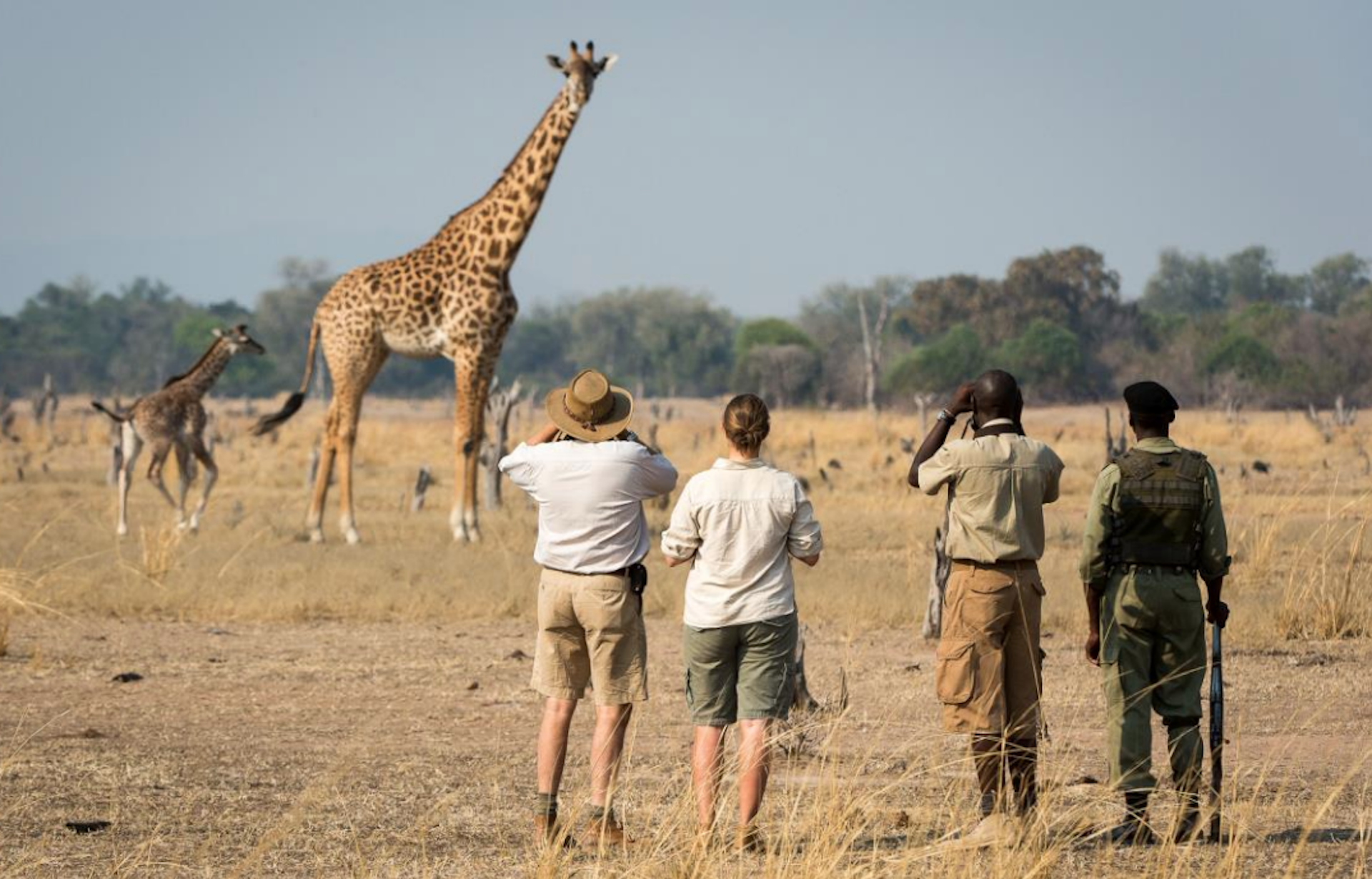
Walking in northern Tanzania’s most famous destinations — the Serengeti and the Ngorongoro Crater — is significantly restricted. The national park regulations prohibit walking without an armed ranger escort, and the crater specifically restricts all access to vehicle-only descents. Walking in the Ngorongoro Conservation Area outside the crater is possible in some zones, and several properties on the crater rim offer guided walks through the highland forest with appropriate ranger escort. These walks have a different character from the open-country walking of the southern parks — more enclosed, more focused on bird life and forest ecology — but provide a dimension of bush engagement that the crater vehicle-only experience does not.
What Makes Tanzania’s Walking Safaris Distinctive
Several specific qualities distinguish Tanzania’s best walking safari programmes from those available elsewhere. The first is scale: Ruaha and Nyerere are vast parks with genuinely remote walking routes that feel like expeditions rather than guided strolls. A full-day walking safari in Ruaha, covering fifteen kilometres through varied terrain with a packed lunch taken beside a seasonal waterway, has a scope and physicality that the shorter conservancy walks of the Mara cannot replicate. The second is wildlife density: the southern Tanzania parks hold some of East Africa’s densest large mammal populations, including African wild dogs, elephant, buffalo, and lion in populations that make walking genuinely exciting rather than merely interesting.
The third distinctive quality is the guide tradition. The walking safari guides at camps that have been operating in Ruaha and Nyerere for twenty or more years have accumulated field experience that is specific to their landscape in a way that newly trained guides in newly established operations cannot replicate. The guide who has watched the specific kopje at the bend of the river for fifteen seasons knows which lion family uses it in which weather conditions and at which time of day. This accumulated knowledge produces walking safari guidance of exceptional quality that no amount of training manual can substitute for.

Multi-Day Walking Expeditions
The most ambitious version of walking safari in Tanzania is the multi-day fly-camp expedition — a programme where guests walk between overnight camp positions, sleeping in simple fly-camps rather than returning to a permanent lodge each evening. This format, available from a small number of specialist operators in Ruaha and Nyerere, produces an immersion in the landscape that the day-walk programme cannot achieve. By night two of a multi-day walk, the relationship between the party and the guide has deepened significantly — the shared experience of spending forty-eight hours moving through wild country creates a conversational and observational intimacy that no amount of game drive hours produces. The fly-camp walking expedition is the most demanding form of East Africa safari activity available to non-technical travellers and, for those with the fitness and interest, one of its most profoundly satisfying.
Safety and the Armed Ranger Protocol
Walking in Tanzania’s national parks requires an armed ranger escort — a requirement that applies to all walking activities within the national park boundaries. The armed ranger is provided by the park authority and accompanies every walk as a regulatory requirement, not simply as the specific camp’s protocol. The quality of armed ranger escort varies between parks and between ranger cohorts; the best walking safari camps maintain ongoing relationships with specific rangers who are experienced, engaged and genuinely interested in the wildlife rather than treating the escort as administrative duty.

The guide who leads the walk and the armed ranger who accompanies it have complementary but distinct roles. The guide provides the ecological and natural history commentary, makes the tracking and approach decisions, and manages the guest experience. The ranger provides the security function and is trained in wildlife encounter management. The best walking programmes integrate these two roles smoothly — the ranger understanding the guide’s protocol and supporting it rather than disrupting it with independent movement decisions.
How RYDER Signature Designs Tanzania Walking Programmes
Tanzania walking safari is a component of approximately half the itineraries we design for clients who include southern Tanzania parks. We select camps specifically for the quality of their walking programme — the specific guide’s experience and reputation in the park, the range of walking routes available, the quality of the ranger relationships, and the physical condition of the routes in the specific season of the visit. We build walking days into the itinerary as full-day experiences rather than morning supplements to vehicle game drives, because the depth of the walking safari experience requires the full day’s attention rather than a two-hour morning addition.
Is walking safari appropriate for older travellers or those with limited mobility?
Walking safaris can be calibrated significantly in pace, distance and terrain to accommodate different fitness levels. A shortened walk of four to five kilometres on relatively flat ground is within most active older travellers’ capacity; the guide adjusts pace accordingly and builds in rest stops at interesting wildlife or botanical features. The terrain in Ruaha’s accessible walking routes is varied but not technically demanding — walking poles are helpful on rocky sections but not required. Travellers with specific joint concerns should discuss the specific routes and terrain with their operator in advance and confirm that the camp can accommodate a modified walking programme.
What is the difference between a Tanzania walking safari and a gorilla trek?
A gorilla trek in Uganda or Rwanda is a specific wildlife encounter focused on a single target species — the mountain gorilla — in dense forest terrain. The trekking distance and difficulty vary based on the gorilla family’s daily movement. A Tanzania walking safari is a general bush walking experience that may encounter many species across varied terrain, with no single guaranteed species. Both are outstanding experiences; they are experiences of different kinds. The gorilla trek is a wildlife encounter; the walking safari is an ecological immersion. Combining both in a single East Africa journey is possible and provides a complete picture of the continent’s walking wildlife experiences.